

The beauty that is Tarn Hows
A winter adventure
Manchester today
Resting on Coniston Water
HBM ~ Harbour tour
Looking across to Wetherlam
The Sentininel
Horsey Windmill: Chocolate box view
Town & Country
Skelwith Falls
The other side of Hunstanton
A walk alongside the Fell
The greens of Coniston Water
HWW ~ An adventure in Brough Castle
Lakeside
A card for winter
A Holkham Hall view
Classic busses
Cattle picnic time.
Gallery 3
HWW ~ What! Who! Me!
The River Brathay near Elter Water
HFF ~ The pier is Closed!
Captive Andromache
“Baby its cold outside”
The first snows of 26
Too damp to sit here
Rydal Cave
A walk on the quay
Mist on the Fells
The British Museum and The Rosetta Stone.
A first look at Rydal Water
The windmill, Cley next the Sea
Tarn Hows ~ Gem of the Lake District
Another ruined picnic at Coniston
Wells-next-the-Sea
Peace and Joy to All
Hidden Coniston
Thornham Stathe
Picnic time on Coniston Water
A trip to the Lakes
A canal walk
Help of the day
Brough Castle
Brough Castle- tower
1/40 • f/1.6 • 4.2 mm • ISO 500 •
Apple iPhone 12
iPhone 12 back dual wide camera 4.2mm f/1.6
EXIF - See more detailsSee also...
Authorizations, license
-
Visible by: Everyone -
All rights reserved
-
43 visits
The Great Bookcase
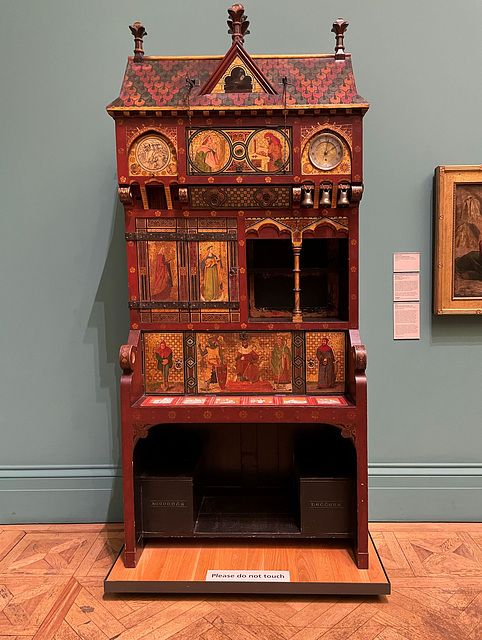

This is the Burges escritoire, also known as the "Great Bookcase," a famous piece of Victorian painted furniture designed by architect William Burges and made by William Gualbert Saunders between 1865 and 1867.
Painted wood escritoire with brass fittings and ceramic tiles. The architectural design influenced by French Gothic styles with its gabled roof and arched recess. Painted decoration includes two central allegorical figures representing Historia (history) and Poesia (poetry and five men representing the five occupations in medieval society: a peasant (Rusticu), a knight, king and bishop, and mercator (a merchant). The cabinet also deals with the passing of time, featuring a boy with his tutor (left hand side), an adolescent, a man in the prime of life (virilitas) and an old man. The mounted clock has the Latin inscription "The clock warns of the passing of time, let everything that is written beneath it, Be an offering to the peace of God"
Enjoy full screen
Painted wood escritoire with brass fittings and ceramic tiles. The architectural design influenced by French Gothic styles with its gabled roof and arched recess. Painted decoration includes two central allegorical figures representing Historia (history) and Poesia (poetry and five men representing the five occupations in medieval society: a peasant (Rusticu), a knight, king and bishop, and mercator (a merchant). The cabinet also deals with the passing of time, featuring a boy with his tutor (left hand side), an adolescent, a man in the prime of life (virilitas) and an old man. The mounted clock has the Latin inscription "The clock warns of the passing of time, let everything that is written beneath it, Be an offering to the peace of God"
Enjoy full screen
John FitzGerald, aNNa schramm, David G Johnson have particularly liked this photo
- Keyboard shortcuts:
Jump to top
RSS feed- Latest comments - Subscribe to the comment feeds of this photo
- ipernity © 2007-2026
- Help & Contact
|
Club news
|
About ipernity
|
History |
ipernity Club & Prices |
Guide of good conduct
Donate | Group guidelines | Privacy policy | Terms of use | Statutes | In memoria -
Facebook
X

David G Johnson club has addedHerb Riddle club has replied to David G Johnson clubHerb
Harry Secombe, Peter Sellers and Spike Milligan
Music by Max Geldray and The Ray Ellington Quartet
Script: Spike Milligan and Eric Sykes ,. ( born in Oldham )
Recorded: Sunday 25 September 1955
First Broadcast : Tuesday 27 September 1955 on the BBC Home Service
Herb Riddle club has replied to David G Johnson clubUnfortunately no longer available on BBC Sounds.
A more compete description now in my description box above.
Sign-in to write a comment.