

Glasswing butterfly
Bee
Auch Weiß kann schön sein - White can be beautiful…
Der Einzelgänger von der fleißigen Armee :)) The l…
Dans mon jardin
Ganz in Weiß ... Clad in White ...
Der Bunte Uferkurzflügler (Paederus riparius) am B…
Der zweitkleinste Bläuling Europas - The Second-Sm…
XYLOCOPA VIOLACEA
Unterscheidung der 3 Rosenkäferarten - How to dist…
Fliegender Smaragd - Flying Emerald
Die Kellerassel (Porcellio scaber) untern Totholz…
Fleur habitée
Die Märzfliege (Bibio marci) am Blatt :)) The Marc…
Holzbiene (Xylocopa violacea)
Die Radnetzspinne (Familie Araneidae) auf ihren Au…
Der Zweiundzwanzigpunkt-Marienkäfer (Psyllobora vi…
5D3 0240-FHD
LIBELLULA DEPRESSA
LIBELLULA DEPRESSA
Der Zombie Pilz (Ophiocordyceps) hat die Ameise be…
CRYPTOCEPHALUS SERICEUS
Absturzgefahr - Risk of falling
Ist sie nicht süss,die Ackerhummel (Bombus pascuor…
P1035931
Garden Snail
Black and White Wasp.
5G0A9721
Ein frohes Osterfest und schöne Feiertage :)) Happ…
P1035725
Furchenbienen (Halictus) am Nestbau :)) Furrow bee…
Bleuet
Die kleine Wolfsspinne (Lycosidae) hat sich unterm…
Sonnenwärme tanken - Soaking Up the Sun
Die Mistbiene (Eristalis tenax) ist mir vor die Li…
Ein seltener Tagfalter - A Rare Butterfly
Die Gerandete Jagdspinne (Dolomedes fimbriatus) gi…
Die erste Mistbiene des Jahres - The first common…
Überlebt - Survived
Die Grüne Stinkwanze (Palomena prasina) im Portrai…
Einer der größten Schmetterlinge - One of the Larg…
Ich sehe alles Güni :)) I see everything, Güni :))…
Tiny butterfly
Durchsichtig wie feines Glas - Transparent Like Fi…
Dans mon jardin

1/500 • f/6.3 • 350.0 mm • ISO 640 •
SONY ILCE-6400
E 70-350mm F4.5-6.3 G OSS
EXIF - See more detailsSee also...
Keywords
Authorizations, license
-
Visible by: Everyone -
All rights reserved
-
410 visits
Jetzt ist Paarungszeit - It’s mating season now - PiPs
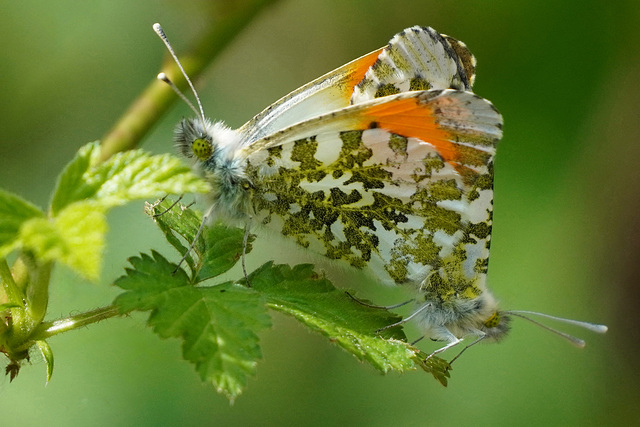

Zur Zeit kann man in Gebieten, wo die Knoblauchsrauke (Alliaria petiolata) verstärkt vorkommt, die Aurorafalter (Anthocharis cardamines) fliegen sehen. Beide Geschlechter sehen sich sehr ähnlich, das Männchen besitzt aber zusätzlich einen orange Fleck auf der Spitze des Vorderflügels. Im PiP1 ein Weibchen. Zum ersten Mal konnte ich die Paarung beobachten: gemeinsames Herumfliegen, gemeinsames Absitzen (s. PiP2) und dann die Vereinigung (s.Hauptbild): Das Männchen befindet sich links, das Weibchen rechts.
de.wikipedia.org/wiki/Aurorafalter
At present, in areas where garlic mustard (Alliaria petiolata) is particularly abundant, you can see the orange tip (Anthocharis cardamines) flying about. Both sexes look very similar, but the male also has an orange spot at the tip of the forewing. In PiP1, a female. For the first time, I was able to observe them mating: flying around together, perching together (see PiP2) and then mating (see main image): the male is on the left, the female on the right.
Translate into English
de.wikipedia.org/wiki/Aurorafalter
At present, in areas where garlic mustard (Alliaria petiolata) is particularly abundant, you can see the orange tip (Anthocharis cardamines) flying about. Both sexes look very similar, but the male also has an orange spot at the tip of the forewing. In PiP1, a female. For the first time, I was able to observe them mating: flying around together, perching together (see PiP2) and then mating (see main image): the male is on the left, the female on the right.
Nouchetdu38, Christel Ehretsmann, Nora Caracci, salfredo and 24 other people have particularly liked this photo
- Keyboard shortcuts:
Jump to top
RSS feed- Latest comments - Subscribe to the comment feeds of this photo
- ipernity © 2007-2026
- Help & Contact
|
Club news
|
About ipernity
|
History |
ipernity Club & Prices |
Guide of good conduct
Donate | Group guidelines | Privacy policy | Terms of use | Statutes | In memoria -
Facebook
X

Wünsche noch einen schönen Tag,liebe Grüße Güni :))
U
N
D
E
R
B
A
R
En pola lingvo la nomo de la papilio estas - zorzynek rzeżuchowiec:)))
Sign-in to write a comment.