

tarboat's photos
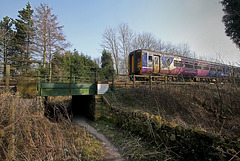
Hall's Bridge
| |
|
A Stockport-bound train leaves the station at Furness Vale and is about to cross Hall's Bridge which once crossed the tramroad carrying clay from the canal and railway sidings to, and bricks from, the works of The Furness Vale Silica and Firebrick Company Ltd. This continuous cable operated tramroad was on the line of the earlier tramroad that had brought coal from the Diglee Mine that was operating in 1811 and was later in the ownership of Levi and Elijah Hall by 1874. It is after these proprietors that the bridge was named.
For details of the mining operations and tramway see:
www.pittdixon.go-plus.net/upfc-furness-basin/upfc-furness...
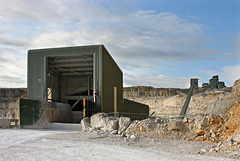
Crusher house
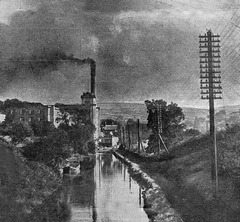
Mill and Canal
| |
|
|
Photographs of the Macclesfield Canal showing working boats are scarce and I have been seeking a view of a boat associated with the fireclay traffic for some time. The best I have managed so far is this newspaper photograph from 1934 which was taken from Sugar Lane bridge in Adlington looking toward the Clarence Mill in Bollington. If you look closely at the canal near to the chimney it appears that there is a boat there, probably bringing in coal for the boilers. Nearer to the camera is a boat at the wharf for the Clarence fireclay mine operated by John Hall & Son (Dukinfield) Limited which supplied their works in Dukinfield with up to six 18 ton boatloads of clay per week. Clay, and a small amount of coal, was brought from the mine off in the fields to the left in tubs and tipped down chutes into the boat. The boat is most likely to be named "Benefactor" as this was a regular on this run at the time. The mine closed in 1938.
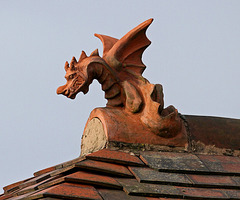
Ridge Dragon
| |
|
|
This example is probably a wyvern rather than a dragon and is lurking on a rooftop in Macclesfield. This looks to be a fairly recent example rather than one of the Victorian examples which are generally of better quality detail.
Canada House
| |
|
|
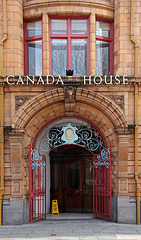
Canada House on Chepstow Street, Manchester, was erected 1905-09 to the design of W and G Higginbottom as a textile packing warehouse for H S Booth and others. The cast iron framing is faced in fine buff terracotta with a variety of decoration. The building is listed Grade II.
Hag Footbridge
| |
|
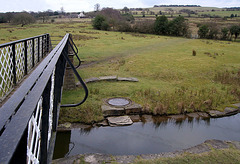
A view of the swingbridge remains from the footbridge over the Macclesfield Canal in Lyme Handley, south of Poynton. The construction of a footbridge as well as a swing bridge in this rural location is a bit of a mystery. The Macclesfield Canal was never so busy that the walker would have been waiting for very long before the bridge was swung back to allow them to continue on their way. The field beyond the hedge is filled with coal workings and there is a shaft off to the left alongside the canal, so there would probably have been a certain amount of coal traffic across the swingbridge in the early years of the canal, but this would have petered out by the end of the 1830s. The swingbridge remained in use until 1971 when it was summarily removed by British Waterways.
Runcorn Bridge
| |
|
|
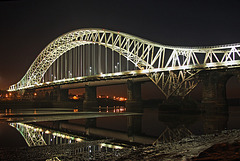
On a very cold night a few years ago I set out for a session of night photography around Runcorn and Widnes. The still conditions were ideal for reflections and the cold meant that I wasn't disturbed by unwelcome visitors whilst making the shots. This is the classic view of the road and rail bridges between Runcorn and Widnes over the Mersey estuary. The old transporter bridge was until 1961 just in front of where I was standing.
Namtu Smelter
| |
|
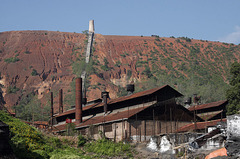
The new smelter at Namtu was constructed after the Second World War during which the old smelter was destroyed. It processed lead, silver, zinc and copper from the Bawdwin mines but has been out of use for some time. It was suggested that it would reopen in 2012 but I have not heard anything of this since my visit. The chimney in the background is at the end of a long flue from the smelter and is intended to carry the noxious fumes away from the works. The poisonous nature of these emissions is evident in the lack of vegetation on the hilltop.
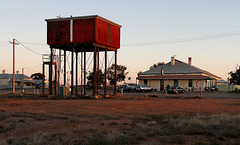
Cockburn
| |
|
The water tank at Cockurn is one of the most obvious remains of the extensive railway yard that once existed here when the narrow gauge trains ran from Broken Hill. The Coburn Hotel in the background continues to provide room and board for travellers, but they now have to arrive by road as the standard gauge trains on the nearby new line don't stop here.
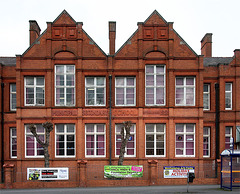
Wolverhampton Municipal Secondary School
| |
|
This building started life as the Higher Grade School, built in 1894 by Henry Lovatt to the design of T. H. Fleeming, who was architect to the School Board. In 1921 it became the Municipal Secondary School and it is clear that the terracotta lettering was altered at this time to show the new designation. From 1945 to 1974 it was the Municipal Grammar School, but this time the lettering was left alone! These days it is used as a campus of Wolverhampton College.
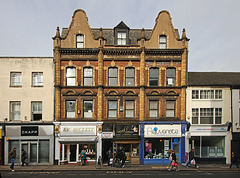
19-21 Queen Street, Wolverhampton
| |
|
This building has a bit of everything - terracotta pinnacles, gables, dormer, brickwork, and stone lintels and sring courses. A crazy piece of excess; I love it!

Compstall weir
| |
|
In the 1830s Thomas Andrew erected cotton spinning mills on the River Etherow at Compstall. To supply a suffcient head of water for the wheels that powered the mills the Etherow was dammed with a great weir about three-quarters of a mile up river from Compstall bridge and the site of the mill, and a canal-sized leat was built alongside the river. This sickle shaped weir is thirty feet high and stepped. Originally built of bricks, it has had to be repaired from time to time with concrete. Originally there were slots to set boards along the top to raise the water level even higher. Demand for water to power the mills was so great that the extensive reservoirs adjacent to the mills and the river above the weir were often drained by the end of a day's working. Today the weir and leat remain along with most of the mill buildings, whilst the surrounding land has become a Country Park.
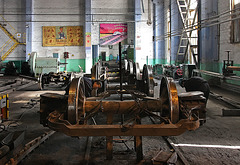
Wheelsets
| |
|
The wheels of SY 0965 which was undergoing a major overhaul in the Baiyin workshops.
Marple Bridge Co-operative
| |
|
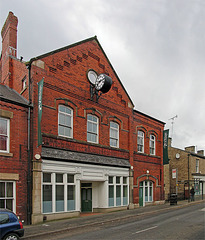
Compstall Co-operative Industrial Society Limited, Marple Bridge Branch of 1892. The building has now been converted to apartments.

Mash Tuns
Melton Road Steam Bakery
| |
|
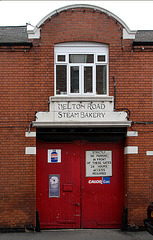
Seen whilst wandering around Leicester in the freezing cold. I wonder how you make bread with steam? :-)

PQ Corporation chemicals
| |
|
On a fine sunny day BITH* and I took a stroll through the PQ (Philadelphia Quartz) Corporation plant adjacent to the Mersey at Warrington. This was once the Crosfield's soap works and today it continues to produce inorganic chemicals.
Runcorn bridges
| |
|
|
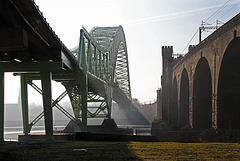
Currently there are two bridges between Runcorn and Widnes over the Mersey estuary. On the right in this view from the Widnes bank is the railway bridge of 1868, whilst to the left is the through arch road bridge that was completed in 1961. The road bridge replaced the 1905 transporter bridge that was off to the left. Another road bridge is now planned a bit further upstream in order to relieve congestion on the existing structure.
