

tarboat's photos

Car House Colliery, Rotherham
| |
|
|
The pumping enginehouse at Car House Colliery in Rotherham once contained steam plant, but now houses electric equipment. After closure of the colliery the shaft was retained for pumping to protect the workings at Maltby Colliery. Now that Maltby has closed the future of this building must be in doubt.

Autotrain
| |
|
Heading towards the tunnel after leaving Bewdley; 1450 and the autotrailer on the recent photo charter.

USAAF Station 571 (Poynton)
| |
|
|
There are just a few remains around USAAF Station 571 at Poynton, Cheshire, adjacent to the now defunct Woodford Airfield. This is a sanitary block type B, flanked by anti- tank cylinders of which there are many dotted around the site. The site was occupied by United States personnel from July 1942, and was used as a dispersal area for stores from Burtonwood AAF 590. The site is now an industrial estate.

Boathouse
| |
|
The Macclesfield Canal once had many boathouses along its top level between Marple and Bosley. With the changes in the type of pleasure boat used on the canals from small wooden or fibreglass cruisers to steel hulled narrowboats these boathouses have mainly been abandoned and demolished. Whilst there are still several remaining on the High Lane Arm, this is the last survivor on the main line and is steadily falling into decay. Another bit of history rotting away. :-(

Castner Kellner
| |
|
|
A late February afternoon and the Castner Kellner chemical plant at Runcorn is silhouetted against the Mersey estuary with the Stanlow refinery in the distance.

On the footplate
| |
|
At the regulator on the big Robert Stephenson & Hawthorns 0-6-0T Nechells No. 4 at the Chasewater Railway.
Flagstaff Quarry, Penmon
| |
|
|
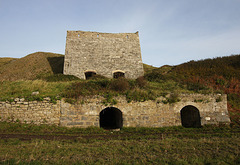
There was a small quarry and pier at this site before 1874 and these kilns were part of the operations at that time. In 1888 William Baird & Co took over and developed the quarry to supply fluxing stone for their steelworks in Glasgow. After a period of low activity Dinmore Quarries Ltd commenced working the site, mainly producing kiln burnt lime for agriculture and this continued until 1948 when all production ceased. The tunnels below the kiln drawing level were for loading lime into carts or possibly railway skips. This was dropped down through shafts with iron doors.

Groverake
| |
|
|
The Groverake Mine, Rookhope, Weardale, Durham, began life as a lead mine but became a major producer of fluorspar in the second half of the twentieth century. After several years of financial problems the mine finally closed in 1999, unable to compete with low Chinese prices.

Railtours the old way
| |
|
Time was when a tour of an industrial railway was undertaken with the participants climbing into wagons for the journey. To remember the old ways a nostalgic wagon trip was arranged on the Chasewater Light Railway for members of the Industrial Railway Society prior to their 2013 AGM. The trip was blessed with warm sunshine and a good time was had by all. Even the smuts were authentic!
Ampsin limekilns
| |
|
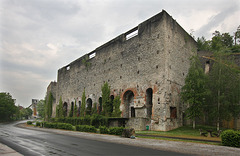
In 1919, Hippolyte Dumont built three lime kilns at Ampsin near Liège. A large lime and cement works was developed here and flourished until c1970 when the Dumont-Wautier Company built the new rotary kiln in its nearby quarry. These old kilns are 11 metres deep and 6 metres in diameter.

Accommodation crossing
| |
|
|
The autotrain passes an accommodation crossing on the Severn Valley Railway during the recent photo charter. A lovely rural setting to capture a typical service as seen on a number of former Great Western branches in the 1950s.

Porthleven
| |
|
It was a breezy day when I visted Porthleven and the sea was rolling in with big breakers. The entrance to the harbour is guarded by this pillbox, just in case of an attempted invasion.

Passing the crossing
| |
|
|
1450 and autotrailer passing an accommodation crossing on the Severn Valley Railway.

Leaving Bewdley
| |
|
|
First shot of today's charter on the Severn Valley Railway as 1450 departs Bewdley with an autotrailer in tow. Hey, we even had some sunshine!

15.41 to Looe
| |
|
Passengers hurry to board the train at Liskeard for a journey down the branch to Looe. The main line station is in the background, across the road and at a right-angle to the branch line.

West Looe
| |
|
|
Spotted in West Looe was this large corrugated iron shed. I have no idea what its purpose was

On request

31st September
| |
|
Sign at the access point to Polkerris Beach. They must have a different calendar in Cornwall.
