

tarboat's photos

Milk tanks
| |
|
|
A weathered 46447 heads away from Cranmore on the East Somerset Railway with the milk tanks.

Bean terminal
| |
|
|
|
Soybean terminal at Royal Seaforth Dock in Liverpool. Cargill’s adjacent soybean crush and refinery has been operating since 1986. The plants produce high protein soybean meal, soya hulls, crude soya oil and crude tocopherol (vitamin E).

Collapsed
| |
|
|
|
Rusty and collapsed roofing over the foundry at the former Brymbo steelworks. The stone structure in the background is the 1796 blast furnace which was not blown out until 1894.

Small mines
| |
|
|
Small drift coal mines in the Hegang area of northern China. There are two drifts in the centre of this view which is best viewed large. The dirt rucks in the background belong to the larger deep mines.

Horse bridge
| |
|
|
Wooden bridge carrying the towpath over the old river channel from the sluices below Dutton locks on the River Weaver.

Moving pit timber
| |
|
|
|
600mm gauge electric locomotive at the Dalu coal mine in Hegang, Heilongjiang province, China. This is one of a number that were supplied to the Hegang Mining Administration from the (Shaoshan) Zhuzhou Electric Locomotive Works (now CRRC Zhuzhou Locomotive) in Hunan Province.

On hire to Berresford Motors
| |
|
|
A trip on ex Bournemouth Daimler Roadliner during the farewell to Hanley Bus Station event in February 2013. A brief stop at Werrington allowed a quick photo of the Perkins V8 powered bus. It certainly gets down the road well.

Harold
| |
|
|
Huddersfield born Prime Minister Harold Wilson is commemorated by this statue outside the magnificent station frontage in that town. The station is said to be Huddersfield's finest building. The foundation stone was laid by Earl Fitzwilliam on 9 October 1846 and it was completed in 1850 to the design of architect James Pigot Pritchett.

Stop lock
| |
|
|
At one time there were two stop locks at Hall Green where the Hall Green Branch of the Trent and Mersey Canal meets the Macclesfield Canal. This necessitated two lock keeper's cottages with the brick on serving the Trent and Mersey and the stone one the Macclesfield. Today there is just the one lock with a small fall from the Macclesfield Canal.

Pennine Tower
| |
|
|
|
Thanks to GRONK on 28dayslater for the history. See his report for lots of photos of what is inside.
www.28dayslater.co.uk/threads/the-pennine-tower-lancaster-services-m6-november-2023.136454
The Pennine Tower was originally due to open in April 1965 but due to delays with construction it was eventually pushed back to November, as part of the newly constructed Forton services on the M6 motorway, it was actually the second service station to open on the motorway after Charnock Richard which opened a few years earlier in 1963. The services took its name from the nearby village of Forton and was designed by T. P. Bennett and Son, when the facility opened it was originally operated by The Rank Organisation. It was opened on the Preston-Lancaster section of the M6 with junction 33 is to the north and junction 32 is to the south; this section of the motorway opened in the same year as the services.
The tower boasted an up-market restaurant and a sun deck which had been designed to resemble an air traffic control tower which spans 22.5 m metres across. Initially the tower proved popular with motorists offering unrivalled views of the countryside. However, during the first quarter of 1967, the tower-restaurant recorded a loss of £700 (approximately £10,700 in 2023). While that's the only period for which precise figures are available, it confirms that even during the supposed peak of the motoring-dining era, the tower was struggling to cover its basic running costs. Rank complained that most visitors weren't buying anything, and that traffic levels were much lower than expected.
The tower had space to hold more than 120 diners. It is true that modern fire regulations wouldn't allow 120 people to congregate in the tower, so it wouldn't be able to operate at full capacity and staff would have to count how many people came up. However the reality is that for most of its life the tower would have struggled to attract 120 diners at any one time, and patronage was usually in the single figures.
Fast forward a few years and cost-cutting was having an additional impact, plus social changes and driving becoming less leisurely all meant that the tower's prospects were bleak. Most of Rank's restaurants were soon struggling to make any money, and the unique running costs and impracticality of the tower meant it was especially difficult to justify. The desperate cutbacks meant the food was soon described as "an insult".
What was left of the 'fine dining' restaurant was converted to a trucker's lounge, swapping with the facilities downstairs, before the tower closed completely to the public in 1989. It then soldiered on for another 15 years, partially re-fitted, as a head office, then as staff training and storage, but even this became too impractical, and the tower is now not used at all.
In 2012 the tower was listed Grade II for its modernist design.

Workington Brewery
| |
|
|
|
The Workington Brewery company was founded by John Curwen in 1792. Brewing ended here in 1988 at which time it was in the ownership of Scottish & Newcastle. The mid-19th century Workington Brewery (also known as the Ladies' Walk Brewery) has survived after conversion to apartments. It is listed Grade II.

Pulverising
No.4, Broad Street
| |
|
|
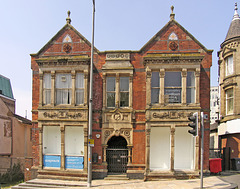
Although fallen on hard times this building on Broad Street in Hanley is certainly attractive. Built as a house in 1878 it was occupied by a dentist who had his surgery and offices on the ground floor with living accommodation above. it was later used by the British Gaslight Company as offices until their gasworks was sold to Stoke-on-Trent Borough Council in 1922. In the mid-1970s the Co-operative Bank had a branch here whilst the Power Group of the National Union of Mineworkers was upstairs.

Heading for the pass
| |
|
|
QJs 6905 and 6991 at the head of a freight service climbing from Linxhi toward Reshui and the Jinpeng section of the Jitong Railway. Steam had only a few months left on this section and would be withdrawn from the Chabuga - Daban section by the end of 2005.
Grey
| |
|
|
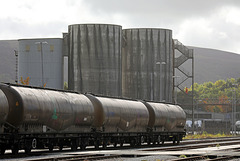
Grey is the definitive colour for cement works. Wagons and silos at the Breedon works in Hope.

Bus station
| |
|
|
A bit of brutalist architecture at Huddersfield bus station. It was opened on Sunday 1 December 1974 and is the busiest bus station in West Yorkshire. It is currently undergoing major renovation works.

Sentinel Tipper
| |
|
|
|
This S6 (six wheel) steam tipping lorry was sold new to Tarmac in 1933. In 1946 it went to carry coke for the Cambridge Gas Light and Coke Co. Ltd. until the mid 1950's, it fell out of use but returned to service during the Suez crisis in 1956. It was fully restored in the early 1970s. Seen at Astle Park traction engine rally.

