

tarboat's photos
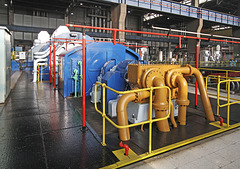
Unit 2
| |
|
|
Parsons built Generating unit No.2 at Ratcliffe power station. This had a rated output of 500 MW.

Winter on the narrow gauge
| |
|
|
|
Winter lasts a long time in North-East China and this image was taken in mid-April. The previous day had seen bright warm sunshine! A C2 0-8-0 locomotive works hard up the last few metres to the summit of the Huanan Coal Railway taking the empties back to the coal loading point. All gone now of course.

Mutual 2 & 3
| |
|
|
Cotton spinning mills at Heywood built for the Mutual Spinning Company. On the left is the No.2 Mill which has a foundation stone dated 1891 and at the right edge is the No.3 Mill, started in late 1914 but due to the war production did not start until 1922.
The completion of the No.3 Mill made the company the largest cotton spinning firm in the district with a total of 246,000 spindles. The mills continued in operation until relatively late, switching from cotton production during the mid-20th century to incorporating woollen and artificial fibre spinning.
The design of the mills was by local architects. Potts, Son and Pickup (No.2) and Potts and Henning (No.3). This is reflected in the similarities between the buildings.
Just visible at the left edge is the No.1 Mill, designed by Potts, Pickup and Dixon, on which construction began in 1884.

Dark day
| |
|
|
|
Under a lowering sky 19B 1412 climbs through the reverse curves between Drew and Jubilee on the former New Cape Central Railway.

Generation Hall
| |
|
|
Looking across the generating hall at Ratcliffe power station back when it was still at work. This was the cleanest, tidiest, power station I have ever been in.

Approaching Tufts
| |
|
|
The ballast hoppers in the charge of pannier tank 9681 are just south of Tufts Junction as the train heads for Whitecroft and Parkend on the Dean Forest Railway.
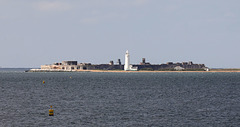
Hurst Castle
| |
|
|
|
This artillery fort was established by Henry VIII on the Hurst Spit between 1541 and 1544 defending the western entrance to the Solent against France and the Holy Roman Empire. In 1649 it was used to detain Charles I before his execution.
Improvements and repairs were made during the French Revolutionary Wars and the Napoleonic Wars and again between 1861 and 1874 when sixty-one gun positions were built in two long granite-faced batteries alongside the older castle. Re-armed in the Second World War it was finally decommissioned in 1956 and has become a tourist attraction. Of the four lighthouses built there from the 18th century onwards, of which the highest, opened in 1867, remains in use.
Coastal erosion is now badly affecting the site and it is threatened with destruction if funding cannot be found to bolster the defences against the sea.

Shift change
| |
|
|
Morning shift change at Tianzhuang shed on the Pingdingshan Coal Railway. At the ash pits the lineup includes JS 8031 and deflectorless QJ 7136.

The shunter's seat
| |
|
|
|
The shunter couples SY 0366 to its train in the yard at Shaguotun on the Nanpiao Coal Railway.

Brickworks power
| |
|
|
|
The steam engine at Bursledon Brickworks was originally supplied in 1885 by John Woods & Co of Wigan for the Chandlers Ford works. The cylinder is 16" x 30" with slide valves, Pickering governor, four bar crosshead guides and a disc crank. It was moved to Bursledon in 1896-97 and remains in situ and is run regularly.
Long ones

Parish Hall
| |
|
|
Evershot Parish Council began building the village hall in 1919 but it was not completed until 1921.In 1939, the hall was commandeered by the British Army who subsequently returned it after the war. It is now administered by a local charity which maintains the hall for use by the local parish community.

Coastguard Lookout
| |
|
|
|
The 1950s coastguard lookout on Dungeness beach is now a holiday let. Apparently the building has no internal doors whatsoever. I note that the advertising for the property suggests that the adjacent power station is in the distance and it does not appear on any of the photos!

Dungeness Power
| |
|
|
The two closed nuclear power stations at Dungeness, Kent.
To the left Dungeness A is a legacy Magnox power station consisting of two 250 MWe reactors which were connected to the National Grid in 1965 and reached its end of life in 2006. Its decommissioning is being managed by Nuclear Restoration Services.
At the right Dungeness B is an advanced gas-cooled reactor (AGR) power station consisting of two 520 MWe reactors, which began operation in 1983 and 1985. They were the first in a series of AGR reactors to be constructed across the UK. In March 2009, unexpected problems discovered during a maintenance shutdown on unit B21 resulted in the reactor remaining offline for nearly 18 months. In 2015, the plant received upgrades and was given a second ten-year life extension to 2028. In September 2018, as both units were shut down for a scheduled maintenance outage, operator EDF (Électricité de France) encountered "significant and ongoing technical challenges" which ultimately led to the announcement of its closure on 7 June 2021.
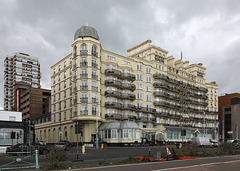
Grand Hotel
| |
|
|
Opened in 1864, The Grand Hotel in Brighton (often called the "Palace by the Sea") was designed by architect John Whichcord Jr. on the site of the former West Battery.
It is infamous for the 1984 bombing by the IRA during the Conservative Party Conference. The blast killed five people and caused catastrophic structural damage. Much of the rebuilt section at the front is characterised by the lack of balconies and railings.
The hotel underwent a massive £16.2 million refurbishment in 2019 to restore its Victorian façade and update its interior.

Winston Churchill
| |
|
|
|
Canadian style pacific locomotive 'Winston Churchill' was completed for the Romney, Hythe & Dymchurch Railway by the Yorkshire Engine Company (2294) in 1931. It is seen here awaiting departure from Hythe with a train to Dungeness. During the journey a slight rain shower caused the locomotive to slip repeatedly and the driver did well to keep the train moving.

Volk's Electric
| |
|
|
The Volk's Electric Railway at Brighton is the oldest working electric railway in the world. It has been in service since 1883. It runs for one and a quarter miles along the top of the beach from the Aquarium Station near Brighton Pier to the Marina.

Chimneys
| |
|
|
|
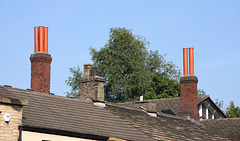
Brighton Pavilion is usually mentioned for its spectacular domes, but the chimneypots are just as good. I wonder who made them?
