

tarboat's photos

Victoria Square
| |
|
|
Victoria Square is the first municipal housing built in Manchester. This tenement block was built in 1889 by Henry Spalding and A.W.Cross, for Manchester Corporation, comprising of 522 rooms, to accommodate 825 people. It is listed Grade II.
Fred
| |
|
|
|
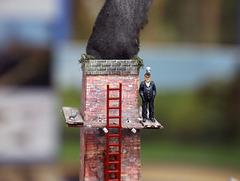
A well known steeplejack appears on this layout built by Bolton Model Railway Society. It can be seen the their unit at Bolton Market Place.

Reception
| |
|
|
All vehicles to report to this office before unloading. Goods in reception at the closed Thomas Bolton copper foundry at Froghall. This has now been cleared away apart from the chimney.

Beddgelert bound
| |
|
|
|
Small England class locomotives Palmerston and Prince amidst the majestic scenery of the Welsh Highland Railway on the long straight after Rhyd Ddu station. These locomotives were built by George England and Co in 1864 and 1863 respectively in the first batch of four steam locomotives to operate on the Festiniog Railway.

Dane Bower Colliery
| |
|
|
A great day's walking on the moors between Wildboarclough and the Dane Valley. This remote area of Cheshire was once the location of a number of collieries including the extensive Dane Bower workings. The shafts on the moor such as this one were worked in the 18th century before the deeper coal was accessed using adits from close to the Dane, the last of which continued at work into the early 20th century. In the background is Shutlingsloe and further back the communications tower on Croker Hill.

Zeche Sterkrade
| |
|
|
|
The Sterkrade colliery was sunk in 1903 and operated independently until 1933 when it was absorbed into the Osterfeld complex. Shaft 1 at Sterkrade was eventually used to wind men and materials whilst the coal was raised at Osterfeld. Closure came in 1992 and the site has been cleared apart from the headframe and associated pithead building.

Towpath bridge
| |
|
Side bridge on the Stockport Branch Canal at Gorton. Maintenance of the Manchester, Sheffield and Lincolnshire Railway Company's boats was undertaken at Gorton dock which was located on the Stockport Branch of the Ashton Canal a short distance from the junction with the main line. This is the bridge that carried the towpath across the entrance to the dock. It is dated 1864.

Campion Chambers
| |
|
|
Campion Chambers, 23-25 St Nicholas Place, Leicester features cream terracotta and a nice art deco font. I guess it dates from the 1920s. The replacement windows don't help and I have cut off the garish subway frontage on the ground floor level.
Swan Lane Collieries Limited
| |
|
|
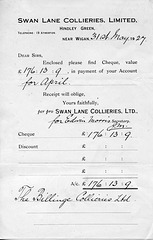
The pits at Swan Lane and Long Lane, Hindley Green, were sunk c1864.They were purchased by the Swan Lane Brick & Coal Co.c1886 and then Swan Lane Collieries Ltd from 1910. This latter company reopened the Swan Lane colliery after it had closed in 1893. Final closure came in November 1927, a few months after this bill was paid. At the end there were 384 men underground and 107 surface workers.

Climbing Prince
| |
|
|
The Ffestiniog Railway's 'Prince' climbing hard at Coed-y-Bleiddiau with a train of vintage stock during a 30742 Charters event.

Grin
| |
|
Grinlow above Buxton saw an extensive limeburning industry develop in the late seventeenth and early eighteenth centuries. By the second half of the latter century the kilns were leased by the Duke of Devonshire to the Brock family who continued to operate them until 1789. From then on into the first quarter of the nineteenth century the Duke appears to have managed the limeworks directly as part of his estates. The hill is covered in the remains of the industry and one of these 18th century earthen kilns is prominent in the foreground of this view looking up to Solomon's Temple. On average these kilns would have been operated for seven months each year.
Drott
| |
|
|
|
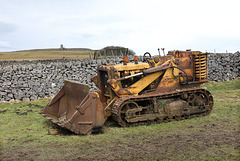
The machine with the four-in-one bucket. This defunct speciman was at Countess Cliff, Harpur Hill. I don't think it has worked in years.
Electricity
| |
|
|
|
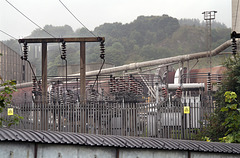
Electrical input at Hope cement works. One of the rotary kilns in the background.
Wigan Coal and Iron
| |
|
|
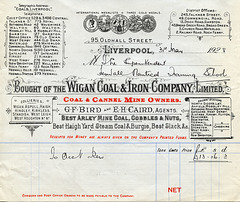
The Wigan Coal and Iron Company was formed when collieries on the Lancashire Coalfield owned by John Lancaster were acquired by Lord Lindsay, the Earl of Crawford and Balcarres, owner of the Haigh Colliery in 1865. The company owned collieries in Haigh, Aspull, Standish, Westhoughton, Blackrod, Westleigh and St Helens and large furnaces and iron-works near Wigan and the Manton Colliery in Nottinghamshire.
Collieries belonging to the Wigan Coal and Iron Company in 1896 were the Alexandra, Bawkhouse, Bridge, Lindsay and Meadow Pits in Haigh. The largest, the Alexandra Pit employed more than 650 workers and the Lindsay Pits more than 350. The Crawford, Kirkless, Moor and Woodshaw Pits in Aspull employed over 1,000 workers. Eatock Pits in Westhoughton employed 484 underground and 89 surface workers whilst the Hewlett Pits in Hart Common employed 981 underground and 182 on the surface. Ladies Lane Colliery in Hindley employed 282 underground and 40 surface workers. The Westleigh Pits were Priestners which employed 387 underground and 70 on the surface, Snapes, and Sovereign which had 180 underground workers and 68 on the surface. The King Coal Pit at Blackrod was a pumping pit, retained to drain the colliery workings. In Standish the company owned the Broomfield, Giants Hall, Gidlow, John, Langtree, Robin Hill, Swire and Taylor Pits. The largest of these was the Langtree Pit with more than 540 employees.
Wigan Coal and Iron Company was the biggest colliery owner on the Lancashire Coalfield and in the 1920s employed 9,000 workers. The shafts of Parsonage Colliery in Leigh, sunk by the company between 1913 and 1920, were at the time the deepest in Britain.
In 1930, the Wigan Coal & Iron Co. Ltd and the Pearson & Knowles Coal & Iron Co. Ltd combined their coal mining operations to establish the Wigan Coal Corporation.

Indoor shipbuilding
| |
|
BAE Systems Submarines' 25,000m² Devonshire Dock Hall indoor shipbuilding complex. This is the largest of its kind in Europe. This was used to construct the Astute-class submarine and is currently being used for the build of four Dreadnought-class submarines.
Bromborough Wharf
| |
|
|
|
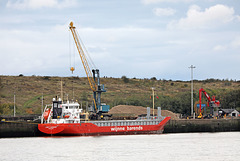
Mersey Wharf at Bromborough, has two operational berths with a quay length of 230m and can handle ships up to 6,000 tonnes. Marine-won sand is landed and processed at the Eastham Sands facilities here. It is used as a source of aggregate for construction and other purposes in the local area. Dutch registered general cargo vessel Lady Harriet has been unloading steel onto the wharf.
Bergwerk Saar
| |
|
|
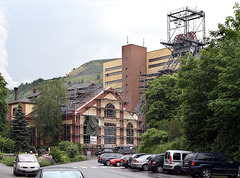
The Duhamel shaft at Bergwerk Saar in Ensdorf was sunk to depth 868 metres in 1913. At the end of June 2012 the colliery closed, marking the end of hard coal mining in the Saarland after several centuries. At closure this shaft was being used for men and materials handling and was wound by a steam engine manufactured by Dingler'sche Maschinenfabrik in 1918.

Cab forward
| |
|
|
|
Ex Harrogate Gasworks No.1 Peckett 2050/1944 arrives at the Oak Tree Halt on the Statfold Barn Railway. The driver is a picture of concentration as he brings his train into the platform.
