

tarboat's photos

Jinpeng glint
| |
|
|
QJs 6882 and 6639 catch the glint as they bring their westbound train towards the summit of the Jinpeng section of the Jitong Railway.

Cathryn
| |
|
|
|
Hudswell Clarke 1884 was built in 1955 to a design used for the supply of locomotives to the Port of London Authority. It went to the National Coal Board and worked at Newmarket Colliery, Near Wakefield. Here it carried the number S102 and worked alongside S103 (Hudswell Clarke Work Number 1864) which was built to the same design.
It worked at the Colliery until 1969 and then following repairs at the central workshops (NCB Allerton Bywater). From there it moved to St Johns Colliery in Wakefield and worked there and at Park Hill Colliery in Wakefield. It was taken out of service in March 1977.
It is now based on the Ecclesbourne Valley Railway where it is was restored to service in 2021. As of July 2023 the locomotive was at Peak Rail where it was photographed in the shed. It was due to stay at Peak Rail for two years.

Donghaikuang Colliery
| |
|
|
Conveyor runs and associated coal processing buildings at Donghaikuang Colliery in the Jixi area of Heilongjiang, China. Judging by Google Maps all this has now been cleared away. Things change very fast in China.

JCB
| |
|
|
The rise and rise of JCB is a British success story and the plant manufacturer continues to expand its business. This is part of the JCB demonstration at the Hillhead quarry exhibition which also saw the spotlight on its most powerful and productive excavator ever, the 52-tonne 520X.

Back to Hailar
| |
|
|
|
A member of the team is watching the road from on top of the tender as JS 5741 heads back to Hailar having deposited wagons at a nearby industrial premises. The locomotive was one of two station pilots that day. The shunter appears to be sitting on the front buffer beam.

Asphalt
| |
|
|
The tallest piece of fixed equipment at this year's Hillhead quarry exhibition was this asphalt plant from the Turkish manufacturer E-MAK that specialises in asphalt and aggregate plant.

Under the bunkers
| |
|
|
SY 0746 is under the loading bunkers at Donghaikuang Colliery at the end of a branch of the Jixi coal railways.

Kronospan
| |
|
|
|
Kronospan has been operating at Chirk since the 1970’s. The works originally made particleboard and melamine and now also produces MDF, T&G flooring for the building trade, laminate flooring and worktops. It is the longest established manufacturer of wood-based panels, and the only laminate flooring producer in the UK.
New timber is sourced in the UK and delivered by train and there is also use of reclaimed wood material

Gas terminal
| |
|
|
This plant at Point of Ayr had a capacity to treat 8.5 million cubic metres (300 million cubic feet) per day at standard conditions of sour gas from offshore. The gas was brought ashore via a 51 centimetres (20 inches) diameter, 33 km long pipeline. The plant separates methanol (used for hydrate inhibition), water and condensate from the gas stream. The gas was sweetened with an amine solvent to remove sulphur compounds down to 3.3 ppm hydrogen sulphide and 35 ppm mercaptans. The hydrocarbon dew-point of the gas is reduced by mechanical refrigeration to a quality suitable for pipeline transportation. The treated gas was piped to Connah's Quay Power Station at 30 bar via a 27 km pipeline. Any gas surplus to the fuel requirements of the power station was further treated and delivered to the Burton Point terminal of the National Transmission System.
The site is owned by eni Liverpool Bay Operating Company Ltd, a subsidiary of eni UK Ltd. It was built near the site of a former colliery, which closed in August 1996. Approval for the site was given in February 1993, to be constructed by Hamilton Oil (of Denver, USA). BHP bought Hamilton Oil in 1991. The amount of gas to be brought onshore would be enough to provide electricity for half of Wales. Construction took place in 1994. eni bought BHP Billiton's interest in the Liverpool Bay Development in April 2014.
In 2026 the gas field is exhausted and the terminal is under demolition. The site is intended to be re-used as a terminal for carbon dioxide, piped from a number of sources (cement works in particular), which is to be injected into the strata of the Morecambe Bay gas field.

Mallet

Desert snow
| |
|
|
|
It is gently snowing across the desert between Daba and Guyaozi as QJ 7205 nears Guyaozi with a long train of empty coal wagons.

Picturedrome
| |
|
|
Art deco cinema architecture. The Picturedrome cinema in Eastbourne first opened its doors on 21st December 1920 and almost made its centenary before closing as the Curzon in summer 2020.

Afternoon on the Cob
| |
|
|
|
In an afternoon heat haze Double Fairlie ‘Merddin Emrys’ heads a Blaenau Ffestiniog train across the Cob from Porthmadog.

Flint face
| |
|
|
Fulking limekiln, West Sussex. This medium-sized draw kiln has a face fronted with flints.

New Year steam
| |
|
|
New Year sunshine as Neilson 2937 leaves Brownhills West station on the Chasewater Railway. The locomotive was built in 1882 and delivered to William Baird & Co at Bedlay Colliery near Glenboig, where it was given the No 11. It returned to service at Chasewater in 2025 after extensive restoration.

Bell kiln
| |
|
|
Bell limekiln was built in the 1860s and was used until 1918. It retains the lime shed in front of the kiln to keep the product dry. In recent years it has seen significant restoration and the top now houses an observatory. It is grade II listed.
Wharton Lodge Works
| |
|
|
|
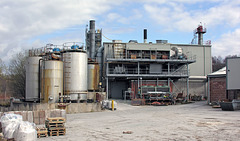
Colin Stewart Minchem, Wharton Lodge Works, Winsford. The company manufactures a range of speciality products based on bentonites and other minerals used in the Detergent, Oil Drilling, Coatings and many other related industries. The business currently trades as AMCOL Minerals Europe Ltd.

Gravel loader
| |
|
|
Attenborough sand and gravel pit was established in Nottinghamshire in the 1920s. Since then the pit has expanded up the Trent Valley in Nottinghamshire, and into Derbyshire. The extraction at the time (2009), operated by CEMEX UK Materials (Aggregates) Ltd, was undertaken almost 5km from the processing plant and material is moved across the flooded former workings with barges pushed by Bantam tugs.
The flooded pits form an extensive nature reserve which is managed by Nottinghamshire Wildlife Trust and Broxtowe Borough Council. Here an empty barge is arriving under the loader with the chimney and cooling towers of Ratcliffe power station in the background. This interesting water traffic seems to have ended in 2016 after exhaustion of the gravel reserves.
