

tarboat's photos
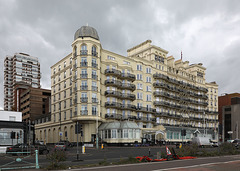
Grand Hotel
| |
|
|
Opened in 1864, The Grand Hotel in Brighton (often called the "Palace by the Sea") was designed by architect John Whichcord Jr. on the site of the former West Battery.
It is infamous for the 1984 bombing by the IRA during the Conservative Party Conference. The blast killed five people and caused catastrophic structural damage. Much of the rebuilt section at the front is characterised by the lack of balconies and railings.
The hotel underwent a massive £16.2 million refurbishment in 2019 to restore its Victorian façade and update its interior.

Winston Churchill
| |
|
|
|
Canadian style pacific locomotive 'Winston Churchill' was completed for the Romney, Hythe & Dymchurch Railway by the Yorkshire Engine Company (2294) in 1931. It is seen here awaiting departure from Hythe with a train to Dungeness. During the journey a slight rain shower caused the locomotive to slip repeatedly and the driver did well to keep the train moving.

Volk's Electric
| |
|
|
The Volk's Electric Railway at Brighton is the oldest working electric railway in the world. It has been in service since 1883. It runs for one and a quarter miles along the top of the beach from the Aquarium Station near Brighton Pier to the Marina.

Chimneys
| |
|
|
|
Brighton Pavilion is usually mentioned for its spectacular domes, but the chimneypots are just as good. I wonder who made them?

Domed
| |
|
|
Eastbourne is a town with plenty of domes. Here are a couple of those found on the pier on the pavilion that was completed in 1888.

The cistern chapel
| |
|
|
In 1733 the Mayor and Jurats of Rye asked permission of Lord Wilmington to erect a water cistern or tower for public use in the corner of the churchyard. Permission was soon granted and the tower was completed during 1735 bringing a much improved water supply to the town.

On the crossing
| |
|
|
Hunslet Engine Co 3163 of 1953, running as former J94 Austerity 68032, crosses the road in pouring rain as it runs round its train at Bodiam.

Hand made brick
| |
|
|
|
Charnwood Forest Brick Ltd is a component of Michelmersh Brick Holdings PLC. The Company produced approximately 3 million facing bricks and special shaped bricks per annum from its manufacturing base at Shepshed, near Loughborough. Hand made facing bricks are here being manufactured and placed on rail trollies to go to the dryer before firing.
Brick production ended here in 2023 and the works then concentrated on Hathern Terracotta wares & FabSpeed pre-fabricated brick components. The remaining business has now been sold to Shaws of Darwen and the works is to be closed.

Debenhams
| |
|
|
|
The former Debenhams shop in Eastbourne stands forlorn and unloved but it does have these two domes on a 1911 dated portion of the building.

Rope changing
| |
|
|
The former shaft rope changing engine ex Agecroft No 4 pit now resides at the Lancashire Mining Museum at Astley Green. It was always run on compressed air at Agecroft.

Shunting
| |
|
|
|
SY 1092 shunts at the Zaojiatun coal mine on the northern branch of the Nanpiao Coal Railway.

Slag plant
| |
|
|
Slag processing plant at Scunthorpe steelworks with the Four Queens blast furnaces in the background.
Luossavaara-Kiirunavaara Aktiebolag (LKAB) is a Swedish mining company. The company mines iron ore at Kiruna and at Malmberget in northern Sweden. The company was established in 1890, and has been 100% state-owned since the 1950s. In 1918 the company purchased the Francis Flower business in the UK which included the GBSS processing plant at Scunthorpe steelworks.
Ground Granulated Blast furnace Slag (GGBS) is produced by quenching molten iron slag from a blast furnace in water or steam, to produce a glassy, granular product that is then dried and ground into a fine powder. It replaces up to 70% of the Portland Cement in concrete, and can significantly reduce CO2-emissions. Francis Flower produced GGBS in Scunthorpe on the grounds of British Steel upgrading their blast furnace slag. LKAB is also a significant supplier of highly upgraded iron ore products to British Steel, the first deliveries were made in the 1930’s. Francis Flower was the second largest supplier of GGBS in the UK.

Morning at Biligou
| |
|
|
|
Early morning light as consecutively numbered QJs 7038 and 7037 storm up the west side of the Jinpeng Pass. It was always worth getting up early on the Jitong Railway.

Old Halifax
| |
|
|
|
This steep setted road links Old Lane with the Woodside area of Halifax. Used mainly for car parking these days the scene is dominated by the chimney of Crossley's former carpet mills at Dean Clough.

Wide-open spaces
| |
|
|
|
A pair of QJ class locomotives head west towards Lindong with a short freight on the Jitong Railway. This sort of open vista is typical of this section of the line.

Tobacco warehouse
| |
|
|
|
The Stanley Dock Tobacco Warehouse is a grade II listed building and is the world's largest brick warehouse, with a net floor area of 1.6 million square feet. It stands 125 feet high, and at the time of its construction in 1900-01, claimed to be the world's largest building in terms of area. The 14 storey building spans across 36 acres and its construction used 27 million bricks, 30,000 panes of glass and 8,000 tons of steel. The overall design was by A. G. Lyster, the Dock Engineer, but Arthur Berrington almost certainly played a part. The warehouse was a late addition to the Stanley Dock complex and was built on land reclaimed from the dock. It has now been converted to apartments with retail and commercial uses on the ground floor.

QJ 3522
| |
|
|
A study of a QJ after preparation for work at the junction depot at Suihua in Heilongjiang, China. This was a very busy location with locomotives being changed on most of the trains passing here. The QJs in the area were coupled with eight wheel tenders rather than the twelve wheel version used for longer distance services.

Mountsorrel
| |
|
|
Primary stone processing buildings at the Lafarge (now Tarmac) granite quarry at Mountsorrel.
