tarboat's photos

Polytunnels (without the poly bit)
| |
|
Interesting shapes of the modern agricultural industry. Seen whilst walking at Withington Marsh near Hereford.
Eschweiler pump
| |
|
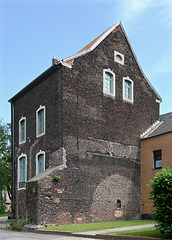
In 1784 Johann Peter Wültgens extended the coal concessions he had in the area of Eschweiler near Aachen. In 1794 a Newcomen type pumping engine was erected on the colliery which is described as driving 2 pumps with 42m of rods. It worked at 11-12 1.76m strokes per minute. It was one of the earliest steam engines in Germany. The enginehouse survives and is rather different from the normal British practice where the beam pivoted on an outer wall and the shaft was outside the building. In this case it looks as if the engine was entirely within the building.
Steam and cabbages
| |
|
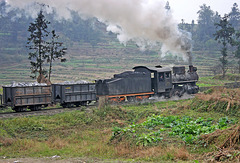
A trainload of building materials heads uphill after passing Caiziba on the Shibanxi Coal Railway.
Severn Valley autotrailer

LFI Crane
| |
|
Ladder & Fencing Industries was established in 1947 and remains as a family business. The company is the UK's leading manufacturer & supplier of aluminium, timber, steel and GRP ladders, based in Newent, Gloucestershire.

Evening departure
| |
|
|
An early evening service is seen leaving Mifengyang uphill on the Shibanxi Coal Railway. It was almost dark when I took this shot and it was a case of erecting the tripod, high ISO setting, and hoping that the low exposure speed wouldn't be too much of a problem head-on. Not something that could be attempted with film.

Skelton Park Ironstone Mine
| |
|
The Skelton Park mine was sunk by Bell Brothers in 1872 with two shafts of 378 ft (upcast) and 384 ft (downcast), both 14ft in diameter. Bell Brothers were taken over by Dorman Long and Co Ltd in 1923 and that company operated the mine until closure in 1938. It is reckoned that the mine produced in excess of 18.5 million tons of ironstone.
This is the top of the upcast shaft and fan house although initially ventilation was by a furnace at the bottom of the shaft. In November 1882 a 12ft 1½ins diameter Schiele fan was installed in a concrete house with a steam engine to drive it. The shaft top brickwork was raised by 8ft to allow cross girders to be installed to carry a pulley wheel for winding in the shaft. The concrete structure to the left of the shaft is the evasee for the fan.
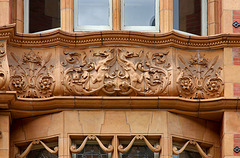
134 Edmund St, Birmingham
| |
|
Terracotta detail from this Grade II listed building in Arts and Crafts Gothic style. The listing states that it was built for C J Company, but I have been unable to find further details.

Huangjia
| |
|
|
|
Afternoon service to Linghe sets out from the Huangjia terminus of the Nanpiao Mining Railway. The bustling street market alongside the line here was a favourite location for watching the passenger trains.
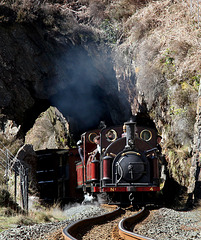
Aberglaslyn tunnel
| |
|
|
|
Prince & Palmerston run out of Aberglaslyn middle tunnel on the Welsh Highland Railway.
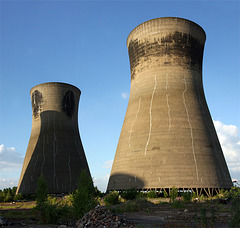
Thorpe Marsh
| |
|
|
The 1000mw power station at Thorpe Marsh opened in the 1960s and was closed in 1994. The six cooling towers remained for many years but have now been felled.

Outside Berresfords
| |
|
|
Stoniers AEC Swift passing the Berresfords garage at Cheddleton late on a spring afternoon. Taken by my good friend John Ryan on one of our outings around Staffordshire in the early 1980s.
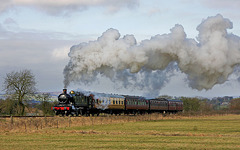
Getting away from Threshing Barn Crossing
Spiralling
| |
|
|
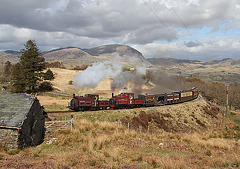
Late afternoon, and Palmerston & Prince with vintage coaches climb the Dduallt spiral on the Ffestiniog Railway.
Going for slate
| |
|
|
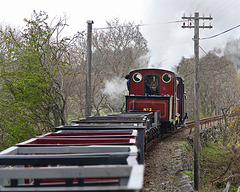
Prince & Palmerston hustle a long load of empty slate wagons up the Ffestiniog Railway above Minffordd.
Toppled
| |
|
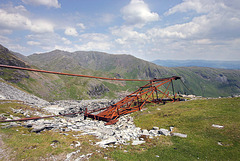
Fallen pylon from the aerial ropeway that brought slate down from the mines and quarrieson the slopes of Coniston Old Man to the mill at Saddlestone. The castings show that the ropeway was manufactured by the Widnes firm of Richard White and Sons.
Slate ropeway
| |
|
|
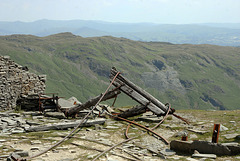
Mandalls Slate Co Ltd worked a number of quarries on the slopes of Coniston Old Man. The main processing area was the mill at Saddlestone to where the slate 'clogs' were brought down by an aerial ropeway.
Remains of the ropeway are still evident right up the hill with both fixed and moving ropes lying on the ground. The collapsed wooden framework was the start of the next flight of the ropeway.