

tarboat's photos

Winnington by night
| |
|
The limekilns and the chimneys of the CHP plant are reflected in the dragonfly pond at Anderton Nature Park.

Silverton
| |
|
|
|
Silver-lead deposits were found in this area in 1875 whilst well drilling and the town of Silverton soon developed as exploitation began. By the 1890s the population was around 3,000 but this soon declined as the best ore became depleted and the Broken Hill deposits began to be developed a short distance away and in 1901 was back to 300 people. These days there are around 50 permanent residents and much of the town has disappeared leaving many relics such as this. It does, however, house a museum dedicated to the film Mad Max 2!

Turning pillars
| |
|
Habergham Colliery was sunk by The Exors of John Hargreaves in 1868-70 and distributed its coal by cart until around 1900 when a chain ginney line was built to connect at Cornfield Colliery with the ginney to Padiham. This line incorporated a tunnel under Tipping Hill Plantation and a turning point at about half way. The colliery operated until 1941 when a shortage of labour cause Hargreaves Collieries to close the pit and transfer the men to their other workings.
Turning the direction of tubs on a chain hauled line was quite a complicated business involving the detaching of the tubs from the haulage chain before the change of direction and their reattachment afterwards. The operation was supposed to be automatic but there are many tales of problems which often necessitated a man being placed at the turn to supervise the operation. This image shows the remains of the turning pillars above Cornfield Farm. The substantial construction reflects the heavy loads and hard use to which it was put.

Zinc Bell No.1
| |
|
The new smelter at Namtu was constructed after the Second World War during which the old smelter was destroyed. It processed lead, silver, zinc and copper from the Bawdwin mines but has been out of use for some time. It was suggested that it would reopen in 2012 but I have not heard anything of this since my visit.

Mendip Colliery
| |
|
The Somerset coalfield was a fascinating place for rural and old-fashioned looking collieries. Mendip Colliery was developed after the old capped shaft at Strap Pit was reopened and drained in 1954-56 in an attempt to prove resources in the area. Subsequently it was developed as a winding shaft connected to the workings at New Rock in order to increase potential output to 70-90,000 tons per annum. New Rock winding shaft was 1,182 ft deep but only 4ft 6in diameter which severely limited daily output. This view by the late Ron Dyer shows the pit with the temporary winding enginehouse and headgear used whilst cleaning out the old shaft which turned out to be10ft 6in diameter rather than the 15ft expected. All the investment in developing the colliery was of little benefit as New Rock began to lose money due to technical difficulties of working the faces with coal ploughs and the need to transport coal away by road. New Rock closed on 28 September 1968 and salvaging the pit followed quickly. By June 1969 the shafts had been filled.

Morewood & Co, Best Best
| |
|
Seen on the goods shed at Burra Station. Morewood & Co, London & Birmingham, Best Best. The Lion Brand was registered in several Australian colonies in 1883. This company was prominent in the Australian trade in the 1880s having, in various incarnations, been involved in the manufacture of corrugated iron since the 1840s.
Much more information here:
mileslewis.net/australian-building/pdf/08-metals/8.03-Mor...

Brownsfield Mill
| |
|
Brownsfield Mill was constructed in 1825 as a room and power cotton mill on the side of the Rochdale Canal in the Ancoats district of Manchester with power supplied by a sixty horse power steam engine. It is Listed Grade II*.

On the crossing
| |
|
A young lass unconcernedly crosses the line just ahead of a heavy train heading away from the washery on the Meihekou coal railway.

Tennants Fine Chemicals
| |
|
This works was once owned by Joshiua Wardle and produced dyestuffs used by the Wardle dyeworks and elsewhere. These days it is operated by Tennants Fine Chemicals, a long established UK family owned private company. They produce aroma chemicals and acetate esters.

Bucket dredger 'Bollin'
| |
|
A number of bucket dredgers were built in the bed of the Manchester Ship Canal during its construction. This plate from Bosdin Leech's tome on the Ship Canal show the nearly completed derdger 'Bollin' at Partington.

Combs old school
| |
|
I have always loved buildings that feature polychromatic brickwork and this example from Suffolk is very much to my taste. The old school at Combs near Stowmarket matches the school house next door. The building has a datestone for 1875 above the stone framed window.

English oil
| |
|
BP's Kimmeridge oilwell on the Dorset coastline is the oldest continually producing wellsite in the United Kingdom. It was drilled in 1959 and now produces 80 barrels (12,720) litres of crude oil per day. The oil is stored in the tanks to the left of the image and collected twice a week by road tanker. It is taken to the BP Gathering Station at Wytch Farm near Corfe Castle and thence by pipeline to the terminal near Southampton.

Wall ornamentation
| |
|
The use of terracotta ornamentation for walls and pillars was common in the late nineteenth and first quarter of the twentieth century. Much has been replaced or swept away these days, so it was good to find this survivor in Mill Lane, Hyde. There had been more along the block but this was the sole survivor. A look at the wall further along showed that the bricks were from the Black Hill Brick Co Ltd Entwistle Bolton Lancashire but that may not be the source of the decorative pieces.

The way in
| |
|
|
The rather unimposing entrance to the generating hall of the Ardnacrusha power station is via the doors on the left. The building was constructed by Siemens-Schuckertwerke and was completed in 1929.

Radium Hill landscape
| |
|
The remote location of the Radium Hill Uranium Mine is evident in this view from the edge of the former town.

Sutton 1849
| |
|
Boundary stone between Sutton and Gawsworth parishes hiding behind the towpath boundary hedge on the Macclesfield Canal. This suddenly caught my eye whilst walking this morning and was a complete surprise as it is not marked on any maps that I have seen. There is a similar stone on the other side of the canal a bit further north behind Gaw End Farm.

Tarmac, Caldon Low
| |
|
Redundant crushing, grading and loading plant at the Tarmac operated Caldon Low limestone quarry. Sadly now all demolished.
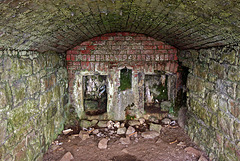
Lledwigan Kiln draw holes
| |
|
Inside one draw tunnel of a pair of draw kilns at Lledwigan on Anglesey. These were working in 1888 but by 1900 were disused. These commercial draw kilns have two draw holes in each tunnel with a poke hole between.
