

tarboat's photos

Village customs
| |
|
I went to Wales today and saw many interesting things. It appears that there is a custom of tying people to street lamps in this village! :-o

Spring Bank Mills, Nelson
| |
|
Peter Reed and John Moorby built their new mill in Nelson where production started om October 31st 1891. Spring Bank Mill contained the second largest weaving shed in the world at that time (748 shuttle looms). Today the firm of William Reed Weaving occupies the premises as part of Allied Textiles plc. William Reed manufacture continuous filament fabrics in nylon, Polyester and Acetate for a wide range of uses including parachutes, hot air balloons, flame retardant fabrics, and spinnaker fabrics.
Getting away from Lindong
| |
|
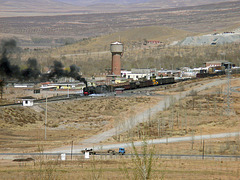
QJ 7049 lays a smokescreen over Lindong station area as it gets a westbound freight underway after prolonged shunting operations. The second locomotive is QJ 6905 which is not in steam and is being moved back to Daban after overhaul.

Electric Cinema
| |
|
The Electric Cinema in Birmingham is the oldest working cinema in the Britain. It opened on 27th December 1909 as the Electric and was subsequently known as the Select Cinema, Tatler News Theatre, The Jacey, The Classic, and The Tivoli, before returning to the original name in 1993. After closure at the end of 2003 it was purchased by a local entrepreneur and renovated before reopening in December 2004. The art deco look of the frontage is based on photographs of the building in the 1930s.

Hatfield
| |
|
Life is really hard for the few surviving deep pits in Britain. Here's hoping that Hatfield can prosper in 2013.
The Alhambra
| |
|
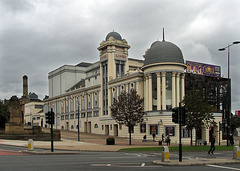
The Bradford Alhambra Theatre was built in 1913 at a cost of £20,000 to the design of architects Chadwick and Watson, for impresario Francis Laidler, and opened on Wednesday 18 March 1914. Purchased by Bradford City Council in 1964 it now seats 1456. It is listed Grade II.
A bit of Dinorwic
| |
|
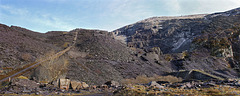
A multiplicity of abandoned inclines in this view of a small part of the Dinorwic slate quarry.

On the climb
| |
|
QJ 7137 heads west on level 3 of the climb above Reshui on the Jinpeng section of the Jitong Railway. The train has already traversed the second level seen below and behind.
Howard & Sons Ltd
Blackbrook
| |
|
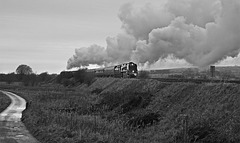
34028 with 44767 near Blackbrook Crossing during the 2010 reopening gala on the Caldon Low line.
Passing point
| |
|
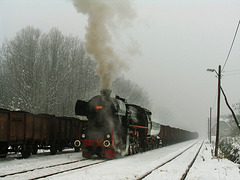
Kriegslok 33-503 stands at Ljubace with the coal empties to Banovici. The other line contains the just arrived fulls for Tuzla from the mine at Dubrave.
Footplate crew
| |
|
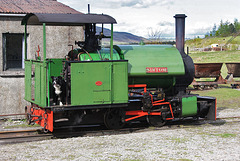
The driver waits on the footplate of Bagnall SIRTOM for his mate to arrive for a shift on the line at Threlkeld Quarry.
Burmantoft's best
| |
|
|
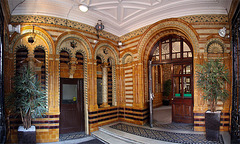
The Oxford Street / Whitworth Street corner block of the Refuge Building was built to the designs of Alfred Waterhouse in 1891-5. The exterior was Doulton terracotta, whilst the interior features extensive glazed terracotta and tiles from Burmantoft of Leeds. This is the vestibule of the corner entrance into what is now the Palace Hotel.
Righton Building
| |
|
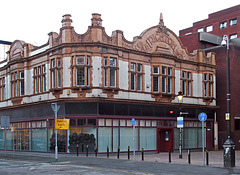
The Righton Building, which was originally a draper’s store was built in 1905 and now is used by the School of Arts at Manchester Metropolitan University. It is listed Grade II.
Sevendale House
| |
|
|
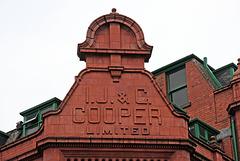
Sevendale House in central Manchester occupies a whole block defined by Dale Street, Lever Street, Stevenson Square and Spear Street. It was built as a warehouse for the drapery company of I J & G Cooper Ltd between 1903 and 1906 to the design of architect John Bowden and is listed grade II.
Walley, Silverdale
| |
|
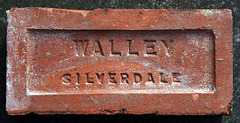
In 1921 Walley & Alsop purchased the brick and tile works formerly run by John Nash Peake in Cemetery Road, Silverdale which were known as Rosemary Hill Tileries. T E Walley took sole control in 1926 and by 1937 the works was run by T E Walley Ltd. G.H. Downing & Co. Ltd. bought the business in 1975 but this only lasted until 1981 when the works was sold to Steetley and then closed, with production transferred to Knutton.

Ironbridge Gorge Power Station
| |
|
|
The first power station on this site was Ironbridge A, built by the West Midlands Joint Electricity Authority and commissioned in 1932 with full 200 MW output achieved in 1939. Ironbridge B was commenced in 1963 and full 1000 MW capacity reached with the commissioning of the second 500 MW unit in February 1970. The A station was closed in 1981 and demolished in 1983. Currently operated by E.ON UK, Ironbridge has been opted out of the Large Combustion Plants Directive, which means the station will only be allowed to operate for up to 20,000 hours after 1 January 2008, and must close by 31 December 2015. It is served by a rail link that brings in up to seven coal trains a day.
Rochester cement works
| |
|
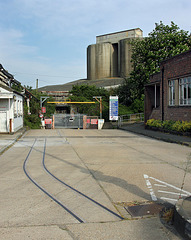
There are still reminders of the internal railway system at the site of the Rochester cement works that was operated by Rugby Group until 2000. The closure of this works brought an end to all cement production in the Thames and Medway area.
