tarboat's photos
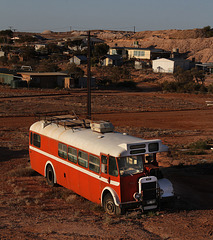
The Andamooka half-cab
| |
|
Another look at the Guy half-cab sitting in the late afternoon sunshine amidst the waste heaps of the Andamooka opal mines.
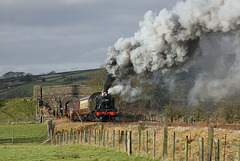
Threshing Barn crossing
| |
|
5199 starts from the compulsory stop at Threshing Barn crossing on the climb to Caldon Low.
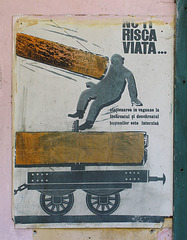
Beware of logs
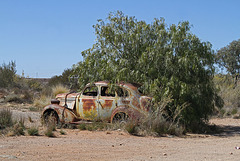
Parked in the bush
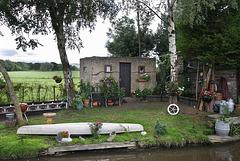
Pillbox - but not as we know it
| |
|
Type 24 pillbox alongside Bridge 13 at Middlecale on the Macclesfield Canal. This was one of the defensive structures along Stop Line No.6 which ran, mainly along canals from Tamworth to south-east Manchester. These days it performs peaceful duties as a garden shed/store for the adjacent moorings.
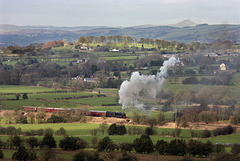
45379 approaching Apesford
| |
|
Black '5' 45379 has just shut off for the level crossing at Apesford as it heads an afternoon service towards Caldon Low. The bulk of Shutlingsloe stand proud on the horizon.
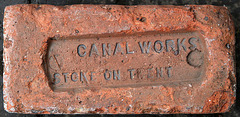
Canal Works, Stoke-on-Trent
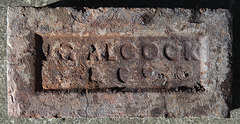
J G Alcock & Co, Fenton
| |
|
Joseph George Alcock appears in the 1871 census as a brick and tile manufacturer at the age of 23. By 1881 he was a tile manufacturer at Trentham and had moved to London by 1891. The trade directories show J & J Alcock trading at Sutherland Street in 1869-70, Alcock and Emery at New Basin, Fenton, in 1875, and Alcock and Forshaw at High Street, Fenton in 1879. From all this information I deduce that this brick is from the period before he went into partnership and made at a works in the Sutherland Street area.
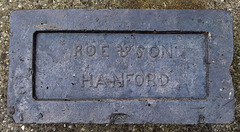
Roe & Son, Hanford
| |
|
Research has so far revealed almost nothing about Roe and Son. There are entries in the trade directories for 1875 and 1879 for Rowe and Son, Hanford.

E Glover, Hanford
| |
|
The Hanford brickworks of Sarah Glover operated from at least 1851 until 1871 and it appears from this brick that her daughter Emily Shelly Glover took over at some point after that date. Emily married William Adams Peake and by 1881 he was running the works in his name as the Hanford Tileries.
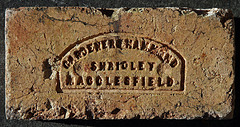
Gardiner & Hammond, Shrigley, Macclesfield
| |
|
You would have thought that the die maker would have spelt the name of one of the principals correctly, but in this case Gardiner has become Gardener. In 1870 William Hammond went into partnership with his brother-in-law Robert Gardiner to work fireclay in Pott Shrigley and they established their brickworks on the north side of the Bakestonedale road opposite that of George Lambert. 1875 saw Mr Lawrence Gardiner succeeded his brother in the business. He died in 1886 and Mr Hammond took over the works entirely, so this firebrick must date from 1870-1886.
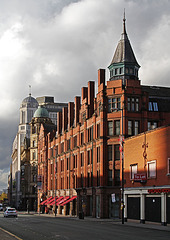
Three buildings with towers
| |
|
Peter Street, Manchester. The furthest two towers are on Quay Street beyond Deansgate.
Bukinje colliery
| |
|
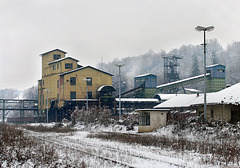
It is already five years since I visited Bosnia-Herzegovina and much has changed since then. Bukinje colliery used to send its coal to the nearby Tuzla power station, but this picturesque little pit has now closed.
Blaenavon Furnace No.4
| |
|
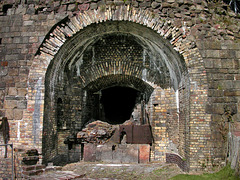
In 1788 three entrepreneurs from Stafforshire leased land around Blaenavon and established a major new ironworks using t he latest industrial methods. Initially there were three blast furnaces, all blown by steam power. It was immediately one of the largest ironworks in the world. The works continued to expand for the next seventy years, with the construction of two additional furnaces, and conversion to hot blast. Today the Blaenavon Ironworks is a world heritage site and the remains have seen considerable conservation work.

Sneyd Collieries Ltd, Burslem
| |
|
A brand new steam wagon for Sneyd Collieries Ltd, simmers outside the Foden works in Sandbach. The Cheshire registration indicates that the year is 1918.
Containers in the outback
| |
|
|
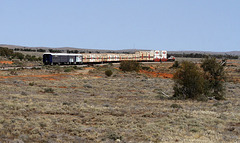
SCT010 at the head of containers moving west between Mingary and Olary NSW. The four ex Northern Rivers Railroad coaches at the rear were causing problems, presumably with wheelflats judging by the noise emanating from them. They were dropped into a siding at Olary and the train proceeded without them.
Pool with a view
| |
|
|
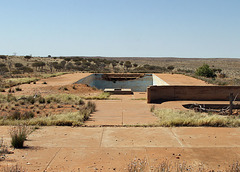
The Uranium Mine at Radium Hill operated from 1954-1961 and on closure the associated town was abandoned and largely demolished. One structure that does remain is the swimming pool on the hill close to the main water supply tank.