

tarboat's photos

GC&S
| |
|
Seen in a yard at Newent, Gloucestershire, I have not been able to identify the manufacturer, The obverse of the brick was stamped CLAYTON & Co PATENT which refers to the manufacturer of the brickmaking machine.
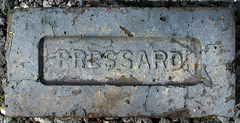
Pressard
| |
|
'Pressard' was a trade name used by the Aldridge Brick Tile & Coal Co. Ltd, Walsall.

Whitfield, Gloucester
| |
|
G. T. Whitfield opened his brickworks on Robins Wood Hill, Tuffley, Gloucester, in the early 1890s. It was closed by the 1950s.
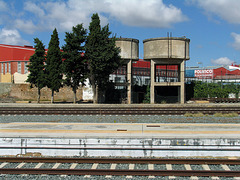
Ronda
| |
|
Steam age infrastructure at Ronda station. The remains of the turntable pit were still visible further up the yard too.
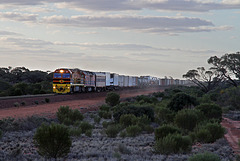
On the tracks of the Ghan
| |
|
GWU 003 and ALF 19 head south at Woocalla towards Port Augusta with single and double-stack containers. We had stopped by the line for a rest on our way to Woomera and had hoped for a train to appear. Needless to say it was only after we set off again that this one appeared in the opposite direction. A long chase followed until we were able to overhaul it and dash onto a small mound for a grab shot against the setting sun.
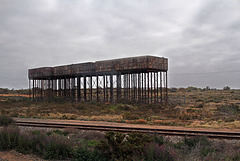
Menindee
| |
|
|
Disused railway water tanks stand forlorn at Menindee on the line between Sydney and nearby Broken Hill. They are all Braithwaite products.

Thompson Shaft
| |
|
|
The Thompson Shaft at British Mine, Broken Hill, was developed from 1910 as this area took over the main production. Winding from this shaft appears to have ended in 1958.
Chaganhada
| |
|
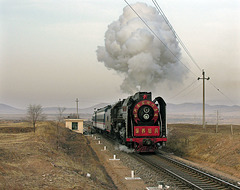
It is just before 6am as the eastbound passenger service leaves the wayside crossing station at Chaganhada on the Jitong Railway. The sun hasn't quite made an appearance and I was hoping the train would be a few minutes later, but it was not to be.
Phone bomber
| |
|
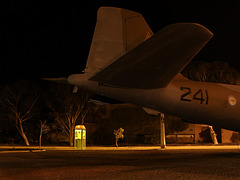
The centre of the town of Woomera features a large display of missiles, bombs and planes developed and used on the rocket testing range established from 1947. A night visit yielded a number of views including the public telephone box seen below the tail of a Canberra Bomber. Unless testing is taking place the population of the town is very small. This evening we didn't see a soul.

Big Mill
| |
|
Big Mill at Leek was part of the Wardle & Davenport Belle Vue Mills complex. It was built in 1857 and now stands empty.

North Mine, Broken Hill
| |
|
The No.3 shaft at North Mine in Broken Hill is the deepest in Australia at 1600 metres. It was commenced in 1948 and commissioned in 1962. Production here finally ended in the mid-1990s.
Narrow gauge to Iron Duke
| |
|
|
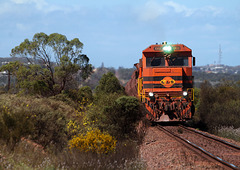
Iron Duke iron ore empties climbing hard out of Whyalla powered by DE 1302 and DA 902. Having seen this train at Whyalla waiting for a loaded train to clear the line, we headed off up the line and were enjoying a picnic when it finally appeared. It was not moving very fast!
Shadowy characters - Tarboat and the Rat
| |
|
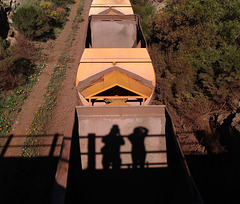
Two Flickrites capture an empty iron ore train heading away from the steel town of Whyalla towards the mine at Iron Duke in South Australia.
Poiana Novat
| |
|
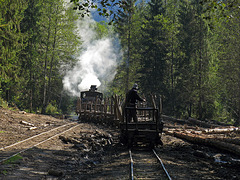
The brakeman is at his post as a train of logging bogies leaves the loop at Poiana Novat on the now defunct branch off the Wassertalbahn.
The Shakespeare
| |
|
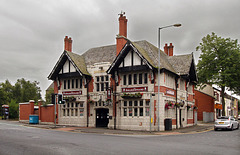
The Shakespeare on Glynne Street, Farnworth, was built in 1926 for Bolton brewer Magee Marshall. The frontage is largely buff terracotta faience. It is listed Grade II for both the exterior and also the remarkably original interior.
A good start
| |
|
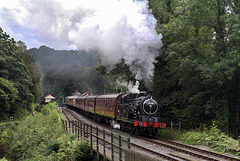
69621 makes a good start from the Consall stop with the second Caldon Low train of the day. I was, of course, able to wait to take this shot whilst enjoying an excellent pint in the garden of the Black Lion. :-)

Gadbury Fold Brickworks, Atherton
| |
|
Gadbury brickworks, on the south side of Wigan Road from Gibfield Colliery, was named after the old Gadbury Fold Farm nearby. It was established by Fletcher Burrows and Co, owners of Atherton Collieries around 1914. The works closed around 1964 shortly after the colliery finished working.

Gardiner & Hammond, Pott Shrigley, Nr Macclesfield
| |
|
In 1870 William Hammond went into partnership with his brother-in-law Robert Gardiner to work fireclay in Pott Shrigley and they established their brickworks on the north side of the Bakestonedale road opposite that of George Lambert. 1875 saw Mr Lawrence Gardiner succeeded his brother in the business. He died in 1886 and Mr Hammond took over the works entirely, so this glazed brick must date from 1870-1886.
