

Die Wiese lebt (6) - The meadow is living (6) - mi…
Die Wiese lebt (7) - The meadow is living (7)
Ein Zaun mit Kuscheltieren - A fence with cuddly t…
Einer unserer Schönsten - One of our most beautifu…
Hängepartie - Hanging out
Mir schmeckt's - I like it - PiP
Anemone hupehensis var. japonica
Twisted - Verdreht - mit PiP
Eine arge Kratzbürste ... A real scratching brush…
Der Zirkus ist da, Manege frei - The circus is her…
Aug in Aug - Face to face
Hochsommer - High summer
Hier kann man sich satt essen - Here you can eat y…
Neulich im Wald ... The other day in the forest ..…
Summer colours - Sommerfarben - mit PiP
Mausoleum im Schlosspark - Mausoleum in the castle…
Der Natur ganz nah - Very close to nature - HBM
Auch Wanzen können schön sein - Bugs can also be b…
Ein gigantischer Pilz - A gigantic mushroom
Eine unbekannte Mutation bei der Weißen Lichtnelke…
Seine Untertanen immer im Blick ... His subjects…
Ich sehe dich - I am watching you
Zeit der Bläulinge - Time of the blues
Am seidenen Faden - Hanging by a thread
Ein außergewöhnliches Jagdrevier - An exceptional…
Nachrichten aus dem Garten (2) - News from the gar…
Die Wiese lebt (5) - The meadow is living (5)
Froschkonzert - Frog concert
Nachrichten aus dem Garten (1) - News from the gar…
Die Wiese lebt (4) - The meadow is living (4) - mi…
Mitbringsel von einem Waldspaziergang - Souvenirs…
Monte papavero - Mohnberg
Schöner Blick auf Würzburg - Beautiful view of Wür…
Noch sind wir wenige ... Still we are few
Die Wiese lebt (3) - The meadow is living (3)
Sommerzeit im Garten - Summertime in the garden
Die Wiese lebt (2) - The meadow is living (2)
Die Wiese lebt (1) - The meadow is living (1)
Farbenexplosion - Explosion of colours
Bald bin ich erwachsen - Soon I will be an adult
Der Puppenspieler - The puppeteer
Ich sehe dich - I can see you
Ein geheimnisvoller Waldtümpel - A mysterious fore…
Der Mauerfuchs - Lasiommata megera - The Wall Brow…
Grenzüberschreitung - Crossing the border - HFF
See also...
Keywords
Authorizations, license
-
Visible by: Everyone -
All rights reserved
-
567 visits
Jetzt kommt die Zeit der Schwebfliegen - Now comes the time of the hoverflies
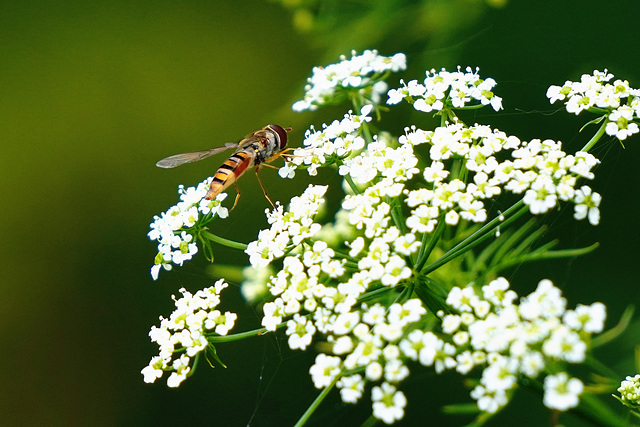

Im Bild eine Schwebfliege auf der Doldenblüte einer Kälberkropf-Pflanze (Chaerophyllum temulum). Der Schwirrflug dieser Insekten begeistert immer wieder. Die harmlosen Schwebfliegen werden von ängstlichen Menschen manchmal mit Wespen verwechselt, weil sie so ähnlich wie Wespen gefärbt sind. Jedoch ist die Färbungsnachahmung eine raffinierte Möglichkeit, mit einem giftigen, wehrhaften Insekt verwechselt und nicht angegriffen zu werden (Mimikry). Die Larven vieler Schwebfliegen sind Blattlausvertilger und somit für den Menschen nützlich, die Schwebfliege selbst ist als Blütenbestäuber bedeutsam.
Das Bild entstand an einem Waldrand mit starkem Kälberkropf-Bestand.
de.wikipedia.org/wiki/Schwebfliegen
The photo shows a hoverfly on the umbel flower of a rough chervil plant (Chaerophyllum temulum). The buzzing flight of these insects never ceases to amaze. The harmless hoverflies are sometimes mistaken for wasps by anxious people because they are coloured so similarly to wasps. However, the colouration imitation is a clever way of being mistaken for a poisonous, defensive insect and not being attacked (mimicry). The larvae of many hoverflies are aphid killers and thus useful to humans; the hoverfly itself is significant as a flower pollinator.
The photo was taken at the edge of a forest with a dense rough chervil plant population.
Translate into English
Das Bild entstand an einem Waldrand mit starkem Kälberkropf-Bestand.
de.wikipedia.org/wiki/Schwebfliegen
The photo shows a hoverfly on the umbel flower of a rough chervil plant (Chaerophyllum temulum). The buzzing flight of these insects never ceases to amaze. The harmless hoverflies are sometimes mistaken for wasps by anxious people because they are coloured so similarly to wasps. However, the colouration imitation is a clever way of being mistaken for a poisonous, defensive insect and not being attacked (mimicry). The larvae of many hoverflies are aphid killers and thus useful to humans; the hoverfly itself is significant as a flower pollinator.
The photo was taken at the edge of a forest with a dense rough chervil plant population.
Günter Klaus, Nouchetdu38, kiiti, Ulrich John and 37 other people have particularly liked this photo
- Keyboard shortcuts:
Jump to top
RSS feed- Latest comments - Subscribe to the comment feeds of this photo
- ipernity © 2007-2026
- Help & Contact
|
Club news
|
About ipernity
|
History |
ipernity Club & Prices |
Guide of good conduct
Donate | Group guidelines | Privacy policy | Terms of use | Statutes | In memoria -
Facebook
X

Admired in:
www.ipernity.com/group/tolerance
Wünsche noch einen schönen Abend,ganz liebe Grüße Güni :))
Sign-in to write a comment.