
Kleiner Feuerfalter (Lycaena phlaeas)
Sommerzeit im Garten - Summertime in the garden
Die Wiese lebt (3) - The meadow is living (3)
Noch sind wir wenige ... Still we are few
Monte papavero - Mohnberg
Mitbringsel von einem Waldspaziergang - Souvenirs…
Die Wiese lebt (4) - The meadow is living (4) - mi…
Nachrichten aus dem Garten (1) - News from the gar…
Froschkonzert - Frog concert
Ein außergewöhnliches Jagdrevier - An exceptional…
Die Wiese lebt (6) - The meadow is living (6) - mi…
Die Wiese lebt (7) - The meadow is living (7)
Einer unserer Schönsten - One of our most beautifu…
Mir schmeckt's - I like it - PiP
Anemone hupehensis var. japonica
Twisted - Verdreht - mit PiP
Eine arge Kratzbürste ... A real scratching brush…
Der Zirkus ist da, Manege frei - The circus is her…
Aug in Aug - Face to face
Hochsommer - High summer
Neulich im Wald ... The other day in the forest ..…
Summer colours - Sommerfarben - mit PiP
Auch Wanzen können schön sein - Bugs can also be b…
Farbenexplosion - Explosion of colours
Bald bin ich erwachsen - Soon I will be an adult
Ich sehe dich - I can see you
Grenzüberschreitung - Crossing the border - HFF
White Clematis
Eine einheimishe Orchidee: Orchis militaris - A na…
Komm und setz dich! Come and sit down!
Mein Lieblingsplatz am Main - My favorite place at…
Happy World Bee Day - Weltbienentag
Ein Bienenwolf - A very hairy beetle
Ausflugswetter - Weather for outings
Bestens getarnt ... Best camouflaged ...
Kleines Teufelsauge ... Summer pheasant's-eye ...
Weißdornblüten ganz nah - Hawthorn flowers very cl…
Pink
Blick in den Hofgarten - View into the court garde…
Bitte eintreten ... Please enter ... HFF!
Eine seltene Gartenpflanze in Europa - A rare gard…
Kostenlose Selbstbedienung - Free self-service
Zitronenfalter nascht an Löwenzahnblüten - A commo…
Die letzten Osterglocken - The last daffodils
Frühlingsstimmung - Spring mood

Location
Lat, Lng:
You can copy the above to your favourite mapping app.
Address: unknown
You can copy the above to your favourite mapping app.
Address: unknown
See also...
Keywords
Authorizations, license
-
Visible by: Everyone -
All rights reserved
-
1 004 visits
Die Wiese lebt (2) - The meadow is living (2)
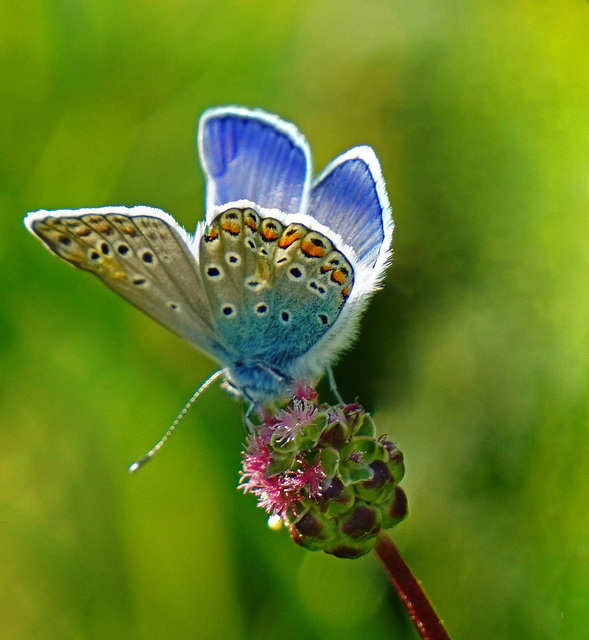

Ein Hauhechel-Bläuling (Polyommatus icarus) labt sich am Nektar eines Wiesenknopfes (Sanguisorba). Er ist einer der häufigsten mitteleuropäischen Bläulinge. Die Eiablage von Polyommatus icarus erfolgt an verschiedenen Klee- und Luzernearten. Die Aufnahme entstand in einer fränkischen Halbtrockenwiese. Die leichte Wellung an den Spitzen beider Vorderflügel dürfte auf Probleme beim Schlupf aus der Puppe zurückzuführen sein. Eine zusätzliche Information: Die Bestimmung der Bläulinge ist nicht einfach. Es werden einige Merkmale der Flügel-Oberseite, aber vor allem Merkmale der Flügel-Unterseite verwendet.
A common blue butterfly (Polyommatus icarus) feasts on the nectar of a burnet (Sanguisorba). It is one of the most common Central European blue butterflies. Polyommatus icarus lays its eggs on various species of clover and alfalfa. The photo was taken in a Franconian semi-arid meadow. The slight waviness at the tips of both forewings might be due to problems during hatching from the pupa. An additional information: The identification of the blue butterflies is not easy. Some features of the upper side of the wings are used, but mainly features of the lower side of the wings.
A common blue butterfly (Polyommatus icarus) feasts on the nectar of a burnet (Sanguisorba). It is one of the most common Central European blue butterflies. Polyommatus icarus lays its eggs on various species of clover and alfalfa. The photo was taken in a Franconian semi-arid meadow. The slight waviness at the tips of both forewings might be due to problems during hatching from the pupa. An additional information: The identification of the blue butterflies is not easy. Some features of the upper side of the wings are used, but mainly features of the lower side of the wings.
Günter Klaus, , Nouchetdu38, Taormina and 58 other people have particularly liked this photo
- Keyboard shortcuts:
Jump to top
RSS feed- Latest comments - Subscribe to the comment feeds of this photo
- ipernity © 2007-2026
- Help & Contact
|
Club news
|
About ipernity
|
History |
ipernity Club & Prices |
Guide of good conduct
Donate | Group guidelines | Privacy policy | Terms of use | Statutes | In memoria -
Facebook
X

Ich wünsche dir einen tollen Abend.
Happy happy new week.
Safe and healthy week ahead.
Admired in:
www.ipernity.com/group/tolerance
Wünsche noch einen schönen Abend,ganz liebe Grüße Güni :))
Sign-in to write a comment.