


Galicia / Spain

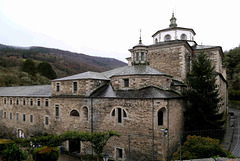
Samos - Monasterio de San Julián
| |
|
The foundation of the monastery is attributed to Martin of Braga. It is known to have been renovated by Saint Fructuoso in the seventh century. The first written mention of this event is from 665. An inscription on the walls says that the Bishop of Lugo Ermefredo rebuilt it. After this restoration it was abandoned before the Muslim invasion until the reconquest of King Fruela I of Asturias, which took place around 760. When, years later, he was assassinated, his widow and son, the future Alfonso II of Asturias ("the Chaste"), found refuge here. That earned the monastery royal protection, starting with the properties in a half-mile radius.
In the early tenth century, the bishop of Lugo attempted to seize control and expelled the monks. The Counts Arias Menéndez and Gutierre Menéndez,were required to repopulate the new monastery with monks. Thereafter there were good relations between the monastery and the Count's family.
In the same century it was reoccupied at the behest of King Ordoño II of León. From 960 the community lived under the rule of St. Benedict. The monastery of Samos enjoyed great importance during the Middle Ages. In 1558, already incorporated into the Royal San Benito of Valladolid, the monastery suffered a fire that forced its complete rebuilding.
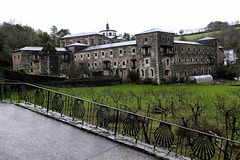
Samos - Monasterio de San Julián
| |
|
|
The foundation of the monastery is attributed to Martin of Braga. It is known to have been renovated by Saint Fructuoso in the seventh century. The first written mention of this event is from 665. An inscription on the walls says that the Bishop of Lugo Ermefredo rebuilt it. After this restoration it was abandoned before the Muslim invasion until the reconquest of King Fruela I of Asturias, which took place around 760. When, years later, he was assassinated, his widow and son, the future Alfonso II of Asturias ("the Chaste"), found refuge here. That earned the monastery royal protection, starting with the properties in a half-mile radius.
In the early tenth century, the bishop of Lugo attempted to seize control and expelled the monks. The Counts Arias Menéndez and Gutierre Menéndez,were required to repopulate the new monastery with monks. Thereafter there were good relations between the monastery and the Count's family.
In the same century it was reoccupied at the behest of King Ordoño II of León. From 960 the community lived under the rule of St. Benedict. The monastery of Samos enjoyed great importance during the Middle Ages. In 1558, already incorporated into the Royal San Benito of Valladolid, the monastery suffered a fire that forced its complete rebuilding.
In the 12th century, the monastery joined the Cluniac reform movement, which strongly promoted the pilgrimage to Santiago de Compostela. This can still seen on the fence today.
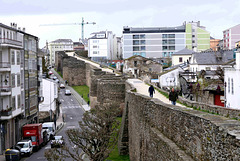
Lugo
| |
|
|
|
Lugo, today a city with a population of about 100.000, claims to be the oldest city in Galicia. Its founding dates back to the expansionist policies of the Romans during the time of Emperor Augustus. Among other things, this aimed to permanently pacify the northwest of the Iberian Peninsula. Paullus Fabius Maximus founded 14–13 BC. BC in the name of his emperor, the place Lucus Augusti on the site of a building dating back to around 25 BC. BC existing military camp.
It is the only city in the world surrounded by completely intact Roman walls. The wall is between six and eight meters thick, around twelve meters high at the highest point and has 85, mostly semicircular towers. In Roman times the wall had five gates and today it has ten.
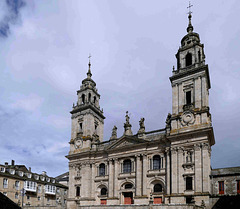
Lugo - Catedral de Santa María
| |
|
Lugo, today a city with a population of about 100.000, claims to be the oldest city in Galicia. Its founding dates back to the expansionist policies of the Romans during the time of Emperor Augustus. Among other things, this aimed to permanently pacify the northwest of the Iberian Peninsula. Paullus Fabius Maximus founded 14–13 BC. BC in the name of his emperor, the place Lucus Augusti on the site of a building dating back to around 25 BC. BC existing military camp.
It is the only city in the world surrounded by completely intact Roman walls. The wall is between six and eight meters thick, around twelve meters high at the highest point and has 85, mostly semicircular towers. In Roman times the wall had five gates and today it has ten.
A predecessor church existed on the site in 755. In 1129, Bishop Petro III commissioned the local architect Raimund to build a new church in the current Romanesque style, which was completed in 1273. Later renovations and restorations added elements in other styles.
The cathedral was built on the floor plan of a Latin cross with a length of 85 metres.
The façade is a Renaissance design, inspired by a design for Pamplona Cathedral. Construction was completed at the end of the 19th century with the completion of the two side towers.

Lugo - Catedral de Santa María
| |
|
|
Lugo, today a city with a population of about 100.000, claims to be the oldest city in Galicia. Its founding dates back to the expansionist policies of the Romans during the time of Emperor Augustus. Among other things, this aimed to permanently pacify the northwest of the Iberian Peninsula. Paullus Fabius Maximus founded 14–13 BC. BC in the name of his emperor, the place Lucus Augusti on the site of a building dating back to around 25 BC. BC existing military camp.
It is the only city in the world surrounded by completely intact Roman walls. The wall is between six and eight meters thick, around twelve meters high at the highest point and has 85, mostly semicircular towers. In Roman times the wall had five gates and today it has ten.
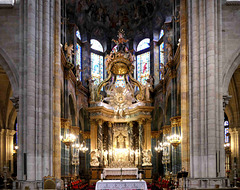
A predecessor church existed on the site in 755. In 1129, Bishop Petro III commissioned the local architect Raimund to build a new church in the current Romanesque style, which was completed in 1273. Later renovations and restorations added elements in other styles.
The cathedral was built on the floor plan of a Latin cross with a length of 85 metres.
Lugo - Catedral de Santa María
| |
|
|
Lugo, today a city with a population of about 100.000, claims to be the oldest city in Galicia. Its founding dates back to the expansionist policies of the Romans during the time of Emperor Augustus. Among other things, this aimed to permanently pacify the northwest of the Iberian Peninsula. Paullus Fabius Maximus founded 14–13 BC. BC in the name of his emperor, the place Lucus Augusti on the site of a building dating back to around 25 BC. BC existing military camp.
It is the only city in the world surrounded by completely intact Roman walls. The wall is between six and eight meters thick, around twelve meters high at the highest point and has 85, mostly semicircular towers. In Roman times the wall had five gates and today it has ten.
A predecessor church existed on the site in 755. In 1129, Bishop Petro III commissioned the local architect Raimund to build a new church in the current Romanesque style, which was completed in 1273. Later renovations and restorations added elements in other styles.
The cathedral was built on the floor plan of a Latin cross with a length of 85 metres.

Lugo - Catedral de Santa María
| |
|
Lugo, today a city with a population of about 100.000, claims to be the oldest city in Galicia. Its founding dates back to the expansionist policies of the Romans during the time of Emperor Augustus. Among other things, this aimed to permanently pacify the northwest of the Iberian Peninsula. Paullus Fabius Maximus founded 14–13 BC. BC in the name of his emperor, the place Lucus Augusti on the site of a building dating back to around 25 BC. BC existing military camp.
It is the only city in the world surrounded by completely intact Roman walls. The wall is between six and eight meters thick, around twelve meters high at the highest point and has 85, mostly semicircular towers. In Roman times the wall had five gates and today it has ten.
A predecessor church existed on the site in 755. In 1129, Bishop Petro III commissioned the local architect Raimund to build a new church in the current Romanesque style, which was completed in 1273. Later renovations and restorations added elements in other styles.
Detail of a side portal
Monterrei - Santa María de Mixós
| |
|
|
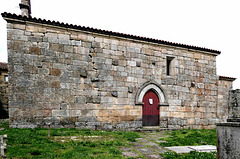
The small pre-Romanesque church of Santa María de Mixós was built on the remains of a 4th century monastery. When it was built in the early 10th century by Mozarabic masters, it had three naves, which were united into one during later restorations.
Unfortunately, the church was closed.
San Tomé de Morgade
| |
|
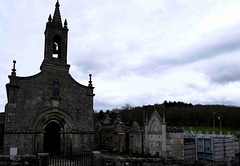
The church of San Tomé de Morgade is essentially Romanesque, but was later ‘renovated’ in Baroque style. It is surrounded by a cemetery.
San Tomé de Morgade
| |
|
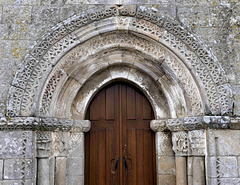
The church of San Tomé de Morgade is essentially Romanesque, but was later ‘renovated’ in Baroque style. It is surrounded by a cemetery.
The portal
Trandeiras - Mosteiro do Bon Xesús
| |
|
|
|
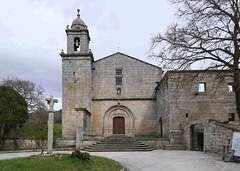
The monastery was founded in 1520 and was inhabited by Franciscans. It was destroyed in 1809 by the French, and with the exclaustration it was definitively abandoned. The church is still in good condition and is still used for worship, but the rest of the building is in a total state of abandonment.
The origins of th foundation are wrapped in the legend of the apparation of the Virgin
Pedra Alta de Antela
| |
|
|
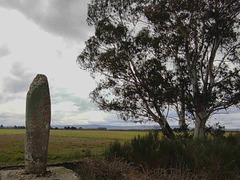
The menhir is about 3,50m high. For a while the standing stone was used as a marker stone at the limit between villages, then disused and forgotten. It was re-discovered in 1975 by a farmer when ploughing the field, and re-erected in 1986.
There is a cross engraved a cross.
Santuario de Nuestra Señora de los Milagros
| |
|
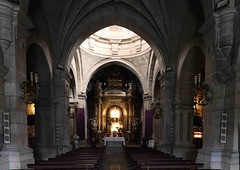
The legend tells, that at the end of the 9th century the Count of Caldelas went to the Virgin Mary, making a vow to build a hermitage there if he achieved victory in a battle. Having defeated his enemy, he fulfilled his vow and ordered the construction of the hermitage
Over time, the hermitage was abandoned and overgrown. Centuries later a young shepherdess was walking here. She found the image of the Virgin in the hollow of an oak tree. The shepherdess reported this to the vicar, to whom she indicated that the Virgin had expressed her wish that the hermitage be rebuilt. An attempt was made to move the image to the local church, but the image, carried on a litter, disappeared and shortly afterwards appeared in the same oak tree in which it had been discovered, so it was decided that the hermitage would be rebuilt here.
By 1731 the influx of devotees was so great that the previous sanctuary was insufficient. Thanks to the alms collected, the construction of a new temple was contemplated. In 1740 only the main chapel and the sacristies remained standing, although work continued thanks to new donations, completing the works in 1768.
Santuario de Nuestra Señora de los Milagros
| |
|
|
|
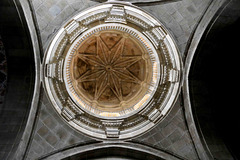
The legend tells, that at the end of the 9th century the Count of Caldelas went to the Virgin Mary, making a vow to build a hermitage there if he achieved victory in a battle. Having defeated his enemy, he fulfilled his vow and ordered the construction of the hermitage
Over time, the hermitage was abandoned and overgrown. Centuries later a young shepherdess was walking here. She found the image of the Virgin in the hollow of an oak tree. The shepherdess reported this to the vicar, to whom she indicated that the Virgin had expressed her wish that the hermitage be rebuilt. An attempt was made to move the image to the local church, but the image, carried on a litter, disappeared and shortly afterwards appeared in the same oak tree in which it had been discovered, so it was decided that the hermitage would be rebuilt here.
By 1731 the influx of devotees was so great that the previous sanctuary was insufficient. Thanks to the alms collected, the construction of a new temple was contemplated. In 1740 only the main chapel and the sacristies remained standing, although work continued thanks to new donations, completing the works in 1768.
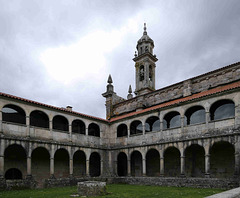
Santa María de Xunqueira de Espadañedo
| |
|
|
Santa María de Xunqueira de Espadañedo was founded in 1150 as an Augustinian convent and passed to the Cistercian Order in 1170. The nearby Montederramo monastery, which was a filiation of the primary abbey of Clairvaux, became the mother monastery.
In 1546 the monastery joined the Castilian Cistercian Congregation. The government's dissolution of the monastery in 1835 brought the end of the monastery.
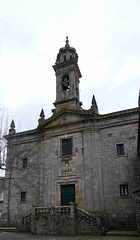
Santa María de Xunqueira de Espadañedo
| |
|
|
Santa María de Xunqueira de Espadañedo was founded in 1150 as an Augustinian convent and passed to the Cistercian Order in 1170. The nearby Montederramo monastery, which was a filiation of the primary abbey of Clairvaux, became the mother monastery.
In 1546 the monastery joined the Castilian Cistercian Congregation. The government's dissolution of the monastery in 1835 brought the end of the monastery.
The façade no longer has any medieval elements
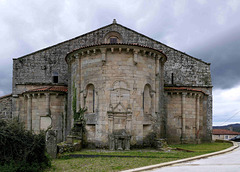
Santa María de Xunqueira de Espadañedo
| |
|
Santa María de Xunqueira de Espadañedo was founded in 1150 as an Augustinian convent and passed to the Cistercian Order in 1170. The nearby Montederramo monastery, which was a filiation of the primary abbey of Clairvaux, became the mother monastery.
In 1546 the monastery joined the Castilian Cistercian Congregation. The government's dissolution of the monastery in 1835 brought the end of the monastery.
The Romanesque church has three naves and three semicircular apses.
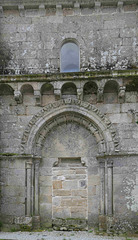
Santa María de Xunqueira de Espadañedo
| |
|
|
|
Santa María de Xunqueira de Espadañedo was founded in 1150 as an Augustinian convent and passed to the Cistercian Order in 1170. The nearby Montederramo monastery, which was a filiation of the primary abbey of Clairvaux, became the mother monastery.
In 1546 the monastery joined the Castilian Cistercian Congregation. The government's dissolution of the monastery in 1835 brought the end of the monastery.
The Romanesque church has three naves and three semicircular apses.
A walled up side portal
Jump to top
RSS feed- Latest items - Subscribe to the latest items added to this album
- ipernity © 2007-2026
- Help & Contact
|
Club news
|
About ipernity
|
History |
ipernity Club & Prices |
Guide of good conduct
Donate | Group guidelines | Privacy policy | Terms of use | Statutes | In memoria -
Facebook
X
