


Galicia / Spain


Ourense - Catedral de Ourense
| |
|
|
The Romans were already here and utilised the hot springs. They built a bridge over the river, the Ponte romana, creating an important communication route, which was of course secured by fortifications.
In the 5th century, Ourense became the seat of a bishopric. As the capital of the kingdom of the Suebi, Ourense flourished in the 5th and 6th centuries. The Suebi king Teodomiro († 570) built the first cathedral in Ourense after converting from Arianism to Catholicism.
Constant raids by the Moorish conquerors and the Normans devastated the city to such an extent that it remained almost uninhabited for several centuries. It was rebuilt in 1071 under King Sancho II of Castile. In the following centuries, the city gained importance as a bishop's see, but also as a trading centre. In the 13th century, Ourense was an important trading centre in Galicia due to its geographical location and its large Jewish community. The economic decline began after the expulsion of Ourense's Jews in 1492 by the Catholic Monarchs. In the centuries that followed, Ourense's importance steadily declined.
The earliest cathedral appears to have been a church dedicated to Santa María la Madre. In 550, the Suevian king Chararic built a second church here dedicated to St Martin of Tour. The cathedral was however repeatedly destroyed over the centuries by the Moors and the Northmen who invaded the city. Today's building was constructed as a Romanesque church in the 12th and 13th centuries. Gothic additions followed until the early 16th century. The consecration of the high altar was already in 1188.
It looks as if people are living in the walls of the cathedral.
Ourense - Catedral de Ourense
| |
|
|
The Romans were already here and utilised the hot springs. They built a bridge over the river, the Ponte romana, creating an important communication route, which was of course secured by fortifications.
In the 5th century, Ourense became the seat of a bishopric. As the capital of the kingdom of the Suebi, Ourense flourished in the 5th and 6th centuries. The Suebi king Teodomiro († 570) built the first cathedral in Ourense after converting from Arianism to Catholicism.
Constant raids by the Moorish conquerors and the Normans devastated the city to such an extent that it remained almost uninhabited for several centuries. It was rebuilt in 1071 under King Sancho II of Castile. In the following centuries, the city gained importance as a bishop's see, but also as a trading centre. In the 13th century, Ourense was an important trading centre in Galicia due to its geographical location and its large Jewish community. The economic decline began after the expulsion of Ourense's Jews in 1492 by the Catholic Monarchs. In the centuries that followed, Ourense's importance steadily declined.
The earliest cathedral appears to have been a church dedicated to Santa María la Madre. In 550, the Suevian king Chararic built a second church here dedicated to St Martin of Tour. The cathedral was however repeatedly destroyed over the centuries by the Moors and the Northmen who invaded the city. Today's building was constructed as a Romanesque church in the 12th and 13th centuries. Gothic additions followed until the early 16th century. The consecration of the high altar was already in 1188.
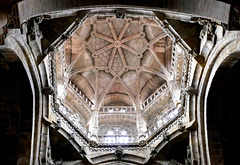
The gothic vaults of the crossing
Ourense - Catedral de Ourense
| |
|
|
The Romans were already here and utilised the hot springs. They built a bridge over the river, the Ponte romana, creating an important communication route, which was of course secured by fortifications.
In the 5th century, Ourense became the seat of a bishopric. As the capital of the kingdom of the Suebi, Ourense flourished in the 5th and 6th centuries. The Suebi king Teodomiro († 570) built the first cathedral in Ourense after converting from Arianism to Catholicism.
Constant raids by the Moorish conquerors and the Normans devastated the city to such an extent that it remained almost uninhabited for several centuries. It was rebuilt in 1071 under King Sancho II of Castile. In the following centuries, the city gained importance as a bishop's see, but also as a trading centre. In the 13th century, Ourense was an important trading centre in Galicia due to its geographical location and its large Jewish community. The economic decline began after the expulsion of Ourense's Jews in 1492 by the Catholic Monarchs. In the centuries that followed, Ourense's importance steadily declined.
The earliest cathedral appears to have been a church dedicated to Santa María la Madre. In 550, the Suevian king Chararic built a second church here dedicated to St Martin of Tour. The cathedral was however repeatedly destroyed over the centuries by the Moors and the Northmen who invaded the city. Today's building was constructed as a Romanesque church in the 12th and 13th centuries. Gothic additions followed until the early 16th century. The consecration of the high altar was already in 1188.
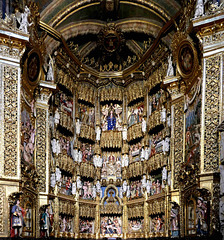
The main altar
Ourense - Catedral de Ourense
| |
|
|
|
The Romans were already here and utilised the hot springs. They built a bridge over the river, the Ponte romana, creating an important communication route, which was of course secured by fortifications.
In the 5th century, Ourense became the seat of a bishopric. As the capital of the kingdom of the Suebi, Ourense flourished in the 5th and 6th centuries. The Suebi king Teodomiro († 570) built the first cathedral in Ourense after converting from Arianism to Catholicism.
Constant raids by the Moorish conquerors and the Normans devastated the city to such an extent that it remained almost uninhabited for several centuries. It was rebuilt in 1071 under King Sancho II of Castile. In the following centuries, the city gained importance as a bishop's see, but also as a trading centre. In the 13th century, Ourense was an important trading centre in Galicia due to its geographical location and its large Jewish community. The economic decline began after the expulsion of Ourense's Jews in 1492 by the Catholic Monarchs. In the centuries that followed, Ourense's importance steadily declined.
The earliest cathedral appears to have been a church dedicated to Santa María la Madre. In 550, the Suevian king Chararic built a second church here dedicated to St Martin of Tour. The cathedral was however repeatedly destroyed over the centuries by the Moors and the Northmen who invaded the city. Today's building was constructed as a Romanesque church in the 12th and 13th centuries. Gothic additions followed until the early 16th century. The consecration of the high altar was already in 1188.
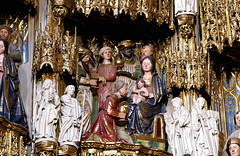
One of the many scenes of the main altar - The Adoration of the Magi
Ourense - Museo Catedralicio
| |
|
|
The Romans were already here and utilised the hot springs. They built a bridge over the river, the Ponte romana, creating an important communication route, which was of course secured by fortifications.
In the 5th century, Ourense became the seat of a bishopric. As the capital of the kingdom of the Suebi, Ourense flourished in the 5th and 6th centuries. The Suebi king Teodomiro († 570) built the first cathedral in Ourense after converting from Arianism to Catholicism.
Constant raids by the Moorish conquerors and the Normans devastated the city to such an extent that it remained almost uninhabited for several centuries. It was rebuilt in 1071 under King Sancho II of Castile. In the following centuries, the city gained importance as a bishop's see, but also as a trading centre. In the 13th century, Ourense was an important trading centre in Galicia due to its geographical location and its large Jewish community. The economic decline began after the expulsion of Ourense's Jews in 1492 by the Catholic Monarchs. In the centuries that followed, Ourense's importance steadily declined.
The earliest cathedral appears to have been a church dedicated to Santa María la Madre. In 550, the Suevian king Chararic built a second church here dedicated to St Martin of Tour. The cathedral was however repeatedly destroyed over the centuries by the Moors and the Northmen who invaded the city. Today's building was constructed as a Romanesque church in the 12th and 13th centuries. Gothic additions followed until the early 16th century. The consecration of the high altar was already in 1188.
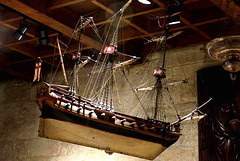
The museum is connected to the cathedral.
A church ship
Ourense - Museo Catedralicio
| |
|
|
The Romans were already here and utilised the hot springs. They built a bridge over the river, the Ponte romana, creating an important communication route, which was of course secured by fortifications.
In the 5th century, Ourense became the seat of a bishopric. As the capital of the kingdom of the Suebi, Ourense flourished in the 5th and 6th centuries. The Suebi king Teodomiro († 570) built the first cathedral in Ourense after converting from Arianism to Catholicism.
Constant raids by the Moorish conquerors and the Normans devastated the city to such an extent that it remained almost uninhabited for several centuries. It was rebuilt in 1071 under King Sancho II of Castile. In the following centuries, the city gained importance as a bishop's see, but also as a trading centre. In the 13th century, Ourense was an important trading centre in Galicia due to its geographical location and its large Jewish community. The economic decline began after the expulsion of Ourense's Jews in 1492 by the Catholic Monarchs. In the centuries that followed, Ourense's importance steadily declined.
The earliest cathedral appears to have been a church dedicated to Santa María la Madre. In 550, the Suevian king Chararic built a second church here dedicated to St Martin of Tour. The cathedral was however repeatedly destroyed over the centuries by the Moors and the Northmen who invaded the city. Today's building was constructed as a Romanesque church in the 12th and 13th centuries. Gothic additions followed until the early 16th century. The consecration of the high altar was already in 1188.
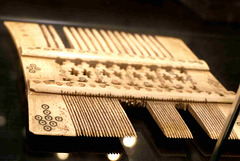
The museum is connected to the cathedral.
A ritual comb, ivory, 1200
Correct, good thoughts could only arise in a well-combed head.
Tui
| |
|
|
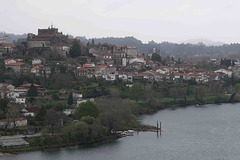
The Minho River froms the border Between Portugal and Spain. So here is spanish Tui seen from Portugese Valença.
Tui had a bishop's see as early as 5th century and developed well. Within the 10th/11th century it was raided by Vikings and Maurs, so the "Catedral de Santa Maria" in Tui seems to be a fortresse.
Poio - San Xoán de Poio
| |
|
|
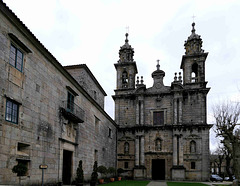
Tradition holds that the monastery was founded by Fructuoso of Braga and his disciples in the 7th century, and three centuries later, in the reign of Bermudo III of León it was rebuilt in another place, but close to the first base. The oldest document is from 942.
In 1581, work on the current church and the cloister began, taking place between 1600 and 1612.
In 1613 the College of Interns of San Juan de Poio began to operate and would not abandon its task until the secularization decree of 1834. After its abandonment by the Benedictines with the seizure in 1890 it was occupied by the Mercedarians, who still continue in the present.
Meis - Mosteiro de Santa María da Armenteira
| |
|
|
The Armenteira monastery was founded in 1149 by the noble Don Ero and joined the Cistercian order in 1162. It belonged to the filiation of the primary abbey of Clairvaux. The monastery received donations from Alfonso VI and Ferdinand II.
The abolition of the monastery in 1837 brought an end to the monastery, which fell into disrepair until a society of friends of the monastery was formed in 1963. In 1989, a community of Trappist nuns moved into the monastery.
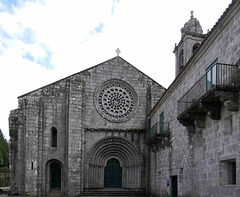
The church, begun around 1167, was completed in 1225. The nave in the shape of a Latin cross has three aisles.
The crossing is surmounted by a low crossing tower.
Meis - Mosteiro de Santa María da Armenteira
| |
|
|
The Armenteira monastery was founded in 1149 by the noble Don Ero and joined the Cistercian order in 1162. It belonged to the filiation of the primary abbey of Clairvaux. The monastery received donations from Alfonso VI and Ferdinand II.
The abolition of the monastery in 1837 brought an end to the monastery, which fell into disrepair until a society of friends of the monastery was formed in 1963. In 1989, a community of Trappist nuns moved into the monastery.
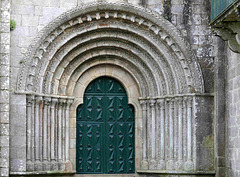
The church, begun around 1167, was completed in 1225. The nave in the shape of a Latin cross has three aisles.
The portal
Meis - Mosteiro de Santa María da Armenteira
| |
|
|
The Armenteira monastery was founded in 1149 by the noble Don Ero and joined the Cistercian order in 1162. It belonged to the filiation of the primary abbey of Clairvaux. The monastery received donations from Alfonso VI and Ferdinand II.
The abolition of the monastery in 1837 brought an end to the monastery, which fell into disrepair until a society of friends of the monastery was formed in 1963. In 1989, a community of Trappist nuns moved into the monastery.
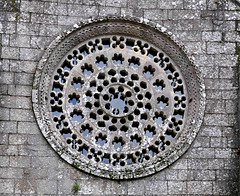
The church, begun around 1167, was completed in 1225. The nave in the shape of a Latin cross has three aisles.
The rose window
Meis - Mosteiro de Santa María da Armenteira
| |
|
|
|
The Armenteira monastery was founded in 1149 by the noble Don Ero and joined the Cistercian order in 1162. It belonged to the filiation of the primary abbey of Clairvaux. The monastery received donations from Alfonso VI and Ferdinand II.
The abolition of the monastery in 1837 brought an end to the monastery, which fell into disrepair until a society of friends of the monastery was formed in 1963. In 1989, a community of Trappist nuns moved into the monastery.
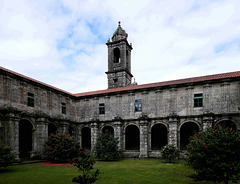
The church, begun around 1167, was completed in 1225. The nave in the shape of a Latin cross has three aisles.
The cloister
Santiago de Compstela - Cathedral
| |
|
|
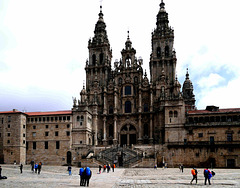
According to legend, the mortal remains of the apostle St James were taken to Galicia for burial, where they were lost. Eight hundred years later, a light led a shepherd, Pelagius the Hermit, who was guarding his flock at night, to the burial site. The shepherd reported his discovery to the bishop of Iria. The bishop declared that the remains were those of St James the Apostle and immediately informed King Alfonso II in Oviedo. In honour of Saint James, the cathedral was built on the spot where his remains were said to have been found. The legend, which includes numerous miraculous events, enabled the Catholic faithful to strengthen their stronghold in northern Spain during the Reconquista against the Moors, but also led to the growth and development of the city.
This is the end if the Camino de Santiago. I arrived the first time in Santiago in 2010 and, like everyone who makes the journey on foot, was overwhelmed. Much has changed since then. Most of all, the deployment of a very unfriendly security force that leaves neither tourists nor pilgrims in peace - in a place where everyone should find peace.
Santiago de Compstela - Cathedral
| |
|
|
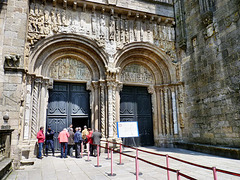
The contruction of the Cathedral began in 1075 and the "Puerta de las Platerías", what is the southern portal, contains the oldest remaining remaining romanesque parts, carved between 1112 and 1117. It is older than the "Pórtico de la Gloria". The two arched portal shows different scenes in quite different styles. It seems a bit like a collage. At the moment, this is the only entrance to the cathedral.
Santiago de Compostela - Cathedral
| |
|
|
|
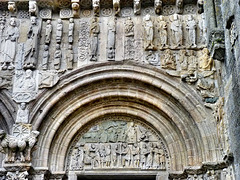
"Puerta de las Platerías", - the right side. The tympanum shows (center) the flagellation of Christ, left the crowning with the Crown of Thorns, and the healing of the blind on the right.
Santiago de Compstela - Cathedral
| |
|
|
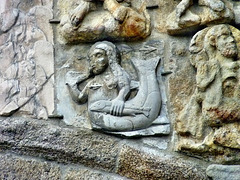
"Puerta de las Platerías" - A detail from the right side of th portal is this mermaid. Hit through the chest by an arrow. A second arrow missed her head and tail. I´m pretty sure, that the arrow comes from the centaur on the left side of the Puerta,
Santiago de Compostela - Museo da Catedral
| |
|
|
According to legend, the mortal remains of the apostle St James were taken to Galicia for burial, where they were lost. Eight hundred years later, a light led a shepherd, Pelagius the Hermit, who was guarding his flock at night, to the burial site. The shepherd reported his discovery to the bishop of Iria. The bishop declared that the remains were those of St James the Apostle and immediately informed King Alfonso II in Oviedo. In honour of Saint James, the cathedral was built on the spot where his remains were said to have been found. The legend, which includes numerous miraculous events, enabled the Catholic faithful to strengthen their stronghold in northern Spain during the Reconquista against the Moors, but also led to the growth and development of the city.
This is the end if the Camino de Santiago. I arrived the first time in Santiago in 2010 and, like everyone who makes the journey on foot, was overwhelmed. Much has changed since then. Most of all, the deployment of a very unfriendly security force that leaves neither tourists nor pilgrims in peace - in a place where everyone should find peace.
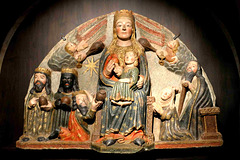
The Museo da Catedral has an extraordinary collection
The Adorating Magi, early 14th century
Santiago de Compostela - Cathedral
| |
|
|
According to legend, the mortal remains of the apostle St James were taken to Galicia for burial, where they were lost. Eight hundred years later, a light led a shepherd, Pelagius the Hermit, who was guarding his flock at night, to the burial site. The shepherd reported his discovery to the bishop of Iria. The bishop declared that the remains were those of St James the Apostle and immediately informed King Alfonso II in Oviedo. In honour of Saint James, the cathedral was built on the spot where his remains were said to have been found. The legend, which includes numerous miraculous events, enabled the Catholic faithful to strengthen their stronghold in northern Spain during the Reconquista against the Moors, but also led to the growth and development of the city.
This is the end if the Camino de Santiago. I arrived the first time in Santiago in 2010 and, like everyone who makes the journey on foot, was overwhelmed. Much has changed since then. Most of all, the deployment of a very unfriendly security force that leaves neither tourists nor pilgrims in peace - in a place where everyone should find peace.
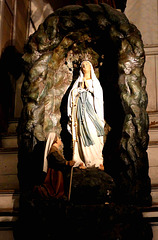
A Lourdes Grotto
Jump to top
RSS feed- Latest items - Subscribe to the latest items added to this album
- ipernity © 2007-2026
- Help & Contact
|
Club news
|
About ipernity
|
History |
ipernity Club & Prices |
Guide of good conduct
Donate | Group guidelines | Privacy policy | Terms of use | Statutes | In memoria -
Facebook
X
