

Roger (Grisly)'s photos


Across the Little Minch
Very strong evening Sun on the coast at Totscore which is a small crofting hamlet/village on the Trotternish peninsula of the Isle of Skye, in the Scottish Highlands. The Little Minch: lying between the Isle of Skye (Inner Hebrides) and the central/southern Outer Hebrides (e.g., North Uist, Benbecula, Harris). This is the stretch visible in the distance from Totscore and northern Skye. these islands are just visible on the horizon!
As a part of the Inner Seas off the West Coast of Scotland this stretch of water is known for its deep waters with strong currents, often with turbulent conditions,plus dramatic scenery, and rich marine environment.
HFF and a good weekend, Shot in 16.9 therefore a large view may be beneficial!
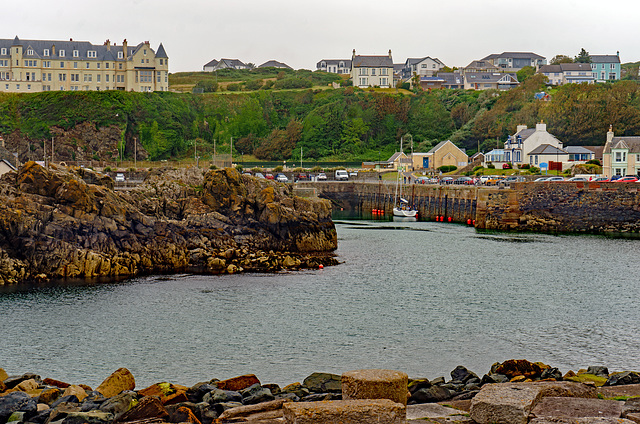
Hazy Day
Portpatrick is a picturesque seaside village and civil parish on the west coast of the Rhins of Galloway peninsula in Dumfries and Galloway, southwest Scotland.
It sits on a stunning bay with colorful pastel houses, a small harbor, and dramatic coastal cliffs overlooking the Irish Sea.
Historically, it was a key ferry port due to its proximity to Northern Ireland (about 21 miles / 34 km to Donaghadee), serving as the shortest sea route
This shows the harbour entrance from the lighthouse on a murky May afternoon.,,,,,,, HWW to all.
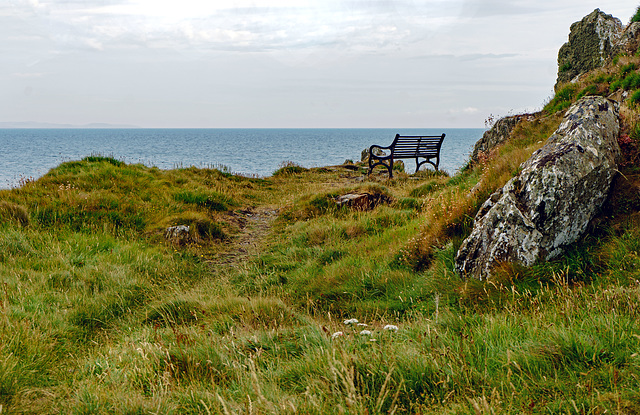
On The Edge
Great Sea Views across the Solway Firth from this bench but perhaps not suitable for anyone with a fear of heights, Isle of Whithorn, Wigtownshire, Dumfriese and Galloway,
HBM and a good new week! Better on a large view perhaps!

Flag End!
The flag has not fared well and appears to have faced many a stiff breeze, the dog appears more interested in the out of shot food van, while his owners enjoy an ice cream and take in the view!,
Captured on a warm early April day on the Somerset Coast at Watchet,
The sign writing on the far quay is a quote from
The Rime of the Ancient Mariner by Samuel Taylor Coleridge which was written here! and first published in 1798.
HFF and a good weekend!,,,,, Better large perhaps !

Cloud Cover!
Mountain Cloud, Glencoe!

2900–2600 BC
Unable to upload a HWW image,IP not playing!
This is the Calanais Standing Stones on the Isle of Lewis in the Outer Hebrides and the most famous of several related stone settings in the Calanais area (including Calanais II, III, and others), forming part of a broader prehistoric ritual landscape. Often called the "Stonehenge of the North," the site features a distinctive cross-shaped arrangement of standing stones made from ancient Lewisian gneiss (some of the oldest exposed rocks on Earth). The main monument (Calanais I) includes:A central stone circle with 13 stones surrounding a tall central monolith (about 4.8–5 meters high).
An avenue of stones extending northward (roughly 83 meters long, formed by two parallel-ish rows that fan out slightly).
Rows of stones extending east, west, and south from the circle, creating the cruciform (cross-like) pattern
The stones were erected around 2900–2600 BC during the Neolithic period—predating the main phases of Stonehenge by several centuries (roughly 500 years earlier than its famous sarsen circle).
The central stone circle is shown in the image,,,,,,,,,,,,,,, It really does need a large view for the full effect !

Main Street!
Parish of Glasserton and Isle of Whithorn Church, Main Street, Isle of Whithorn. Newton Stewart,
Associated with St. Ninian (one of the earliest Christian missionaries in Scotland), who is traditionally said to have landed nearby around 380–431 AD.
Home to the ruined 13th-century St. Ninian's Chapel (linked to Whithorn Priory), which served as a key stopping point for medieval pilgrims arriving by sea and heading to Whithorn.
Evidence of earlier habitation includes ancient clearance cairns, cultivation furrows, and building remains near the chapel.
For much of its history, it acted as the port for the inland town of Whithorn, supporting trade and pilgrimage. Today, it is a quiet, scenic village with a strong sense of history, popular for walking, coastal views, and as a base for exploring the Machars.,,,,,,,,,,,,,, HBM!

From the Pass
Shores of Loch Achray,from Dukes Pass
Woodland tracks and forest roads on the south side are great for walking/hiking. There are trails nearby with views of the loch.
Duke's Pass is a famous scenic road in the Trossachs area of the Scottish Highlands. It is One of Scotland’s best driving and motorcycling roads — often featured in “greatest drives” lists and videos,
HFF and a good weekend,

From Wall to the Sea.
A fishing boat waits for recovery by tractor and trailer during low tide at Port Logan, in the Rhins of Galloway! Scotland.
It is on the western side of the Rhins peninsula, about 12 miles (19 km) south of Stranraer and 7 miles (11 km) north of the Mull of Galloway.
HWW!
