

Roger (Grisly)'s photos


A Flat Misty Morn!
Flat but very bright light at Applecross which is a peninsula in Wester Ross, in the Scottish Highlands. It is bounded by Loch Kishorn to the south, Loch Torridon to the north, and Glen Shieldaig to the east. On its western side is Applecross Bay and the Inner Sound.this is reached by
The Bealach na Bà: A historic mountain road featuring steep 20% gradients and tight hairpin bends that rise higher than any other road in the UK, offering panoramic views toward the Isle of Skye.
Founded in the 7th century by Saint Máel Ruba, it was an early Christian sanctuary historically known as A' Chomraich, It is now an essential part of the North Coast 500 Road trip!
HBM and a good week! and a large view if possible!

High Level
The smallest fence of the week protects visitors who climb to the top of the
National Trust for Scotland's.'Glenfinnan Monument"
In 1815, the 18m-high monument was built as a poignant reminder of the clansmen who gave their lives to the Jacobite cause, It stands on the shores of Loch Shiel which is the 4th longest freshwater loch in scotland,
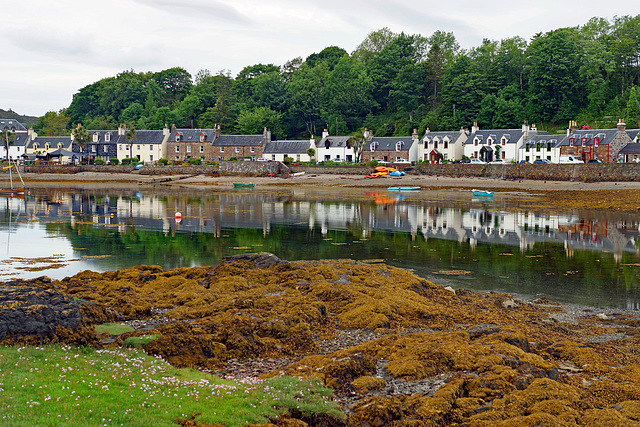
Walls & Reflections
Another image from the beautiful village of Plockton, Loch Carron (sea Loch)
Plockton is a village in the Lochalsh, Wester Ross area of the Scottish Highlands with a 2020 population of 468. Plockton settlement is on the shores of Loch Carron.
Hamish Macbeth (1995–1997): This popular BBC television series starring Robert Carlyle was primarily filmed in Plockton, which stood in for the fictional coastal village of Lochdubh.
The Wicker Man (1973): The classic cult horror film used Plockton for several key scenes on the fictional island of Summerisle, including the harbor and seafront where Sergeant Howie (Edward Woodward) arrives by seaplane.,
The Inspector Alleyn Mysteries: Scenes for this television detective series were also shot on location in the village,
Although not on the main route Plockton is roughly a 22-mile round-trip detour from the official NC500 path near Wester Ross and Loch Carron.
HWW and a large view recommended

Village Life
Lochcarron is a scenic, linear village stretching nearly two miles along the northern shore of a sea loch in Wester Ross, Scottish Highlands,
Lochcarron is widely reputed to be the longest village in Scotland. ! and is home to a little over 900 people.
The scenic 516-mile North Coast 500 road trip comes inland on the west coast between Inverness and Lochcarron. It serves as a key stop or gateway just before or after tackling the famous Bealach na Bà mountain pass toward Applecross.
HBM and a large view perhaps!

Pipers Pose
This elderly piper played the Bag pipes and sold a few Cds from a suitcase in a car parking area above Loch Gary, Invernesshire.
Very smartly turned out although his breath was failing he managed the occasional tune very well,
He was happy to chat and pose for photographs with the collecting point close by. It was a pleasant and enlightening experience! I love talking to people like this!

Hard to Port
Trawler Adaptable, Registered in North Shields heading to sea from the harbour at Mallaig, Lochaber
Mallaig is a port in Morar, on the west coast of the Highlands of Scotland. It faces Skye from across the Sound of Sleat. The local railway station is the terminus of the West Highland Line, and the town is linked to Fort William by the A830 road – the "Road to the Isles"

Wet Wall
Ex Slate Jetty at Ellenbeich Isle of Seil Scotland,
The island of Easedale including ferry slipway as a backdrop, Easdale Island is a tiny, car-free island in the Firth of Lorn, Scotland, measuring just 62 acres with a population of around 60 residents.
If ever you manage a visit to the island see The Puffer Bar & Restaurant:
HWW!

Clachaig Inn
A slightly misty autumnal view of Signal Rock as a backdrop to the Clachaig inn, a warm and welcoming pub especially on a cold Glen Coe day in an image from 2013, deserted benches and HBM!
When my editing software failed I took the opportunity to reload and re-edit all of my images so older stuff like this will appear from time to time, But I am actually enjoying the process!
Very few walks are as emotive as the short loop visiting Signal Rock in Glen Coe. This gnarled boulder is now surrounded by forest but is said to have been the place (though there is some doubt) where government forces commanded by Robert Campbell of Glenlyon gave the order to attack the local MacDonald clan. Contrast this sobering event with the feeling of elation when the wonderful sight of the Clachaig Gully and the end of the Aonach Eagach ridge is revealed from An Torr. The circuit is a quick one – rare for this fine glen, where many of the best spots involve more serious hikes – but conceals a handful of surprisingly steep sections; refuelling may therefore be required at the famous climbers’ haunt of the Clachaig Inn near the finish.

Look out a Shooter!
Oh dear the fence just about sneaks in at the bottom of the image,
And the location may not be accurate GPS failed at this point.
This is from the Isle of Lewis one of the islands that form Scotland's Outer Hebrides, sometimes also called the Western Isles,
HFF and a good weekend to all,,,,,,,,,,,,Large view recommended,
