

Roger (Grisly)'s photos

Whispering breeze !
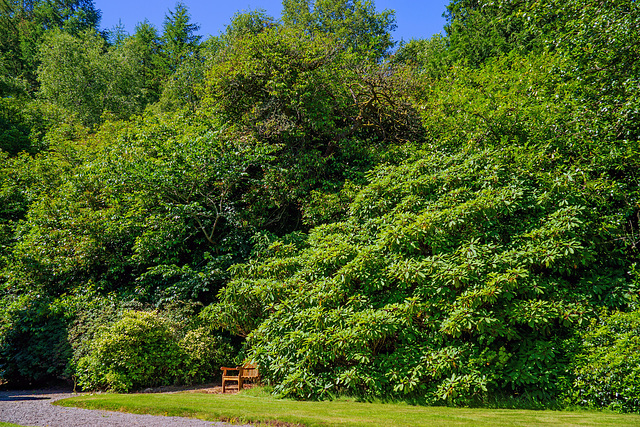
A quiet corner for peace, contemplation or memories, with only the whispering of a gentle breeze through the leaves to disturb the silence, this is in the grounds of the church of Scotland’s Southwick Parish Church, Dumfries and Galloway!
A previously posted image of the church, can be found here. Country Church,
A real standard with a Celtic twist www.youtube.com/watch?v=o3ZDJMvLYvQ&list=RDo3ZDJMvLYvQ&start_radio=1
HBM and a good week ahead!

Gentle Sea.
Gentle waves reach the shore and provide a relaxing coastal view of the Sound of Jura, from Port nan Clachan, Kintyre,
Cool water for a hot day!
In 16.9 format therefore a large view should be better,

You can't park there
The Passenger Ferry from Easedale Island arrives at Ellenabeich, Isle of Seil, only to find a local fisherman in its landing spot, A few well chosen Scottish words would have quickly resolved the situation no doubt, This is the only ferry across to the island, and carries building materials and anything else needed, all without any protection from the Scottish West Coast Weather!
Easdale, is one of the Slate Islands situated in the Firth of Lorn, Scotland. Once the centre of the Scottish slate industry, there has been some recent island regeneration by the owners. This is one of the smallest of the inhabited islands of the Inner Hebrides and is home to traditional white-washed cottages and disused slate quarries.The island supports a successful arts programme and an award-winning museum and is without cars or street lights!.
HFF and a good weekend to all, Large view recommended!
A Celtic link, www.youtube.com/watch?v=jWIEHT8eOnk&list=RDjWIEHT8eOnk&start_radio=1

Kind of Blue!
Back to one of our local harbours for this weeks wall, a low tide capture of the inner harbour which is now a 150 berth Marina at Watchet on Somerset’s, Bristol Channel Coast,
The high walls have to cope with the second highest tidal range in the world, often exceeding 12 to 14 metres (approx. 40 to 50 feet) during spring tides. This extreme fluctuation is caused by the funnelling shape of the estuary and resonant amplification of the Atlantic tide,
HWW to all!

The Streaker!
Clouds reflected in the water as the Streaker, rests in Lybster Harbour, Caithness,
I know little about boats but assume this is some form of inshore fishing craft
Any information would be welcome,
A couple of small benches on board, therefore HBM and a good week,
It 's not often I post a link but this just had to done, keep smiling and "Don't look Ethel"
www.youtube.com/watch?v=XtzoUu7w-YM&list=RDXtzoUu7w-YM&start_radio=1

Lower Reaches
Of the Dalveen Pass, The pass is known for its sweeping views, rolling green hills, and quiet driving/cycling experience. It's often praised as one of Scotland’s best driving roads, especially southbound for the long, gradual descent.
It has been an important route since ancient times, with a Roman road running through the northern end (near Durisdeer, where a Roman fortlet remains)
The area features glacial features, including a U-shaped valley, and lies near the source of the River Clyde.
HFF and a good weekend to all!

Coe Colours!
The River Coe rushes down the glen, following a heavy storm!
A large view may be rewarding!
Uploaded for the contest without prize group

The Moat.
The official abode of Bishop of Bath and Wells is the Bishops Palace, Wells, in Somerset,
The main entrance and drawbridge can be seen behind the distant swan, A large view may be required! Note the pigeon in the arrow slit on the right!
Captured late afternoon on an early spring day,
Construction began around 1210 under Bishop Jocelin. The palace features medieval architecture, including a vaulted Undercroft, the Long Gallery, and the ruins of the Great Hall. It sits within a moat (with resident mute swans) and includes springs that gave the city of Wells its name.
HWW to all, especially Pam!

Country Church,
The church of Scotland, Southwick Parish Church, Built in 1891 and is a Category B listed building
Romanesque/Early Christian and Norman (sometimes described as Early English). It features local grey Galloway granite with red sandstone dressings. It also has a distinctive crossing tower (inspired by the 14th-century tower of St Monans Parish Church in Fife)
A bench on the right for quiet contemplation, HBM and a good week!
