

Roger (Grisly)'s photos


Mountain Hut!
Not the best quality perhaps mainly because this is an image from 2013
Lagangarbh Mountain Hut is an iconic and historic mountain hut nestled in the dramatic Glencoe area of the Scottish Highlands. Often affectionately known as "the wee white house in Glen Coe," this distinctive white structure stands at an elevation of 280 metres at the foot of the majestic Buachaille Etive Mòr, near the River Coupall. (between hut and bench)
It is an old croft house, owned by the National Trust for Scotland and maintained by The Scottish Mountaineering Club, note the row of trees to help prevent the roar from the prevailing south-westerlies.
This is a part of the Devils Staircase Trail
HBM and a good week to all!

Variable Loch
Another from the archives, this image is a litle soft perhaps,
this is Loch Surdale, Dunvegan, Isle of Skye,
Hoping to be back out with the camera in the next few days for fresh images,
Loch Surdale is a small freshwater loch located near the village of Dunvegan on the northwest coast of the Isle of Skye, Scotland.It is situated close to Dunvegan Castle and flows into the larger sea loch, Loch Dunvegan , which is a prominent saltwater inlet on Skye's west coast.
HFF and good weekend

Mist across the harbour!
Section of the harbour at Crail,
Often described as one of the most photographed harbours in Scotland (and arguably one of the prettiest in the UK), it features a small, sheltered basin enclosed by sturdy red sandstone walls, with traditional whitewashed cottages, stepped gables, and colourful fishing boats clustered around it.
HWW, to all!

Brodies Grannies
Very basic benches outside of the ice cream shop and firewood left over from the winter plus a glimpse of the Castle Walk through the mist!
This is King Street, in the very attractive fishing village of Crail in the East Neuk of Fife, Scotland,
HBM and a good week to all!

Bulldozed by Cattle
This is I assume a young Ceder tree, planted to replace a number of mature trees killed by Sirococcus blight, Taken on a damp and grey October day in Ceder Avenue, Butleigh, Somerset,
Just a couple of miles as the crow flies from the Glastonbury festival site!
A large view perhaps, and HFF to one and all!

Stirling Castle
The site has been fortified since ancient times due to its strategic position guarding the lowest crossing point of the River Forth, which historically separated the Lowlands from the Highlands. The castle dates back to at least the early 12th century, with most of the present buildings constructed between the late 15th and early 17th centuries under the Stewart (Stuart) monarchs.It played a pivotal role in Scotland's Wars of Independence:It changed hands multiple times between Scots and English forces.
In 1304, it was the last major Scottish stronghold held by the English.
Nearby battles include William Wallace's victory at Stirling Bridge (1297) and Robert the Bruce's triumph at Bannockburn (1314), both fought for control of the castle.

Misty Mountains!
A misty mountain view from the Spean Bridge view point,
The Commando Memorial is a Category A listed monument in Lochaber, Scotland, dedicated to the men of the original British Commando Forces raised during World War II. Situated around a mile from Spean Bridge, it overlooks the training areas of the Commando Training Depot established in 1942 at Achnacarry Castle. Unveiled in 1952 by the Queen Mother, it is one of Scotland's best-known monuments, both as a war memorial and as a tourist attraction offering views of Ben Nevis and Aonach Mòr.
Enjoy a large view and Happy Bench Monday!

Steam and Water
Black 5 locomotive 45407, The Lancashier Fuslier, with " The Jacobite Steam Train" Crossing the Morar Viaduct,
The Jacobite Train is a famous heritage steam locomotive service operating on the West Highland Line in Scotland. It's widely regarded as one of the most scenic railway journeys in the world, covering an 84-mile (135 km) round trip from Fort William to Mallaig and back.
The Morar Railway Viaduct is a historic railway bridge carrying the scenic West Highland Line over the River Morar at the Falls of Morar, Built as part of the West Highland extension from Fort William to Mallaig, construction began in 1897 and it officially opened in 1901. It's an early and impressive example of mass concrete construction in British railway engineering.
HFF and a good weekend!
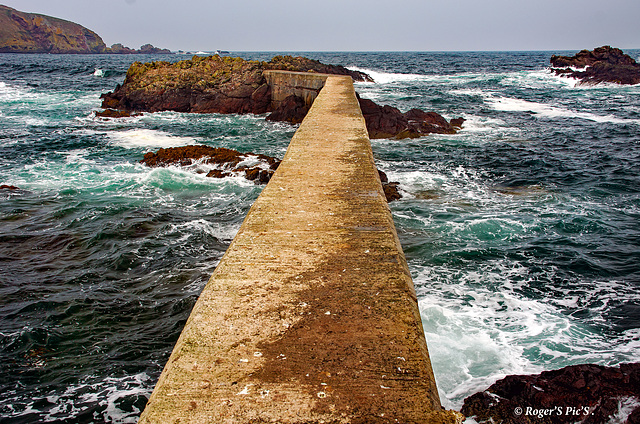
Perspective,
Another archive image from Scotland's border country, Taken from on top of one of the sea walls pointing out into the choppy waters of the North Sea at St Abbs!
