

Martin M. Miles' photos

Cape Sounion

Cape Sounion - Temple of Poseidon
| |
|
|
There is evidence of the establishment of sanctuaries on the cape from as early as the 11th century BC. The Greeks considered Poseidon to be the "master of the sea".
Given the importance to Athens of trade by sea and the significance of its navy in its creation and survival during the 5th century, Poseidon was of a particular relevance and value to the Athenians.
The Archaic-period temple of Poseidon was probably destroyed in 480 AD by Persian troops during Xerxes' invasion of Greece as punishment for the Athenians' defiance. After they defeated Xerxes in the naval Battle of Salamis, the Athenians placed an entire captured enemy warship at Sounion as a trophy dedicated to Poseidon.
The temple was constructed in 444–440 AD, during the reign of Pericles. It is perched above the sea at a height of almost 60 metres. Only some columns of the temple stand today, but when intact it would have closely resembled the well-preserved Temple of Hephaestus beneath the Acropolis, which may have been designed by the same architect Kallikrates.
Of the original 38 Doric columns, 11 were still standing in the 19th century, 5 more have since been re-erected.
Even in ancient times, visitors used to carve their names into walls and columns. Such graffiti are mentioned in the earliest accounts. We knew that even Lord Byron had left his name here, so we ‘scanned’ all sides, to find his "signature" and we finally did.
Lord Byron (1788 – 1824) was a British poet (and the father of Ada Lovelace), who led a very adventurous life. In 1823 Byron, at that time living in Genua, accepted overtures for his support from representatives of the Greek independence movement from the Ottoman Empire.
Byron chartered a brig to take him to Greece and arrived at Kefalonia in the Ionian Islands on 4 August 1823. The Ionian islands, of which Kefalonia is one, were under British rule until 1864. When Byron travelled to the mainland of Greece and reached Missolonghi in January 1824. To help raise money for the revolution, Byron sold his estate in England. News that a wealthy British aristocrat had arrived in Greece made Byron the object of much solicitation in that desperately poor country.
By the end of March 1824, the so-called "Byron brigade" of 30 officers and exactly 231 men had been formed, paid for entirely by Byron. but now the leaders of the different Greek fractions intervened, so that he
complained that the Greeks were hopelessly disunited and spent more time feuding with each other than trying to win independence.
Byron planned to attack the Turkish-held fortress of Lepanto and employed a fire master to prepare artillery. He took part of the rebel army under his own command despite his lack of military experience. Before the expedition could sail, he fell ill, and bloodletting weakened him further. He contracted a fever and died in Missolonghi on 19 April 1824. Because of his commitment to the Greek independence movement, Byron remains well known and highly regarded in Greece to this day.
.

Cape Sounion - Temple of Poseidon
| |
|
|
There is evidence of the establishment of sanctuaries on the cape from as early as the 11th century BC. The Greeks considered Poseidon to be the "master of the sea".
Given the importance to Athens of trade by sea and the significance of its navy in its creation and survival during the 5th century, Poseidon was of a particular relevance and value to the Athenians.
The Archaic-period temple of Poseidon was probably destroyed in 480 AD by Persian troops during Xerxes' invasion of Greece as punishment for the Athenians' defiance. After they defeated Xerxes in the naval Battle of Salamis, the Athenians placed an entire captured enemy warship at Sounion as a trophy dedicated to Poseidon.
The temple was constructed in 444–440 AD, during the reign of Pericles. It is perched above the sea at a height of almost 60 metres. Only some columns of the temple stand today, but when intact it would have closely resembled the well-preserved Temple of Hephaestus beneath the Acropolis, which may have been designed by the same architect Kallikrates.
Of the original 38 Doric columns, 11 were still standing in the 19th century, 5 more have since been re-erected.
Even in ancient times, visitors used to carve their names into walls and columns. Such graffiti are mentioned in the earliest accounts. We knew that even Lord Byron had left his name here, so we ‘scanned’ all sides, to find his "signature".

Cape Sounion - Temple of Poseidon
| |
|
|
There is evidence of the establishment of sanctuaries on the cape from as early as the 11th century BC. The Greeks considered Poseidon to be the "master of the sea".
Given the importance to Athens of trade by sea and the significance of its navy in its creation and survival during the 5th century, Poseidon was of a particular relevance and value to the Athenians.
The Archaic-period temple of Poseidon was probably destroyed in 480 AD by Persian troops during Xerxes' invasion of Greece as punishment for the Athenians' defiance. After they defeated Xerxes in the naval Battle of Salamis, the Athenians placed an entire captured enemy warship at Sounion as a trophy dedicated to Poseidon.
The temple was constructed in 444–440 AD, during the reign of Pericles. It is perched above the sea at a height of almost 60 metres. Only some columns of the temple stand today, but when intact it would have closely resembled the well-preserved Temple of Hephaestus beneath the Acropolis, which may have been designed by the same architect Kallikrates.
Of the original 38 Doric columns, 11 were still standing in the 19th century, 5 more have since been re-erected.
Even in ancient times, visitors used to carve their names into walls and columns. Such graffiti are mentioned in the earliest accounts. We knew that even Lord Byron had left his name here, so we ‘scanned’ all sides, to find his "signature".

Cape Sounion - Temple of Poseidon
| |
|
|
There is evidence of the establishment of sanctuaries on the cape from as early as the 11th century BC. The Greeks considered Poseidon to be the "master of the sea".
Given the importance to Athens of trade by sea and the significance of its navy in its creation and survival during the 5th century, Poseidon was of a particular relevance and value to the Athenians.
The Archaic-period temple of Poseidon was probably destroyed in 480 AD by Persian troops during Xerxes' invasion of Greece as punishment for the Athenians' defiance. After they defeated Xerxes in the naval Battle of Salamis, the Athenians placed an entire captured enemy warship at Sounion as a trophy dedicated to Poseidon.
The temple was constructed in 444–440 AD, during the reign of Pericles. It is perched above the sea at a height of almost 60 metres. Only some columns of the temple stand today, but when intact it would have closely resembled the well-preserved Temple of Hephaestus beneath the Acropolis, which may have been designed by the same architect Kallikrates.
Of the original 38 Doric columns, 11 were still standing in the 19th century, 5 more have since been re-erected.
Since time immemorial, the Cape and all its sacred sanctuaries have been guarded by these tortoises. This one is probably a "testudo hermanni".

Cape Sounion - Temple of Poseidon
| |
|
|
There is evidence of the establishment of sanctuaries on the cape from as early as the 11th century BC. The Greeks considered Poseidon to be the "master of the sea".
Given the importance to Athens of trade by sea and the significance of its navy in its creation and survival during the 5th century, Poseidon was of a particular relevance and value to the Athenians.
The Archaic-period temple of Poseidon was probably destroyed in 480 AD by Persian troops during Xerxes' invasion of Greece as punishment for the Athenians' defiance. After they defeated Xerxes in the naval Battle of Salamis, the Athenians placed an entire captured enemy warship at Sounion as a trophy dedicated to Poseidon.
The temple was constructed in 444–440 AD, during the reign of Pericles. It is perched above the sea at a height of almost 60 metres. Only some columns of the temple stand today, but when intact it would have closely resembled the well-preserved Temple of Hephaestus beneath the Acropolis, which may have been designed by the same architect Kallikrates.
Of the original 38 Doric columns, 11 were still standing in the 19th century, 5 more have since been re-erected.

Cape Sounion - Temple of Poseidon
| |
|
|
There is evidence of the establishment of sanctuaries on the cape from as early as the 11th century BC. The Greeks considered Poseidon to be the "master of the sea".
Given the importance to Athens of trade by sea and the significance of its navy in its creation and survival during the 5th century, Poseidon was of a particular relevance and value to the Athenians.
The Archaic-period temple of Poseidon was probably destroyed in 480 AD by Persian troops during Xerxes' invasion of Greece as punishment for the Athenians' defiance. After they defeated Xerxes in the naval Battle of Salamis, the Athenians placed an entire captured enemy warship at Sounion as a trophy dedicated to Poseidon.
The temple was constructed in 444–440 AD, during the reign of Pericles. It is perched above the sea at a height of almost 60 metres. Only some columns of the temple stand today, but when intact it would have closely resembled the well-preserved Temple of Hephaestus beneath the Acropolis, which may have been designed by the same architect Kallikrates.
Of the original 38 Doric columns, 11 were still standing in the 19th century, 5 more have since been re-erected.

Cape Sounion - Temple of Poseidon
| |
|
|
|
There is evidence of the establishment of sanctuaries on the cape from as early as the 11th century BC. The Greeks considered Poseidon to be the "master of the sea".
Given the importance to Athens of trade by sea and the significance of its navy in its creation and survival during the 5th century, Poseidon was of a particular relevance and value to the Athenians.
The Archaic-period temple of Poseidon was probably destroyed in 480 AD by Persian troops during Xerxes' invasion of Greece as punishment for the Athenians' defiance. After they defeated Xerxes in the naval Battle of Salamis, the Athenians placed an entire captured enemy warship at Sounion as a trophy dedicated to Poseidon.
The temple was constructed in 444–440 AD, during the reign of Pericles. It is perched above the sea at a height of almost 60 metres. Only some columns of the temple stand today, but when intact it would have closely resembled the well-preserved Temple of Hephaestus beneath the Acropolis, which may have been designed by the same architect Kallikrates.
Of the original 38 Doric columns, 11 were still standing in the 19th century, 5 more have since been re-erected.

Cape Sounion - Temple of Poseidon
| |
|
|
There is evidence of the establishment of sanctuaries on the cape from as early as the 11th century BC. The Greeks considered Poseidon to be the "master of the sea".
Given the importance to Athens of trade by sea and the significance of its navy in its creation and survival during the 5th century, Poseidon was of a particular relevance and value to the Athenians.
The Archaic-period temple of Poseidon was probably destroyed in 480 AD by Persian troops during Xerxes' invasion of Greece as punishment for the Athenians' defiance. After they defeated Xerxes in the naval Battle of Salamis, the Athenians placed an entire captured enemy warship at Sounion as a trophy dedicated to Poseidon.
The temple was constructed in 444–440 AD, during the reign of Pericles. It is perched above the sea at a height of almost 60 metres. Only some columns of the temple stand today, but when intact it would have closely resembled the well-preserved Temple of Hephaestus beneath the Acropolis, which may have been designed by the same architect Kallikrates.
Of the original 38 Doric columns, 11 were still standing in the 19th century, 5 more have since been re-erected.
Cape Sounion - Temple of Poseidon
| |
|
|
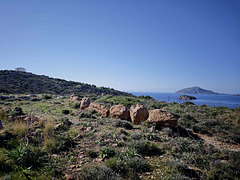
The Temple of Poseidon, as seen from the ruins of the Temple of Athena Sounias, which was built in 470 B.C. It was constructed in the immediate vicinity of a burial mound and a sanctuary dedicated to Phrontis—Menelaus’s helmsman—whose burial at Sounion is mentioned in the Odyssey.
The Temple of Athena was demolished in the 1st century AD. Parts of its columns were taken to Athens to be used in the Southeast Temple of the Agora.

Cape Sounion - Attention
| |
|
|
Cape Sounion is best known for the Temple of Poseidon, but there are also ancient mines here. Copper and lead were already being mined here in the Neolithic period. During the Bronze Age, the mines were an important source of income for the Greek cultures of the time – the Mycenaeans, Minoans and Cycladians – all of whom benefited from the deposits’ wealth of silver, lead and copper.
The mines reached their peak during Classical Antiquity. Thousands of enslaved men toiled here to extract galena – the raw material for silver production. This wealth of silver contributed to the fame of Athens.
Today, numerous mines – abandoned for centuries and structurally unstable – bear witness to the dangers of the past. For this reason, the site is secured by signs and fences.
Seen in the backdrop are the ruins of Agios Ioannis Prodromos.

Cape Sounion - Agios Ioannis Prodromos
| |
|
|
Cape Sounion is best known for the Temple of Poseidon, but there are also ancient mines here. Copper and lead were already being mined here in the Neolithic period. During the Bronze Age, the mines were an important source of income for the Greek cultures of the time – the Mycenaeans, Minoans and Cycladians – all of whom benefited from the deposits’ wealth of silver, lead and copper.
The mines reached their peak during Classical Antiquity. Thousands of enslaved men toiled here to extract galena – the raw material for silver production. This wealth of silver contributed to the fame of Athens.
Today, numerous mines – abandoned for centuries and structurally unstable – bear witness to the dangers of the past. For this reason, the site is secured by signs and fences.
In the heart of this area lie the ruins of Agios Ioannis Prodromos.

Gouves – Agios Konstantinos

Malia - Laundry
| |
|
|
Malia is first mentioned in 1390. The very first hotel to be built here dates back to the early 1960s. Since then, tourism has boomed, with Malia attracting mainly young tourists, particularly British holidaymakers aged between 18 and 30 who are looking for a holiday combining partying and relaxation
What is now known as the "Malia Strip" therefore bears a strong resemblance to Agia Napa on Cyprus – and just like there, everything is in hibernation in January.
This laundry, located in the village stays open over the winter. Not really the long ours of the summer season, but at least from 9 - 12 and from 15 - 20.

Malia - Ford Consul Classic
| |
|
|
The Ford Consul Classic was built by Ford UK from 1961 to 1963.
As the car was complex and expensive to produce it was already replaced in October 1963 by the Ford Corsair.
Only 111,225 Classics were produced, here is one of the survivors.

Malia - Ford Consul Classic
| |
|
|
The Ford Consul Classic was built by Ford UK from 1961 to 1963.
As the car was complex and expensive to produce it was already replaced in October 1963 by the Ford Corsair.
Only 111,225 Classics were produced, here is one of the survivors.

Malia - Spar
| |
|
|
|
Malia is first mentioned in 1390. The very first hotel to be built here dates back to the early 1960s. Since then, tourism has boomed, with Malia attracting mainly young tourists, particularly British holidaymakers aged between 18 and 30 who are looking for a holiday combining partying and relaxation
What is now known as the "Malia Strip" therefore bears a strong resemblance to Agia Napa on Cyprus – and just like there, everything is in hibernation in January.

Malia - McDonald’s
| |
|
|
Malia is first mentioned in 1390. The very first hotel to be built here dates back to the early 1960s. Since then, tourism has boomed, with Malia attracting mainly young tourists, particularly British holidaymakers aged between 18 and 30 who are looking for a holiday combining partying and relaxation
What is now known as the "Malia Strip" therefore bears a strong resemblance to Agia Napa on Cyprus – and just like there, everything is in hibernation in January.
