

Martin M. Miles' photos

Heraklion - Butcher's shop
| |
|
|
Lamb's heads are a common (and inexpensive) delicacy in the Eastern Mediterranean. To the average tourist—like me—such heads always look a bit creepy.

Heraklion - Moumoulidis (PiP)
| |
|
This shop was my favourite when I visited in 2025 – and it still is. If they don’t stock it here, you don’t need it.

Heraklion - Saint Paraskevi
| |
|
|
|
Crete is the largest and most populous of the Greek islands, is located about 100 km south of the Peloponnese. Crete was the center of Europe's first advanced civilization, the Minoans, from 3000 to 1400 BC. The Minoan civilization was overrun by the Mycenaean civilization from mainland Greece. Crete was later ruled by Rome, then successively by the Byzantine Empire, Andalusian Arabs, the Byzantine Empire again, the Venetian Republic, and the Ottoman Empire. In 1898 Crete, whose people had for some time wanted to join the Greek state, achieved independence from the Ottomans, formally becoming the Cretan State. Crete became part of Greece in December 1913.
Heraklion is the largest city and the administrative capital of the island of Crete. With a municipal population of about 180.000 it is the fourth largest city in Greece. The greater area of Heraklion has been continuously inhabited since at least 7000 BCE, making it one of the oldest inhabited regions in Europe. As a major center of the Minoan civilization it often considered Europe's oldest city.
The present day church of Saint Paraskevi was built in the early 20th century and consecrated 2010. In the first inventory of churches dating to 1320, mention is made of a church on the same site dedicated to "Virgin Mary Manolitissa at the Outer Gate".
The earlier church was divided into two naves divided by three arches. Parts of the earlier church ware incorporated into the church of Saint Paraskevi.
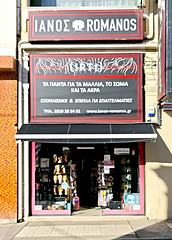
Heraklion
| |
|
|
“Ianos Romanos” offers everything the beauty industry needs. A specialist shop for hairdressers, make-up artists, nail salons and podiatrists.
Here is an overview
ianos-romanos.gr
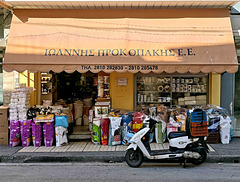
Heraklion
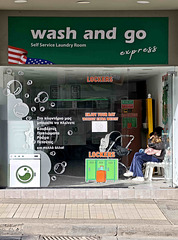
Heraklion - wash and go
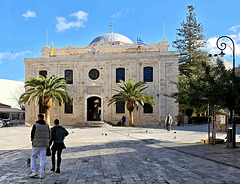
Heraklion - Agios Titos
| |
|
|
Crete is the largest and most populous of the Greek islands, is located about 100 km south of the Peloponnese. Crete was the center of Europe's first advanced civilization, the Minoans, from 3000 to 1400 BC. The Minoan civilization was overrun by the Mycenaean civilization from mainland Greece. Crete was later ruled by Rome, then successively by the Byzantine Empire, Andalusian Arabs, the Byzantine Empire again, the Venetian Republic, and the Ottoman Empire. In 1898 Crete, whose people had for some time wanted to join the Greek state, achieved independence from the Ottomans, formally becoming the Cretan State. Crete became part of Greece in December 1913.
Heraklion is the largest city and the administrative capital of the island of Crete. With a municipal population of about 180.000 it is the fourth largest city in Greece. The greater area of Heraklion has been continuously inhabited since at least 7000 BCE, making it one of the oldest inhabited regions in Europe. As a major center of the Minoan civilization it often considered Europe's oldest city.
In 55 AD, the apostle Paul and his companion Titos may have stayed in Gortyn, the capital of Crete where Titos became the first bishop of Crete.
After the division of the Roman Empire in 395 AD, Crete came under Byzantine rule. The successful Christianisation made it necessary to build a new church around 600. Around 826, the Saracens conquered Crete, destroyed Gortyn and founded Crete's new capital Iraklio. In 960, Nikephoros Phokas reconquered Crete for the Byzantine Empire and expelled the Arabs from Crete and a new metropolitan church, dedicated to the apostle Titus, was built. After the Fourth Crusade of 1204, Crete fell to the Venetians and the church became the Roman Catholic cathedral. In 1544 the church burned down completely, only the skull relic of St Tito could be saved. In 1669, the Turks conquered Crete and the church was converted into a mosque. The Venetians took the skull relic of St Tito to Venice. The building was destroyed by an earthquake in 1856 and was rebuilt in Ottoman style until 1872 and the holy skull was returned.

Heraklion - Kafeneio O Tempelis
| |
|
|
Restaurant Kafeneio O Tempelis doesn't offer "fine dining". Instead the tourist finds down to th earth food to very reasonable prices.
Pork belly
Heraklion - Kafeneio O Tempelis
| |
|
|
Restaurant Kafeneio O Tempelis doesn't offer "fine dining". Instead the tourist finds down to th earth food to very reasonable prices.
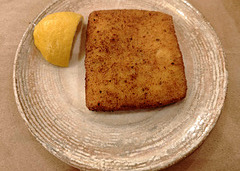
Saganaki - Fried Cheese

Heraklion - Venetian Loggia
| |
|
|
Crete is the largest and most populous of the Greek islands, is located about 100 km south of the Peloponnese. Crete was the center of Europe's first advanced civilization, the Minoans, from 3000 to 1400 BC. The Minoan civilization was overrun by the Mycenaean civilization from mainland Greece. Crete was later ruled by Rome, then successively by the Byzantine Empire, Andalusian Arabs, the Byzantine Empire again, the Venetian Republic, and the Ottoman Empire. In 1898 Crete, whose people had for some time wanted to join the Greek state, achieved independence from the Ottomans, formally becoming the Cretan State. Crete became part of Greece in December 1913.
Heraklion is the largest city and the administrative capital of the island of Crete. With a municipal population of about 180.000 it is the fourth largest city in Greece. The greater area of Heraklion has been continuously inhabited since at least 7000 BCE, making it one of the oldest inhabited regions in Europe. As a major center of the Minoan civilization it often considered Europe's oldest city.
The Venetians erected this luxurious building so that the nobles and lords could spend their time in comfort. It is considered one of the most elegant architectural monuments in Heraklion from the Venetian period. The building was built around 1628 by Francisco Morosini, the General Provost of Crete. After the conquest of the city by the Turks, the Loggia lost its old identity and fame.
Today the town hall is located in the Venetian loggia.
Heraklion - Hans & Gretel
| |
|
|
Crete, the largest and most populous of the Greek islands, is located about 100 km south of the Peloponnese. Crete was the center of Europe's first advanced civilization, the Minoans, from 3000 to 1400 BC. The Minoan civilization was overrun by the Mycenaean civilization from mainland Greece. Crete was later ruled by Rome, then successively by the Byzantine Empire, Andalusian Arabs, the Byzantine Empire again, the Venetian Republic, and the Ottoman Empire. In 1898 Crete, whose people had for some time wanted to join the Greek state, achieved independence from the Ottomans, formally becoming the Cretan State. Crete became part of Greece in December 1913.
Heraklion is the largest city and the administrative capital of the island of Crete.
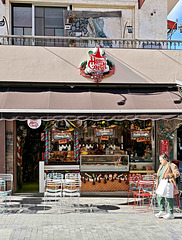
Hans & Gretel run an ice cream parlour in Heraklion

Heraklion - Minoan
| |
|
|
Crete, the largest and most populous of the Greek islands, is located about 100 km south of the Peloponnese. Crete was the center of Europe's first advanced civilization, the Minoans, from 3000 to 1400 BC. The Minoan civilization was overrun by the Mycenaean civilization from mainland Greece. Crete was later ruled by Rome, then successively by the Byzantine Empire, Andalusian Arabs, the Byzantine Empire again, the Venetian Republic, and the Ottoman Empire. In 1898 Crete, whose people had for some time wanted to join the Greek state, achieved independence from the Ottomans, formally becoming the Cretan State. Crete became part of Greece in December 1913.
Heraklion is the largest city and the administrative capital of the island of Crete.
Knossos, an ancient urban centre near Heraklion, was a hub of Minoan culture. The bull-leaping scene on the back of the Coke vending machine, which is a reproduction of a scene from the Palace of Knossos, is a well-known motif of Minoan culture.

Heraklion - Eleftherias Square
| |
|
|
Crete, the largest and most populous of the Greek islands, is located about 100 km south of the Peloponnese. Crete was the center of Europe's first advanced civilization, the Minoans, from 3000 to 1400 BC. The Minoan civilization was overrun by the Mycenaean civilization from mainland Greece. Crete was later ruled by Rome, then successively by the Byzantine Empire, Andalusian Arabs, the Byzantine Empire again, the Venetian Republic, and the Ottoman Empire. In 1898 Crete, whose people had for some time wanted to join the Greek state, achieved independence from the Ottomans, formally becoming the Cretan State. Crete became part of Greece in December 1913.
Heraklion is the largest city and the administrative capital of the island of Crete. Heraklion is the largest city and the administrative seat of the island of Crete. Located on Eleftherias Square, the administration of the Region of Crete is housed in this neoclassical building.
Larnaca - Flamingo

Larnaca - Hala Sultan Tekke
| |
|
|
With a population of over 50,000, Larnaca is one of the largest cities in Cyprus.
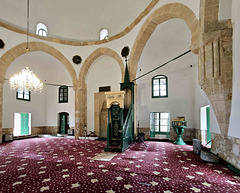
Hala Sultan Tekke is a mosque on the shores of Larnaca Salt Lake. Umm Haram – also known as Hala Sultan – was an aunt of the Prophet Muhammad. When the Arabs conquered Cyprus in 647, she fell from her mule and lost her life. She was buried on the spot, and her grave gradually became a place of pilgrimage. In 1760, Sheikh Hassan began building a mosque. Since 1816, the Hala Sultan Tekke complex has consisted of a mosque, a mausoleum and a cemetery.
The prominent tomb in the background is attributed to Hala Sultan (Umm Haram).
Larnaca - Hala Sultan Tekke
| |
|
|
With a population of over 50,000, Larnaca is one of the largest cities in Cyprus.
Hala Sultan Tekke is a mosque on the shores of Larnaca Salt Lake. Umm Haram – also known as Hala Sultan – was an aunt of the Prophet Muhammad. When the Arabs conquered Cyprus in 647, she fell from her mule and lost her life. She was buried on the spot, and her grave gradually became a place of pilgrimage. In 1760, Sheikh Hassan began building a mosque. Since 1816, the Hala Sultan Tekke complex has consisted of a mosque, a mausoleum and a cemetery.

Larnaca - Hala Sultan Tekke
| |
|
|
With a population of over 50,000, Larnaca is one of the largest cities in Cyprus.
Hala Sultan Tekke is a mosque on the shores of Larnaca Salt Lake. Umm Haram – also known as Hala Sultan – was an aunt of the Prophet Muhammad. When the Arabs conquered Cyprus in 647, she fell from her mule and lost her life. She was buried on the spot, and her grave gradually became a place of pilgrimage. In 1760, Sheikh Hassan began building a mosque. Since 1816, the Hala Sultan Tekke complex has consisted of a mosque, a mausoleum and a cemetery.

Larnaca - Hala Sultan Tekke
| |
|
|
With a population of over 50,000, Larnaca is one of the largest cities in Cyprus.
Hala Sultan Tekke is a mosque on the shores of Larnaca Salt Lake. Umm Haram – also known as Hala Sultan – was an aunt of the Prophet Muhammad. When the Arabs conquered Cyprus in 647, she fell from her mule and lost her life. She was buried on the spot, and her grave gradually became a place of pilgrimage. In 1760, Sheikh Hassan began building a mosque. Since 1816, the Hala Sultan Tekke complex has consisted of a mosque, a mausoleum and a cemetery.
Hala Sultan Tekke is also an archaeological site. In the second half of the 2nd millennium BC, the grounds of the Hala Sultan Tekke were used as a cemetery by the inhabitants of a large Late Cypriot city located just a few hundred metres further west. In the late 19th century, numerous graves from the Late Bronze Age (c. 1650–1100 BC) were uncovered, containing rich grave goods.
Recent radar surveys have shown that this city was one of the largest settlements of the Late Bronze Age (c. 1600–1100 BC). Further archaeological investigations have also brought to light architectural remains dating to the Late Archaic, Classical and Hellenistic periods (6th to 1st century BC).
