

tarboat's photos
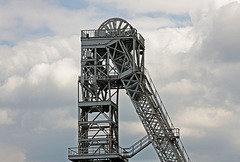
Zeche Sterkrade
| |
|
The Sterkrade colliery was sunk in 1903 and operated independently until 1933 when it was absorbed into the Osterfeld complex. Shaft 1 at Sterkrade was eventually used to wind men and materials whilst the coal was raised at Osterfeld. Closure came in 1992 and the site has been cleared apart from the headframe and associated pithead building.
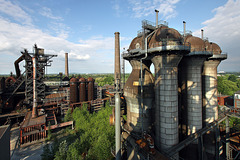
Meiderich
| |
|
|
The view from one of the blast furnaces at the former Meiderich works of ThyssenKrupp in Duisburg is full of interest both near and far. The second furnace is visible on the left and both sets of Cowper Stoves still stand too. The plant was closed in 1985 and is now a focal point of the Lanschaftspark Duisburg-Nord.
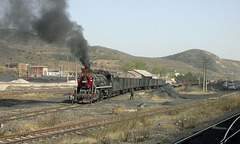
Xiamiaozi exchange yard
| |
|
The decorated headboard indicates the pet locomotive of the Nanpiao mine railway fleet. SY 1092 is preparing to leave with a load of empties for the Sanjiazi collieries as soon as the afternoon passenger service has gone ahead.
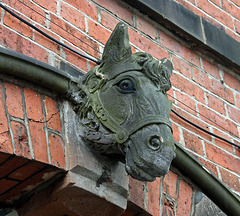
Stables
| |
|
I had a good mooch around Leek today and really enjoyed the wealth of interesting and whimsical architecture to be found around the town. This keystone is in the entrance arch to a former stables in Leonard St. The adjacent buildings dated from the 1880s and this is almost certainly contemporary.
Back home
| |
|
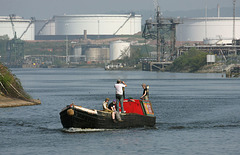
The tanker narrowboat passing the Stanlow oil refinery on the Manchester Ship Canal. The boat was back home at the place where she used to be loaded with gas oil for transporting to Oldbury near Birmingham. It was more than 56 years since she last loaded here.

Zolder
| |
|
Zolder was the last colliery in the Benelux countries and closed in 1992. The machine hall still has much of the machinery remaining, including two Koepe winders.
Xiangyang
| |
|
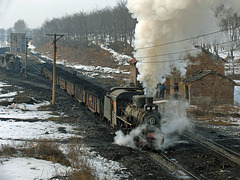
The Yinghao Coal Railway was still busy in early 2006 shifting coal from a mine at Liangjiawajing to tghe town of Yinghao. A loaded train is seen here departing the junction at Xiangyang where the traffic was exchanged with the mine branch. Loaded wagons were brought up the steep gradient from the mine three at a time by the locomotive seen on the left. The main line in the background served the workshops at Huangmen where the mine had been closed for some time.
Schacht XII
| |
|
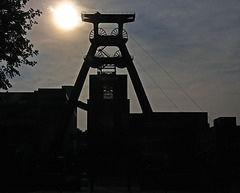
Zollverein colliery headstock over shaft No.12 is still used for drainage of the central Ruhr area although mining here ended in 1986. It forms an important landmark and is part of the Museum of the Ruhr and a World Heritage Site.
L&NWR Co
| |
|
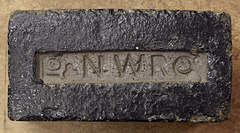
The London and North Western Railway even made its own steel at Crewe, so brickmaking was almost a given. The 1876 1:2500 OS map shows a large round kiln near to West Street in Crewe along with rectangular kilns within the works buildings adjacent to the Chester line. By 1898 the rectangular kilns had gone and the round kiln had a standard gauge siding entirely circling the structure. There were also four more smaller round kilns nearby.
Great Western Railway
| |
|
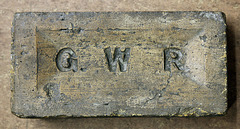
It is perhaps unsurprising that the Great Western Railway produced its own bricks as it would have always had building works underway somewhere on its system.
Le Jumeau
| |
|
|
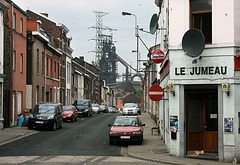
Blast Furnace No.6 at the Arcelor Mittal steelworks in Seraing near Liège viewed down the Rue des Pierres. Le Jumeau was closed for modernisation and so the drinks had to wait.
On arrival
| |
|
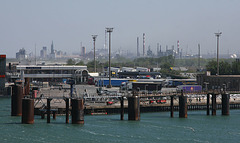
Distant industry beckons on arrival at the Dunkerque ferry terminal. Most obvious is the oil refinery, but the plume of steam indicates the coking plant at the steelworks and the orangey coloured buildings left of centres are the Kerneos aluminium silicates plant.
Vohwinkel street scene
| |
|
|
|
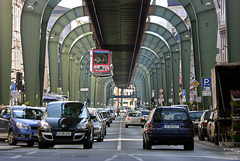
No traffic problems for the street railway in the Wuppertal area. The Schwebebahn is the oldest monorail in the world , having opened in sections between 1901 and 1903. The 13km line carries around 75,000 passengers each weekday and is seen here on the approaches to the western terminus at Vohwinkel. Much of the route follows the course of the Wupper river up to Oberbarmen.
Road trip
| |
|
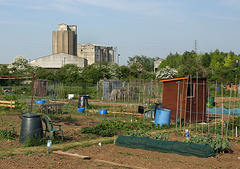
Just back from a long road trip across Europe where I took far too many photographs. On the way to the ferry a stop at the Rochester works, formerly owned by Rugby Cement, revealed that most of the site had been levelled apart from the offices and the storage silos.
Morning freight departure
| |
|
|
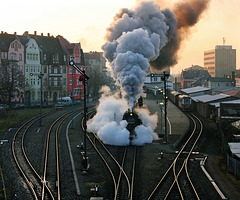
Early morning and a freight is departing the station at Nordhausen on a run to Silberhütte on the Selketalbahn.
Chasing down to Latchford
| |
|
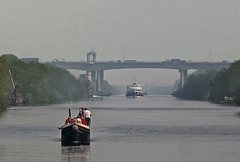
As the tanker narrowboat approaches Latchford Locks on the Manchester Ship Canal, she is rapidly being chased down by the Mersey Ferry Snowdrop with the Daisy Doardo and the container shuttle not far behind.

Goyt's Moss Collieries
| |
|
The Buxton coalfield was extensively worked in the eighteenth century for the benefit of the Duke of Devonshire as landowner. The Goyt's Moss workings comprised a large number of shafts connected by raised roadways with the associated whim gins being moved from shaft to shaft as the workings progressed. Analysis of the accounts for 1790 suggests that usually three shafts were in operation at any one time, although two and four were also worked at times.
The image shows the remains of a collapsed eighteenth century shaft out on the moor. The lighter coloured patch on the right is part of the gin circle of which the remainder had been lost into the collapsed shaft which would have been 75 or 80 feet deep.
Dane Thorn Colliery
| |
|
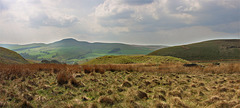
Dane Thorn colliery tip and remains of building at the right hand end. Farey lists this mine as working in 1811. In 1864 it was disused but by 1880 it had reopened and was being worked by worked by W. and H. Hand who also operated the nearby Robinsclough Mine. The later operations may well have used a different entrance and the colliery appears to have closed again by 1900.
