

tarboat's photos
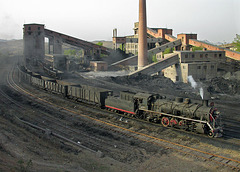
No.5 mine Sanjiazi
| |
|
|
|
This is one of the larger mines in the Nanpiao area and this particular evening it was being shunted by SY 1092 which was the local favourite and kept in better external condition than the other locomotives on the line. Some of the wagons in the train still had wooden bodies, but these were restricted to internal use and did not appear on the China Rail network.
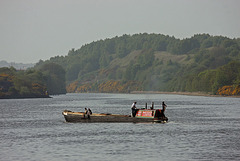
Preparing to enter Ellesmere Port
| |
|
|
Looking rather small on the vast expanses of the Manchester Ship Canal, a narrowboat tanker is swinging in to enter the bottom basin of the Shropshire Union Canal at Ellesmere Port. This particular boat once regularly made this entrance after loading gas oil at the Stanlow oil refinery a short distance up the Ship Canal.
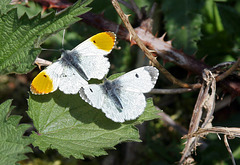
One of each
| |
|
It's not often you can photograph male and female Orange-tip (Anthocharis cardamines) butterflies together. This morning along the Whitegate Way I was lucky enough to find these two perched nicely in the sun.
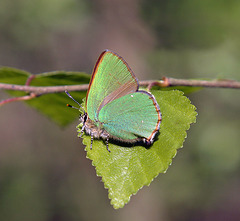
Green Hairstreak 2011
| |
|
This year's Green Hairstreak (Callophrys rubi) seen at Newchurch Common, Cheshire. This year the numbers are good and I saw at least ten individuals on a short stretch of my walk.

First of the year
| |
|
My first damselfly of 2011 and it was no surprise that it was the Large Red Damselfly ( Pyrrhosoma nymphula ). This teneral female was busy devouring a small fly at Newchurch Common.
Early limekiln
| |
|
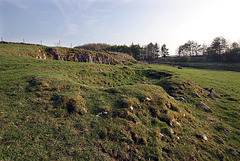
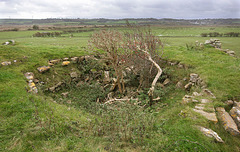
Sterndale Moor limekiln is probably late eighteenth century in origin. In the foreground is the typical rectangular shape of a Pye or clamp kiln with a draw hole in the middle of the low bank around the kiln. The small quarry for one of the raw materials is in the background. These clamps were operated intermittently as required to provide lime for local use. It is believed that these kilns were more efficient and less labour intensive than the 'pudding-pie' intermittent kilns and the small running kilns used in the rural areas. They could not, however, match the productivity of the much larger masonry built commercial running kilns.
Kiln top
Vicar's Lane, Chester
| |
|
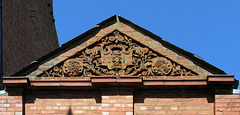
Decorative work dated 1881 on a building in Vicar's Lane in Chester. There is a lot of weathering damage to the brickwork which is probably a local product rather than from the quality terracotta manufacturers around Ruabon.
Hegang in the rain
| |
|
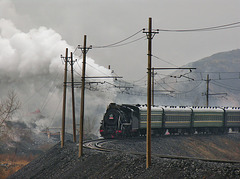
Regular passenger locomotive SY 1498 leads a morning passenger service to Hegang towards Dalu as the rain and sleet falls steadily. I really enjoyed visiting this line as it had a great variety in traffic and gritty mining scenery.
Coaling stage
| |
|
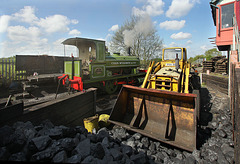
Andrew Barclay tank ‘Colin McAndrew’, formerly at Greening Wireworks in Warrington, simmers quietly at the coaling stage on the Chasewater Railway whilst awaiting its next duty.
Leaving summit tunnel
| |
|
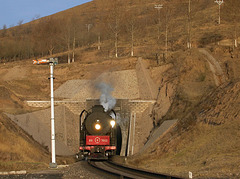
The early morning sun reflects from the driver's window as a freight leaves the summit tunnel and begins the long descent from towards Reshui on the Jinpeng section of the Jitong Railway.
Hawkins Colliery
| |
|
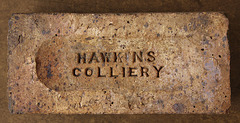
Hawkins Colliery was also known as Cannock Old Coppice Colliery and commenced working c1840. Joseph Hawkins took on the lease in 1869 and the colliery remained under the control of the Hawkins family until nationalisation in 1947. The company also opearted a brick and tile works with adjacent clay pit at Longhouse, adjacent to the Wyrley and Essington Canal. By the 1920s Henry Hawkins was advertising a wide range of products from the Longhouse Brick & Tile Works, Cannock. About 7 million bricks were made annually using clay mixed with mining spoil. The works continued in Hawkins' ownership after the colliery was nationalised and remains in production today under the Eternit name.
F H Gordon, Brownhills
| |
|
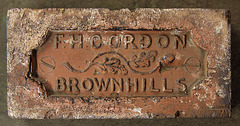
This one is special; the decoration in the frog is just wonderful.
Francis Harry Gordon opened his brickworks in the 1870s, on a site with a 30ft thick bed of clay, adjacent to the Daw End Canal just south-west of Clayhanger Bridge at Brownhills. The buildings included three drying sheds, the largest measuring 150ft x 30ft and had a cast iron plated floor. Nearby and on the other side of the canal was the Walsall Wood Colliery brickworks and price cutting by this works led to the demise of the Gordon business in 1896.

Brownhills West
| |
|
Today was the AGM of the Industrial Railway Society, held at the Chasewater Railway. We were made very welcome and three locomotives were in steam along with several diesels also in use. Hawthorn Leslie 2780 of 1909, " Asbestos ", is departing Brownhills West with one of the many trains run during the day.
On top of the coal tip
| |
|
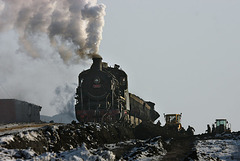
Tipping small coal onto the massive pile at the tip by the washery at Didao near Jixi. It was a steep push up for SY 1213, but an easy roll back down once everything was empty.
The Thorpe Marsh Six
| |
|
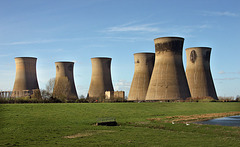
A recent trip to South Yorkshire included a visit to the cooling towers at Thorpe Marsh. The 1000mw power station here opened in the 1960s and was closed in 1994. The cooling towers remain as they are deemed too difficult to demolish.
Harz action
| |
|
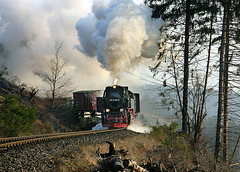
Freight train of standard gauge wagons on narrow gauge transporters heads around the curves on its way towards Drei Annen Hohne on the Harzquerbahn.
South Buckley Co
| |
|
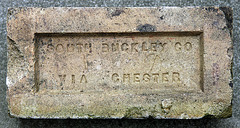
The South Buckley Coal & Firebrick Co was registered in February 1866 to open and operate a colliery and brickworks on land to the west of Buckley. It appears that the colliery was the first business to be developed and the brickworks did not commence operations until the 1870s. Financial problems followed and the works passed to the Main Coal & Cannel Co around July 1877 although this company was also unsuccessful and the company was dissolved after being taken over by David Evans, a Liverpool brickmaker and builder. The works, along with that of his North Buckley Colliery and Firebrick Co were sold in 1881 to the newly formed North & South Buckley Colliery, Brick & Tile Co Ltd.
