

tarboat's photos
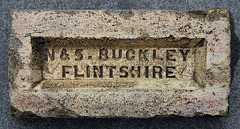
North & South Buckley
| |
|
The North & South Buckley Colliery, Brick & Tile Co Ltd was incorporated in 1881 and absorbed the South Buckley Coal & Firebrick Co and the North Buckley Colliery and Firebrick Co. The South Buckley works flourished and expanded to the extent that it outgrew the collieries and was renamed as the South Buckley Rock Brick Co in the early 1890s.
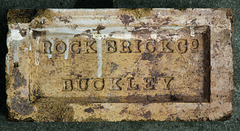
Rock Brick Co, Buckley
| |
|
A glazed product of the South Buckley Rock Brick Co which operated under this name from the early 1890s until the closure of the works in 1914. Fireclay was supplied along with coal for the kilns from the adjacent colliery. When the colliery closed in 1909 the clay and coal was brought by a tramroad from the associated North Buckley site, which had been rename as West Buckley Colliery by this time.
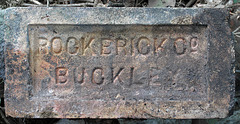
Rock Brick Co, Buckley
| |
|
A product of the South Buckley Rock Brick Co which operated under this name from the early 1890s until the closure of the works in 1914. Fireclay was supplied along with coal for the kilns from the adjacent colliery. When the colliery closed in 1909 the clay and coal was brought by a tramroad from the associated North Buckley site, which had been rename as West Buckley Colliery by this time.
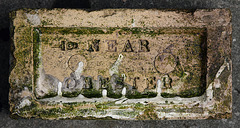
Rock Brick Co, Buckley obverse
| |
|
The South Buckley Rock Brick Co always made a play of being near to Chester, presumably to gain marketing advantage in Cheshire.
Drill Hall
| |
|
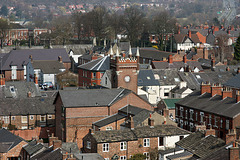
The tower of the old Drill Hall is prominent in this look over the rooftops of Macclesfield. Kings School is top left and the Silk Road heads out of town at the top right.
Eggborough
| |
|
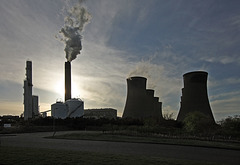
Eggborough Power Station. This is British Energy's only coal fired power station. Generation is with four 500 megawatt units, the first of which started working in 1967.
Maerz Kilns

Fan house
| |
|
|
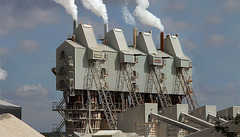
Englefield Colliery near Greenfield was at work in 1869 and continued until c1937-38. The Coal Authority has recently destroyed the top of the upcast shaft with overenthusiastic safety measures to obliterate the shaft top, even though it was already filled-in almost to the surface. Fortunately there are still some interesting remains on site, including the fan drift from the upcast leading to the fan house and evasee.
This view is looking from the side of the fan house and the steam engine drive through the circular opening to the fan itself. There is an identical hole on the other side of the fan chamber which would have lead to an identical steam engine. The drive would have been taken from the cylinder/engine on one side, with the other as spare. It would not take long to change over if there was a breakdown. The brickwork includes many glazed examples and is all from various incarnations of the Rock Brick Company at Buckley.

Rapid loading
| |
|
There is plenty of supervision in the cabin during the loading the MGR hoppers under the bunker at Silverdale Colliery. The train was probably heading for Fiddler's Ferry power station when it departed behind Brush type 4 47 354.
Paper Mill
| |
|
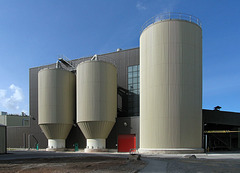
Went to have a peek at a paper mill today. Great place with plenty of scope for photography. Silos and tanks here at the end of the building where the pulp is prepared from recycled paper. These are for the waste material, such as ink, from the preparation flotation process.
Dalu bank
| |
|
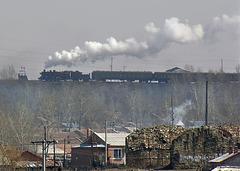
Morning passenger service from the outlying collieries seen over the roooftops as it climbs the steep bank towards Dalu. The locomotive was reduced almost to a crawl by the time it crossed the summit.
The tarboat and the pit
Reshui dawn
| |
|
|
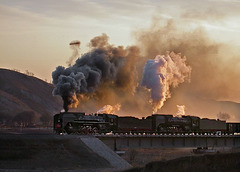
The morning sun is just touching the exhaust of the second locomotive as this westbound freight digs into the climb of the Jinpeng section of the Jitong Railway.
Flagstaff Quarry, Penmon
| |
|
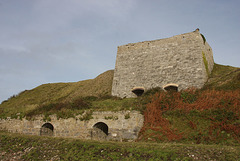
There was a small quarry and pier at this site before 1874 and these kilns were part of the operations at that time. In 1888 William Baird & Co took over and developed the quarry to supply fluxing stone for their steelworks in Glasgow. After a period of low activity Dinmore Quarries Ltd commenced working the site, mainly producing kiln burnt lime for agriculture and this continued until 1948 when all production ceased. The tunnels below the kiln drawing level were for loading lime into carts or possibly railway skips. This was dropped down through shafts with iron doors.
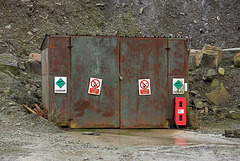
Danger
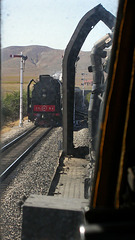
Crossing loop
| |
|
QJs 6984 and 7104 on an eastbound freight are seen from the driver's window on QJ 7081 at Dariqiga on the Jitong Railway. This was the day I spent on the footplate with a very friendly crew. The fireman couldn't speak any English and my Mandarin is worse than basic, but we managed to communicate via pictograms and the photos and apps on his mobile phone! A wonderful day that I shall always remember.

Danethorn coal pits
| |
|
On a lovely spring afternoon I took a wander on the moors looking at the coal mining remains above Wildboarclough, to the south west of Danethorn Hollow. This stitch of six images is looking from the Buxton to Congleton road and Dane Valley on the left, to Shutlingsloe on the right.The land beyond the nearer wall is filled with mining remains as is the area immediately beyond the second walll. There are at least ten shafts and associated spoil heaps visible here. I think they are probably eighteenth century workings and judging by the remains they were not worked with a gin. These shallow pits were probably wound with a hand windlass.
Best viewed in original size .
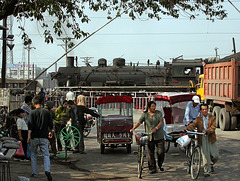
Yet another Fuxin crossing
| |
|
The Fuxin mining railway has several crossings in the town where the locals pay little attention as the SY class locomotives go about their daily work.
