

tarboat's photos
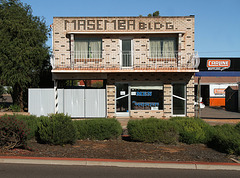
Masemba Building
| |
|
|
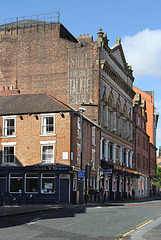
Amongst the modern buildings in Whyalla this one stood out. The Masemba Building comprises three premises with a hairdresser & formerly a Laundromat downstairs, a vacant upstairs office that was previously consulting rooms consisting of three rooms, reception area plus a large hall or board room. The estate agent selling this property suggested that conversion of the upstairs to an apartment was a likely outcome.
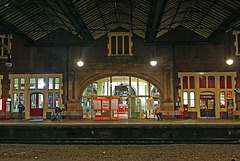
Lest we forget
| |
|
|
|
The archway leading from the platform into the booking hall of Stoke-on-Trent railway station war forms the memorial to those employees of the North Staffordshire Railway who fell in the Great War of 1914 - 1918. Their names are recorded on brass plaques on either side of the arch. This being Armistice Day in 2014 there are wreaths recently placed above both plaques.
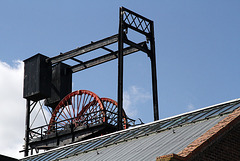
Ropes still on
| |
|
Lady Victoria Colliery at Newtongrange. The ropes may still be on the sheaves but there will be no more coal wound here.
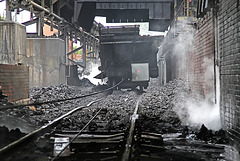
Coke car
| |
|
|
|
The coke car at Monckton Cokeworks is propelled by cable haulage and positioned using a laser seen here reflected on the mirror attached to the car.
Stoll Picture Theatre
| |
|
|
The Mill Volvo Tyne Theatre originally opened as the Tyne Theatre and Opera House in 1867. closure of the theatre came in 1917. It was leased by Sir Oswald Stoll and converted for cinema use by 1919 (following on from some experimentation in 1916 by Howard & Wyndham). The Stoll Picture Theatre opened on 2nd June 1919 with an opening presentation of ‘Tarzan of the Apes’. It was the first cinema in Newcastle to show ‘talkies’. The conversion, unlike that of many other theatres around the country was minimal and when the cinema closed in 1974 it was able to revert to its original role which continues to this day. The building is listed Grade 1.
Circular Quay
| |
|
|
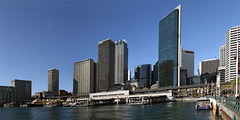
When I visited Australia there were a few hours to wait in Sydney before catching the train across the country. The time was spent in walking across the city and viewing a few of the tourist attractions. We started with a proper breakfast in a cafe close to the harbour and then moved on to Circular Quay. This is said to have been the site of the initial landing of the First Fleet in Port Jackson on 26 January 1788. I wonder what those 18th century arrivals would have made of the place today?
Quenching plume
| |
|
|
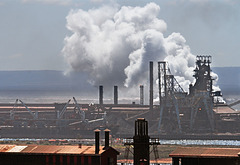
Another load of coke is under the quenching tower at the Whyalla Steelworks. Operated by OneSteel this is a fully integrated steelworks and the only manufacturer of rail in Australia. It processes iron ore from the Middleback Range. Approximately 1.2 million tonnes of raw steel is produced in the steelworks each year, with about 65% of that transferred by rail to OneSteel's Market Mills as billets for further processing. The balance of the steel is then converted to finished products in the Whyalla Rolling Mill.
Halifax at Barnsley
| |
|
|
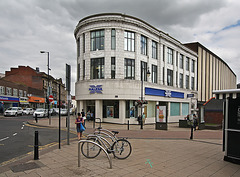
The Halifax Bank on Eldon Street, Barnsley is housed in this rather fine corner building with cream terracotta faience.
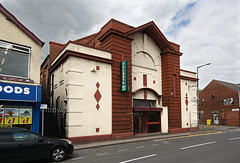
From Palace to Pockets
| |
|
The Palace Cinema at Royston, near Barnsley, was opened in 1914 (the date is in terracotta above the entrance). The proscenium was 11 feet wide. It was equipped with a British Thomson Houston(BTH) sound system in the early 1930’s. In the mid 1950’s it was equipped with CinemScope and the proscenium was extended to 24 feet wide. The Palace Cinema was still open in 1966, but had closed by 1980. It is now in use as Pockets snooker club.
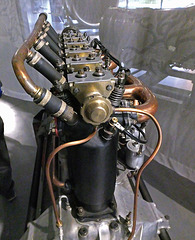
Rolls Royce Hawk
| |
|
|
|
The Hawk is a British aero engine designed by Rolls-Royce in 1915. Derived from one bank of six cylinders of the Rolls-Royce Eagle engine, it produced 75 horsepower at 1,370 rpm. Power was progressively increased to 91 hp by February 1916, and 105 hp by October 1918.
After Rolls-Royce made the prototypes, the Hawk was manufactured under licence by Brazil Straker in Bristol between 1915 and 1918. During this period 204 engines were built, and the Hawk earned a reputation for high reliability.
It is said that Royce developed the engine having seen coastal blimps struggling over the English Channel with unreliable and underpowered engines. Many engines of this type were used to power the SSZ (Sea Scout Zero) class coastal patrol airships of which 76 were built. They were capable of patrols of 30 hours duration.
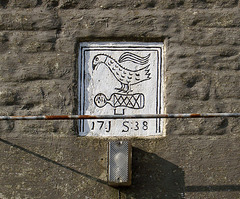
Eagle & Child
| |
|
Datestone over the door at the Eagle & Child at Burntcliff Top on the road from Allgreave to Gradbach. In 1892 the landlord was William Tunnicliffe. This former pub,built in 1738 is now a private house and the building is listed Grade II.
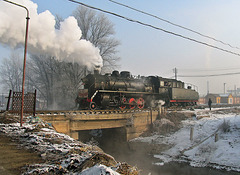
Meihekou
| |
|
|
|
I only visited the Meihekou coal railway for one day and it was very, very, cold! The only way to survive was to keep moving around and only stop to take photos for brief moments. After servicing SY1662 is seen here at Yijing preparing to collect a train of empty wagons for the Sanjing mine at the end of the line.

Pearl No.81
| |
|
Wooden narrowboats are a rare beast these days due to the cost and difficulty of maintaining them in good order. Pearl was originally built for carrying gasworks by-products and gas oil around the West Midlands and from Ellesmere Port to Oldbury. Originally a horse boat built in 1935 it was converted to a motor boat in 1945. For a long time this boat was moored on the Trent & Mersey Canal at Wincham but fell on hard times and was seized by the Waterways people. Luckily it wasn't dragged out and left to rot on the bank and is now at the boatyard at Saul on the Gloucester and Sharpness Canal. I do hope that someone will lavish some love and attention on this historic craft before it is too late.
Hemingfield
| |
|
|
|
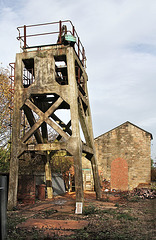
Hemingfield or Elsecar Low Colliery was sunk circa 1842-3 for Earl Fitzwilliam to work the Barnsley Bed Coal Seam at a depth of about 117 yards. By 1846 production had reached some 1000 tons per day.
After the mine finally closed for winding coal in 1920 one of the shafts continued to be used as a water pumping station. Since then the original headgears have been replaced by concrete structures. This is the headgear on the upcast shaft.
Shop At The Co-op
Brandon Walls kilns
| |
|
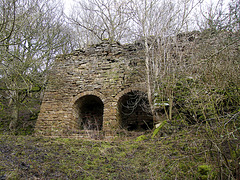
Disused limekilns high up above Weardale. These took a bit of finding as they were well hidden amongst the trees. There appeared to be two kilns with each pot being served by two draw holes.
Dedicated to the Few
| |
|
|
|
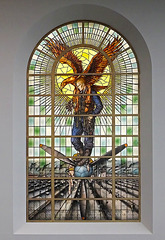
Stained glass window memorial at Rolls Royce, Derby. This is the Rolls Royce company's tribute and the wording at the bottom of the glass says: "This window commemorates the pilots of the Royal Air Force who in the Battle of Britain turned the work of our hands into the salvation of our country".
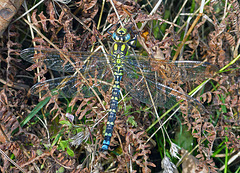
Southern Hawker at large
| |
|
|
It may be nearly November but there are still some dragonflies to be seen as the weather has remained fairly warm and we have avoided frosts so far this autumn. This male Southern Hawker ( Aeshna cyanea ) was busy feeding alongside the Macclesfield Canal at Middlewood.
