

tarboat's photos
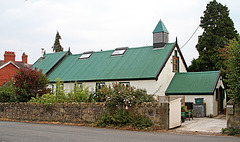
Halton Mission Church
| |
|
|
Halton Mission Church near Chirk. Built in 1878 as a Mission Room, as part of the evangelising of the district undertaken by the Rev Joseph Maude of Chirk. It is Grade II listed and is now a private house.
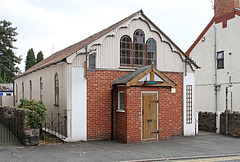
Former Methodist church, Caergwrle
| |
|
|
|
The Methodist Church on Castle Street, Caergwrle, was built in 1859 but replaced with a larger building in 1914. The front was removed and replaced with a large door to be used as the fire station in WW2. It now houses a furniture business.
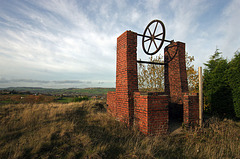
Hollin Busk Colliery
| |
|
|
|
The Hollin Busk Colliery, Stocksbridge, South Yorkshire, appears to have worked coal and fireclay (or possibly ganister). It is supposed to have reached Coal at 108ft and Pot Clay at 261ft. Until recently there were remains of a hand winch adjacent to the headgear. The winding shaft for the colliery was a short distance to the north west of this one which appears to have been sunk c1900 for ventilation. The whole mine had closed before 1930.

Bewdley local
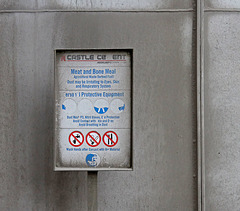
Animal fuel
| |
|
|
Meat and bone meal forms a significant portion of the fuel used in the kiln and preheater at Clitheroe cement works. Clearly sensible precautions need to be taken when in contact with this material.
Clitheroe cement works
| |
|
|
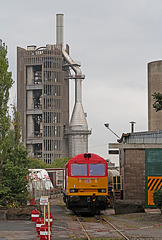
Open day at the Hanson (Heidelberg) cement works at Clitheroe. Seen here in front of the preheater for the kiln is class 60 024 "Clitheroe Castle".
Richard Hine, Grocer & Tea Dealer
| |
|
|
|
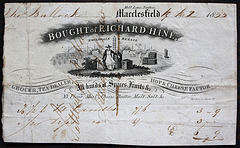
Invoice for candles and tallow dips supplied by Richard Hine of Mill Lane, Sutton, Macclesfield. The business operated for many years becoming Richard Hine & Son by the 1850s. A William Hine was trading as a grocer in Macclesfield in 1878 but I am unsure if this business was related. The image on the billhead concentrates on the sourcing of tea from China.
Power house
| |
|
|
Butterworth Hall Colliery was one of the largest in Milnrow in the early twentieth century. In 1869 the mine was owned by Richard and William Stott, but it was sold to Platt Brothers of Oldham. It is said to have been a very wet mine and it finally closed in 1928 after the workings became flooded. It was then purchased by Oldham Corporation for use as an underground reservoir, with upwards of a million gallons of water per day being pumped to Piethorne Reservoir, around 2 miles away. The headstocks were demolished in 1950.
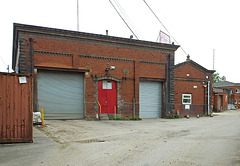
This building was originally constructed as the power house for generating electricity for use on the colliery. It is now used by a civil engineering company.
The name lives on and today the shaft, which is situated a short distance behind this building continues to supply water, although the site is now run by United Utilities.
Open day catering
| |
|
|
|
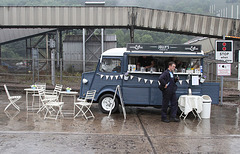
One of the catering options at the Hope Cement Works open day was refreshments served from this Citroen H van. I am grateful to Cold War Warrior for the information as to what this is.
Night departure
| |
|
|
|
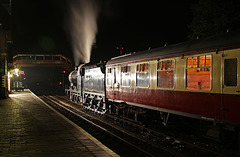
Midland 4F 43924 waiting to leave Bewdley during a recent Martin Creese photo charter on the Severn Valley Railway.

Hope Cement panorama
| |
|
|
It may have been dull and wet at the Hope cement works open day, but there was still a chance for a panoramic shot of the kilns and silos from high up near the limestone quarry. Best viewed large.

Fodens on parade
| |
|
|
Part of the Earle's Cement fleet of Foden lorries lined up for a group photograph at Hope cement works in 1939.
Tanks to go
| |
|
|
|
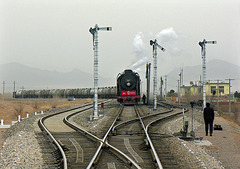
The pointsman has a bored stance whilst waiting for QJ 6984 to start from a stop in the loop at Gulumanhan with a train of oil tanks heading west on the Jitong Railway.
Mk IV tank
| |
|
|
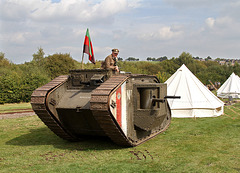
Replica Mk IV tank at the 'Tracks to the Trenches' event at Apedale today. It proved to be a real beggar to steer. The event was superb with a wide variety of WW1 railway equipment running on a real field railway and plenty of different re-enactments and contemporary equipment. They even had their own trench system to explore.

Lisa's
| |
|
|
The last remaining house from the Birchinlee village where the workers on the Upper Derwent dams were housed. It now stands on Edale Road in Hope.
Nunlow back home
| |
|
|
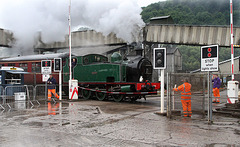
Nunlow on the shuttle at the Hope cement works open day. This locomotive is a survivor from the fleet that used to work here many years ago and it was good to see it back, if only for a day.
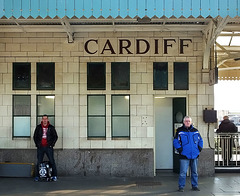
Great Western terracotta
| |
|
|
Cardiff Central Station was rebuilt by the Great Western Railway between 1932 an 1934 in an art-deco style. Much still remains including the fine terracotta names on the platform structures.
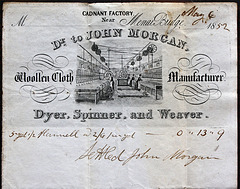
John Morgan, Cadnant Factory, Nr Menai Bridge
| |
|
|
|
Invoice for 5½ yards of flannel supplied in 1852 from the woollen mill on the River Cadnant close to Menai Bridge. I suspect that the engraved image represents a rather grander affair than this mill actually was.
More information and old images can be found here. www.anglesey.info/menai-bridge-woolen-mill.htm
