

tarboat's photos
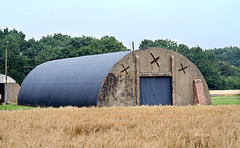
RAF Wickenby
| |
|
|
Storage building on the former technical site at Wickenby Airfield, a WWII bomber base. Just like a big Nissen hut.

The high tip
| |
|
|
|
Colourful lighting at sunset as a spoil train climbs the high tip at Sandaoling opencast coal mine.

Ars longa, vita brevis
| |
|
|
Art is long, life is short.
Panel on the former Technical School on Abbey Road, Barrow-in-Furness which was was built 1900-1903 for Barrow Corporation to the design of Woodhouse and Willoughby. The building contractor was W Gradwell and Co. It is listed Grade II.
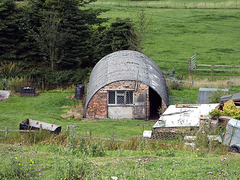
Asbestos nissen
| |
|
|
Not all nissen type huts have corrugated iron roofs. The non-rusting nature of asbestos meant that quite a lot of them used corrugated asbestos sheets instead. This example is at Corda Well Farm, Astbury.

Limekiln in action
| |
|
|
Limekiln at Liaosichang west of Baofeng near Pingdingshan. Limestone ready for burning on the left and a large supply of coal to the right.
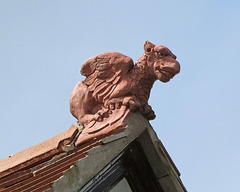
Not really a dragon
| |
|
|
|
Another ridge beast spotted in Green Lane, Buxton. This is definitely not a dragon, rather some other mythical beast sitting on the roof. Clearly a fairly modern replica as the detailing is nowhere near as good as on the examples from the early 20th century.
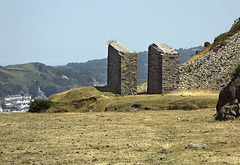
Incline Head
| |
|
|
|
The Conwy stone quarries are easily visible from the A55 a short distance west of the tunnel under the estuary. A microgranite was worked here during the nineteenth century under a number of quarry owners. A series of inclines connected at least four levels with the mill and loading bunkers on a siding off the Chester and Holyhead Railway. Closure came at some point between 1936 and 1945 after an agreement was reached to supply the North Wales Granite Co Ltd with stone from Penmaenmawr. The quarry is now sometimes used by climbers and the five incline drum houses stand empty, staring out onto the Irish Sea. This is the remains of the drumhouse on one of two inclines leading down from the second level of the quarry

Drilling rig
| |
|
Sandvik DX800 drilling rig seen at the recent Hillhead Quarry Exhibition.
From the publicity material: - " The Sandvik DX800 is a hydraulic, self-propelled, self-contained and crawler-based surface rig with an ergonomic, high-visibility cabin and a rod handling system. The DX's revolving superstructure, power, precision and versatility make them an ideal choice for construction, quarrying, or surface mining operations. "
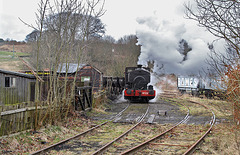
Exchange sidings
| |
|
|
AB 2774 gets to grip with a train of chaldron type wagons at the exchange sidings at the Beamish museum colliery site.
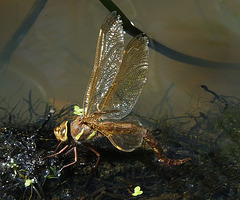
Brown Hawker at work
| |
|
|
Another view from the Church Minshull marl pit where this female Brown Hawker (Aeshna grandis) was busy ovipositing into the floating vegetation. This is a notoriously difficult species to photograph except when ovipositing as the adult males hardly land for more than a few seconds when on a territory.

Pant-y-Pydew kilns
| |
|
|
A fine block of five kilns stands adjacent to a large working quarry. The stone here was worked in the first half of the nineteenth century by John Lloyd and by 1862 it was operating as Lloyd Jones & Co. There is a large bank of lime waste in front of the kilns. Lime from here was used in the building of docks in Liverpool, Birkenhead and Belfast between 1860 and 1890. It appears that the bank of kilns was extended twice. Production ended in 1914 and the face of one kiln has now collapsed whilst its neighbour shows signs of having been robbed of stone. Since this photo was taken the kilns have seen significant restorationn and stabilisation works.
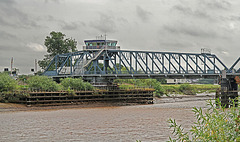
Boothferry Bridge
| |
|
Boothferry Bridge was built between 1926 and 1929. It replaced the ferry service by boat, from which the district took its name - Boothferry. This swing bridge crosses the Ouse and opens to allow shipping to pass through on its way to Selby amongst other places. Until the building of the M62 motorway and the Ouse bridge, it was the only point at which to cross the river without a round trip to Selby. This bridge carried most of the traffic traveling south from the port of Hull. The Humber bridge has relieved a lot of the southbound traffic and the M62 now carries the bulk of the traffic that otherwise would have used Boothferry bridge.
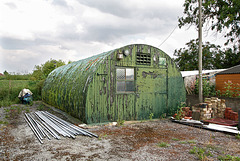
Owston Ferry Nissen
| |
|
|
This Nissen Hut was spotted whilst mooching around Lincolnshire recently. It is in good condition and being used by a builder.
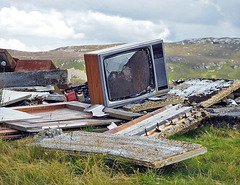
Bad reception
| |
|
|
The Blaen-y-Cwm TV booster station was blown down in a gale some time ago. The remains have just been abandoned as they fell, and provide a strange sight to anyone walking this high up above Ffestiniog.

Ferrybridge 'C'
| |
|
|
|
Scottish and Southern Energy plc currently operate the 2000 megawatt power station at Ferrybridge. This station first generated electricity in 1966.
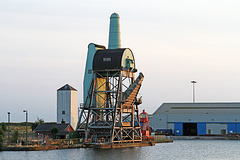
Tom Pudding hoist No.5
| |
|
|
|
The surviving compartment boat hoist at Goole Docks dozes in the late evening sun. These hoists were designed to load coal brought from Yorkshire collieries in floating trains of compartment boats into seagoing vessels. There was even a floating version of the hoist that could be towed to wherever in the docks it was required. This No.5 hoist is now preserved with a small museum attached.

Cottam Power Station
| |
|
|
|
EDF owns and operates the 2,000 MW coal-fired power station at Cottam alongside the River Trent in Nottinghamshire. It was opened in 1969.
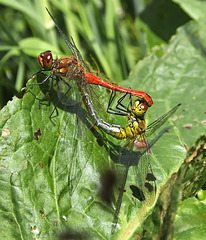
Ruddy Darters
| |
|
The Ruddy Darter (Sympetrum sanguineum) first appeared in Cheshire in the early 1980s, probably indicating a change in climate. The species is now widely distributed across the lowland areas of the county. This pair were at a marlpit in Church Minshull.
