

tarboat's photos
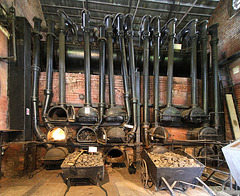
Retort House
| |
|
|
|
The Fakenham Gasworks Museum is a real gem and highly recommended to anyone interested in industrial history. At one time the works employed 8 men and supplied 500 homes.It closed in 1965 but was preserved and made into a museum in 1987. It is the only complete surviving gasworks in England.
This is the retort house which dates from 1907 - 1910 with 14 retorts grouped around two furnaces. The ascension pipes can be seen rising from the retorts to feed the gas and by-products into the hydraulic main above. The hydraulic main was essential to stop gas feeding back when the retorts were opened for recharging.
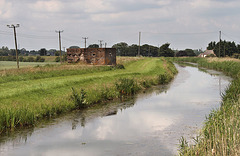
Defending the fens
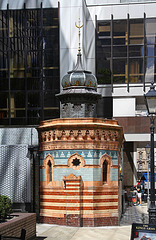
Nevill's New Turkish Baths
| |
|
|
This building and the baths beneath were constructed in 1894-5 by G. Harold Elphick for Henry and James Forder Nevill and opened by City of London Alderman Treloar on 5th February 1895.
Architectural journals of the day described the baths in glowing terms, praising both the overall decorative scheme and quality of fittings, and also the imaginative manner in which a very small ground level area was utilised. In 1895, before many of the streets in the area were re-named, the main entrance to the baths was in Alderman's Walk (now Bishopsgate Churchyard).
The baths themselves were partly underneath the original New Broad Street House (now demolished), and partly underneath Alderman's Walk. The entrance forms part of a kiosk in the upper portion of which were water tanks, masked by a Moorish style wall, and surmounted by a similarly styled onion shaped cupola, decorated with a star and crescent.
Entering the kiosk, the bather went down a winding staircase, lined by tin-glazed earthenware (faïence) to the entrance vestibule, where he bought his ticket.
At the end of July 1908, the two Nevills floated a company, Nevill's Turkish Baths Ltd, with an capital of £75,000. In addition to the New Broad Street Baths, the company was to 'acquire and take over as going concerns the business of proprietors or keepers of Turkish, Electrical, Light, and other Baths and appliances, carried on by James Forder Nevill' at Harrow Road, Northumberland Avenue, Commercial Road East, High Street Whitechapel, Wool Exchange, and Railway Approach at London Bridge.
At this time, the lease on the New Broad Street basement still had 46 years to run at an annual rent (in 1908) of £395. The baths remained open until 1954 until the expiry of the lease when Nevill's decided not to renew it.
After a period of use for storage the baths were converted as a restaurant although that business has now closed. The building itself is listed Grade II.
More details are on this page from which much of the above has been gleaned. www.victorianturkishbath.org/6directory/AtoZEstab/London/NewBroad/NewBroadSF.htm
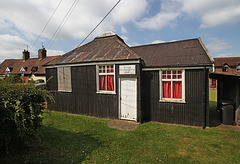
Denver Reading Room
| |
|
|
The Reading Room at Denver, near Downham Market in Norfolk, dates from 1903. The design is completely different from any tin tabernacles I have seen. It also has an add-on bin store.
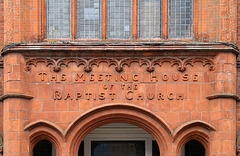
Meeting House
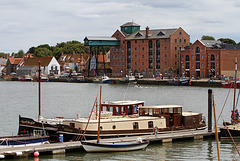
Barges at the quay
| |
|
|
A couple of barges have made the trip over the Wash from Boston to Wells-Next-The-Sea harbour. The old granary in the background has now been converted to holiday flats.
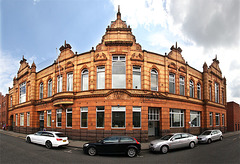
Municipal Buildings
| |
|
The municipal buildings in Boston are dated 1902 although they were not officially opened until 1904. This is currently the headquarters of Boston Borough Council.
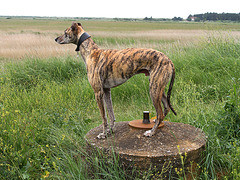
Against invasion
| |
|
|
|
Once again Jefferson does his best impression of a 29mm spigot mortar, this time on a base located on the coast at Thornham in Norfolk.
Norfolk kiln
| |
|
|
|
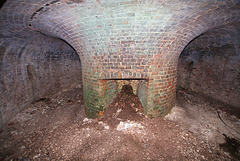
The design of limekilns in Norfolk is very different from those seen in the north of Britain. The bowl is sunk into the ground with a circular chamber around the draw holes. This chamber has a number of vents to the surface with small square brick chimneys to take away the fumes and smoke. This limekiln at Holkham is in better condition than most although it dates from before 1838. Repairs to the structure suggest that it may have been reactivated during the Second World War.
Classic garden shed
Simms Reeve Institute
| |
|
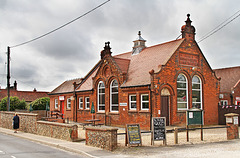
This village hall at Brancaster was built in 1905 and is named after Simms Reeve who was apparently Lord of the Manor in the latter years of the nineteenth century.
Holiday accommodation
| |
|
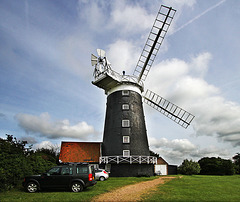
The windmill at Burnham Overy Staithe was built in 1816 for miller Edmund Savory. It worked until 1919 and in 1926 was sold to Hugh Hughes, an architect from Grantchester, Cambridgeshire. Hughes who had the mill converted to holiday accommodation. After significant repairs in 1957 it passed to the National Trust. It is listed Grade II*.
Central Buildings
| |
|
|
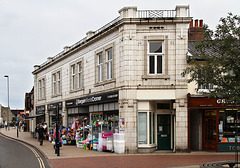
Central Buildings - 71-73 Church Street, Cromer. Erected in the 1930s to the design of J Brown of Northampton. A stand-out building clad with cream faience.
The bells, the bells!
| |
|
|
|
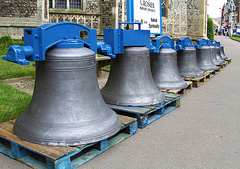
It's not often you find a whole peal of bells standing on the ground. The Cromer Church bells have been undergoing refurbishment at the Whitechapel Bell Foundry from where 5 of the 6 that have rung out over the town were cast in 1873. All but one of the earlier bells were sold in 1767 to help pay for roof repairs. The bell second from the left is an original dating from 1495 and that to the left is the tenor which weighs 635kg. Two new bells at the far end have been paid for by donations and will bring the peal to a full octave when they are rehung in the church.
Boston
| |
|
|
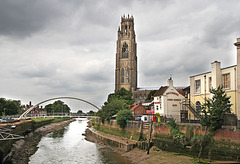
Having never before explored towards the Lincolnshire coast, we took a trip to Boston to see what was there. We found an interesting little town where everyone spoke Polish. The most memorable feature of the town is the medieval church of St Botolph's with its 272 ft high tower known widely as 'Boston Stump'.
Docking water tower
| |
|
|
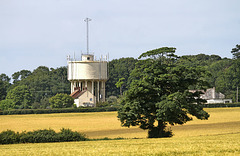
The water tower at Docking in Norfolk is, sadly, somewhat disfigured by communications masts and antennae.
Prudential building
| |
|
|
|
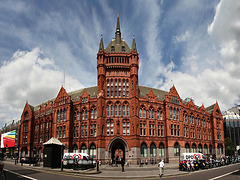
The Prudential Building at Holborn Bars was built in phases between 1879 and 1901 to the designs of Alfred Waterhouse. It was the headquarters of what was the largest life assurance company in Britain. It is now in multiple occupancy and Grade II* listed.
Engine House Cottage
| |
|
|
|
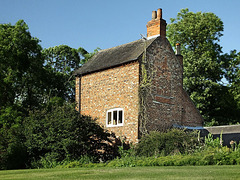
This former Newcomen enginehouse close to the blast furnace at Moira has been dated to 1805 based on a dated beam within. It pumped the Furnace Pit before conversion to housing in the nineteenth century. It is listed Grade II.
