

tarboat's photos
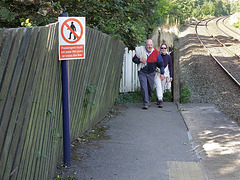
Corporate stupidity
| |
|
|
The rules must state that every station platform requires a sign at the end(s) to inform the public that they must not pass beyond that point. This is fine up to a point, but what happens when a main access to the station is through a gate beyond the platform end? Two hopeful passengers arrive at Middlewood Station, apparently in direct conflict with the rules.
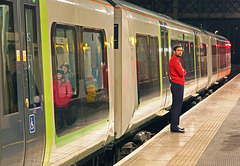
Ready to go
| |
|
|
The passengers who have just disembarked are reflected in a Desiro EMU is ready for departure from Stoke Station on a service to Crewe.
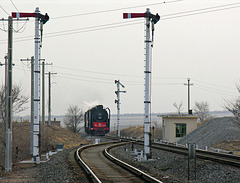
Light engines
| |
|
|
|
QJs 6998 and 7012 running light engine back to Daban, move into the loop at Chaganhada on the Jitong Railway, ready to pass the eastbound passenger service which arrived a few minutes later.
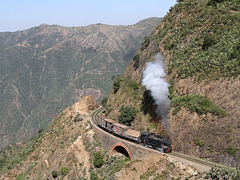
Devil's Gate
| |
|
|
|
One of the signature views for the Eritrea Railway is the Devil's Gate at Shegereni. This is one take on the subject with a Mallet passing with a short freight.
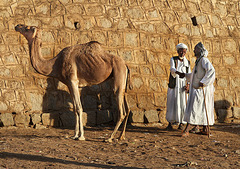
A deal is struck
| |
|
|
After close examination of the goods, and subsequent haggling over the price, a deal is struck at the Keren camel market.
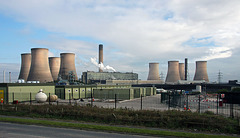
Coal power
| |
|
|
Fiddler's Ferry Power Station burns up to 16,000 tonnes of coal a day and is also capable of co-firing biomass. Opened in 1971, the station has a generating capacity of 1,989 megawatts and is currently operated by Scottish and Southern Energy.
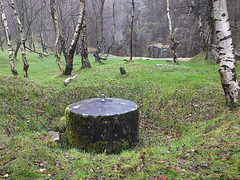
Bolehill Quarry Spigot Mortar
| |
|
This spigot mortar mount in a quarry was a complete surprise. I can only surmise that it was built to allow the local Home Guard unit to practice with the weapon in a safe location.
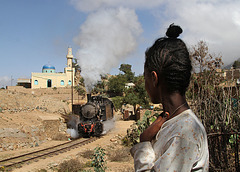
Nefasit departure
| |
|
|
|
A local girl watches Mallet 442-59 make a spirited start towards Asmara from the village of Nefasit on the Eritrean Railway.
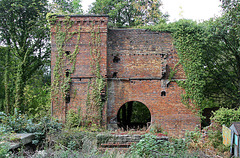
Wynnstay Colliery fan house
| |
|
|
Wynnstay Colliery was sunk by the New British Iron Company starting in 1856.By 1896 the ownership lay with Wynnstay Collieries Co. Ltd., Ruabon, and this company erected a 22ft Walker ventilation fan in 1902. Although the colliery closed in 1927 there are extensive remains to be found on the site including the winding enginehouse ( www.ipernity.com/doc/302581/35388203 ), and this building that housed the fan.
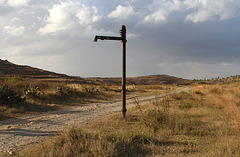
Run dry
| |
|
|
|
A lonely water column awaits the traveller on the trackbed of the old railway at Zazzega between Keren and Asmara. At the top of a long climb at 1 in 30 for eastbound trains it would have been a welcome sight for hard pressed loco drivers. The torpedo tank that had supplied this column was nearby having been tumbled from its mountings.
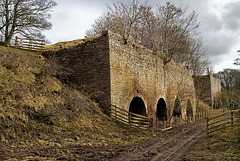
Frosterley kilns
| |
|
|
Limekilns formerly serving Bishopley Quarry, Frosterley, Durham. They are in good order considering that they have been abandoned for over 100 years.
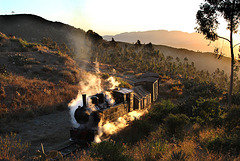
Eritrean steam sunrise
| |
|
|
|
1915 built small Mallet 440-008 may be leaking a lot of steam but it still performed well with this short freight approaching the summit of the line to Asmara at sunrise. Sadly this may be its swansong as the future of steam operations on this line is in doubt unless coal supplies can be secured.
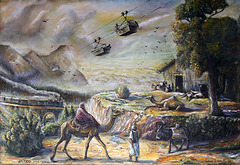
Eritrean transport
| |
|
|
|
This painting is displayed in the reception area of the Sunshine Hotel in Asmara. It depicts the main modes of transport available at that time between the port of Massawa and the capital city of Asmara. The camels continue to provide heavy transport in many places, whilst the railway has been rebuilt and sees occasional trains. The other mode was the 76km long aerial ropeway that was completed in 1937.
The ropeway was constructed by Ceretti and Tanfani S. A. of Milan. The motors were to be supplied by S. A. Franco Tosi of Lengano. The cables were the responsibility of S. A. Giuseppe & Fratello Redaelli of Milan. Finally all the physical work of digging and building the materials was contracted locally. Construction took only 16 months even though the terrain was rugged and rose from sea level to a height of 2340m at Asmara. Each car could hold about 300 kg (660 lbs.) and could be covered to keep out the elements. When operating at full capacity, the tramway could support about 1520 cars at once. At capacity the tramway was able to deliver 30 tonnes of goods an hour, 24 hours a day.
The painting is inaccurate as it depicts the ropeway as a single rope system, whereas it was actually a two rope system with a fixed rope on which the cars ran and a separate hauling rope to which the cars were attached.
After the British ejected the Italians from Eritrea in 1941 the ropeway saw reduced use and was soon abandoned with the diesel engines that drove it being taken for use elsewhere. There is an excellent booklet about the system which is available on line at www.trainweb.org/italeritrea/teleferica1.htm .
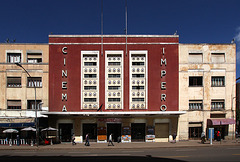
Cinema Impero
| |
|
|
|
The Cinema Impero in Asmara was built in 1937 by the Italian colonial authorities. It was named after Mussolini's conquest of Ethiopia and his proclamation of the Italian Empire. The building is considered to be one of the finest Art Deco style buildings in the world and remains in use as a cinema.

Baths entrance
| |
|
|
Ansley Hall Colliery opened in 1878 and soon after the Ansley Hall Coal & Iron Co. Ltd was founded. The pit closed in 1959 and since then the pithead baths buildings have been in industrial use. This is one of the entrances to this 1930s building.
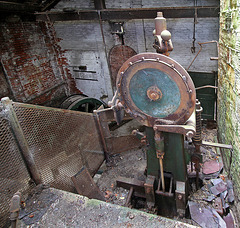
Indication and governance
| |
|
|
Shaft indicator and governor remains on one of the winding engines at Hemingfield Colliery.
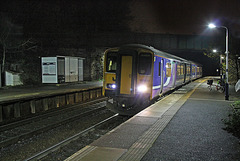
Middlewood Station
| |
|
|
I never cease to be amazed by the capabilities of digital cameras in low light situations. Having dived off the train on my way home from an evening in Stoke, I was able to capture the scene hand held, without flash, using 1600 ISO. OK it's quite grainy, but the overall effect isn't that bad.
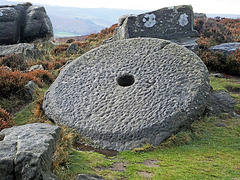
When millstones go bad!
| |
|
|
|
Failed millstone on moor above Mother Cap on the Sheffield moors. To have done all that work before the faults appeared must have been heartbreaking.
