

tarboat's photos

Con Club
| |
|
|
The polychromatic brickwork is prominent on the Con Club restaurant and bar on Greenwood Street in Altrincham. This was formerly Altrincham Working Men’s Conservative Club on Greenwood Street from 1887 - 2016, The keystone over the entrance is inscribed ACWC OPENED FEB 17TH 1887.

O&K
| |
|
|
|
Orenstein & Koppel 5662 of 1912 was sold to a company in Argentina and may have worked there in the sugar industry. It arrived in the UK in 2003 having languished out of use since at least the 1980s and eventually came to Apedale via Statfold Barn in May 2014. Restoration was completed at Apedale and the loco entered traffic in 2022. It is seen here ready for work at the late December gala on the Apedale Valley Light Railway.

Hulme's Pit
| |
|
|
Hulme's Pit alongside the river Tame in Denton. It is reputed to have opened in c.1730 but it is known that it was operated by the Fletcher family (Denton Colliery Company) who eventually used it as a pumping station to drain water from their mine workings. A beam engine was installed here before 1834, prior to the pit being taken over by Denton Colliery It was used for both winding (men and coal) and pumping. It raised water from a depth of 420 feet at a boiler pressure of five pounds per square inch. Steam was supplied by two Cornish boilers. In the early 1920s it was recorded that it removed eight gallons of water per stroke at six strokes per minute. It worked 4½ hours a day, 7 days a week and it consumed three tons of coal per week. This means that it raised 4,730,400 gallons of water from the workings of Denton Colliery every year for a coal consumption of 156 tons. The pit closed in 1929/30, at the same time as Denton Colliery, and the beam engine was scrapped in the early 1930s. All the buildings associated with the pit were subsequently demolished but the surviving stone foundations of the pit were excavated in the 1970s.

Haig Pit
| |
|
|
Haig Pit at Whitehaven was sunk in 1914 and closed in 1986. The surviving buildings at the pithead were incorporated into a mining museum but this closed in 2016.

Regent Foundry
| |
|
|
M H Watts, engineers and founders, Regent Iron Works, Catherine Street, Macclesfield.
The business started in 1810 when Messrs Stringer and Green opened a machine shop in Catherine Street. A foundry was added to the works c1816/1820. Martin Watts married Anne Green and in the early 1840s was manager of the works, subsequently buying the business in 1847.
Watts' foundry produced iron castings up to 30cwts from the cupola furnace and a variety of non-ferrous castings in a pit furnace. The business finally stopped production in the 1970's by which time it was in the ownership of Peter Allmand Smith, the son-in-law of Percy Watts. The premises have since been converted to apartments.

Rhydymwyn
| |
|
|
Building at the Rhydymwyn Valley Works near Mold. This large site was used for the processing of poison gas munitions during WWII. The finished shells and bombs were stored in nearby tunnels.

Piccadilly
| |
|
|
|
Northern and TransPennine Express services awaiting departure at Manchester Piccadilly.

Winding drum

Arrow
| |
|
|
Arrow Mill, Castleton, Rochdale was was designed by Sydney Stott for R & T Howarth. It was built very quickly. The contract to build was signed in late 1906, the first brick was laid in January 1907, the engine first ran under steam in February 1908 and the first cotton was spun in this large mill fifteen months after the first brick was laid. It was acquired by Courtaulds Ltd in 1934 and sold by them to Arrow Mill Fabrics Ltd in 1979. This was the last cotton mill to operate in the Rochdale area and did not cease production until the late 1990s. It is now listed Grade II and is in multiple occupation.

Waiting to enter service
| |
|
|
A nice lineup at Sandtoft Trolleybus Museum. From the left are ARD 676, Reading Corporation Transport AEC661T Park Royal trolleybus of 1938/39, Huddersfield Corporation Sunbeam S7A trolleybus PVH 931, new in 1959, and 297 LJ, Bournemouth Corporation 1962 Sunbeam MF2B / Weymann 65-seater.

Free Library
| |
|
|
|
Penzance School of Art and Free Library, designed by Silvanus Trevail, was opened in March 1881. The Grade II listed building was financed by the gift of land and other donations. During the late 1880s there was remodelling of the façade, and a museum and science school were added, all designed by Henry White FRIBA, a former student. The school is currently run by Penwith College but the library closed in 2016.
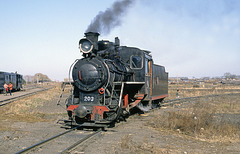
Forest line
| |
|
|
C2 203 on the turning triangle at the terminus of the Suiling forestry railway. This was a very long line with several branches and almost entirely steam operated when I visited in 1992.

Ready for casting
| |
|
|
|
Moulds ready for casting plaques and signs in aluminium at the Dove Holes foundry of Leander Architectural.

British Steel

Welcome to Bligh's Meadow

Spring steam
| |
|
|
'Isaac' - Bagnall 3023 of 1952, at the head of two Darjeeling type coaches during the Statfold Barn Railway spring event of 2025.

Energy from waste
| |
|
|
|
The Lostock Sustainable Energy Plant (LSEP) is an Energy from Waste facility which is currently under construction at the Lostock Works site near Northwich in Cheshire, formerly the coal fired power station for Lostock Works. It will export 69.9MW of electricity to the grid using residual waste (the waste material remaining once materials that can be recycled have been removed) as a fuel. It was was due to open in 2025 but is running behind schedule.
LSEP Ltd is a joint venture between Copenhagen Infrastructure Partners (CIP) and FCC Environment.

Two giants
| |
|
|
West Burton power station was on part load whilst beyond the Cottam power station was hard at work on this bright cold winter day in January 2019. All now closed and under demolition.
