

tarboat's photos

Richard White & Sons
| |
|
|
The Widnes based firm of Richard White and Sons was well known for its railway and materials handling equipment. A particular speciality was aerial wire ropeways which found a ready market in mines and quarries across Britain.

Clarence over the rooftops
| |
|
|
|
Clarence Mill is a five-storey former cotton spinning mill in Bollington, Cheshire, built between 1834 and 1877 for the Swindells family. It was located alongside the Macclesfield Canal, which opened in 1831, in order to take advantage of the latest transport options. The building is now a mix of apartments and commercial uses and is listed Grade II.
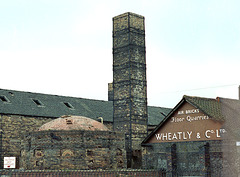
Wheatly's
| |
|
|
Wheatly & Co Ltd. Springfield tileries, Trent Vale. Wheatly's was established before 1819 and was famous for its 'Triton' brand roofing tiles. In 1978 the company was taken over by Daniel Platt Ltd of Brownhills Tileries in Stoke, then in 1982 works was closed and demolished soon afterwards.

Bergrivier
| |
|
|
|
19D 3322 takes a mixed train across the Bergrivier bridge at Moravia on the Klawer Branch in Western Cape.

Cranmore milk
| |
|
|
|
46447 leaves Cranmore station on the East Somerset Railway with a train of milk tanks.

Island Flyer
| |
|
|
|
The Isle of Wight Hovercraft operated by Hovertravel is the world's only year-round scheduled passenger hovercraft service. It operates a regular timetable transporting passengers between Ryde and Southsea in Portsmouth. Hovercraft GH-2161, 'Island Flyer'," is a Griffon Hoverwork 12000TD model and was introduced on the service in 2016. It has a capacity for around 80 passengers and a 12-tonne payload.

Industry
| |
|
|
Droylsden formed its own industrial Co-operative Society in December 1861, with 71 members and £104 4s 1d. The Society thrived and in 1876 it opened a large meeting hall above its shop facilities. Subsequent extensions included this 1911 building embellished in stone and terracotta. It's good to see the industrious bees at work. The building is no longer in Co-op use.

Coal delivery
| |
|
|
As winter draws in the boaters on the Macclesfield Canal need plenty of solid fuel to keep warm and maybe diesel for the engine or central heating. The setting sun glints on the moored boats and the fuel boat Alton as it makes a delivery to the moorings at Middlecale.

Tanks

Coal for the washery
| |
|
|
|
Whilst the Jalainur opencast coal mine supplied the majority of the coal handled by the adjacent washery, there was also traffic from the nearby deep mines. Deflector fitted SY 1416 is here bringing in a trainload from the Tiebeikuang mine.

Guangshan Mine
| |
|
|
The winding towers and coal bunkers of the Guangshan Mine at Beipiao viewed across a large area of workers' housing under demolition. The mine is now also abandoned.

Wildboarclough
| |
|
|
|
Another view from my recent walk on the moors above Buxton. This is looking across Wildboarclough to the bulk of Shutlingsloe. The farmstead in the centre is Lower Barn and that to the right side is Higher Barn. In the lower right corner are the remains of the Dane Thorn drift mine which was being worked in 1879 by William and Harold Hand.

Sanbao loading
| |
|
|
The screens building and rail loading area at at the Sanbao colliery, Liaoning Province, China. At first glance it looked to be closed but the presence of loaded wagons told another story. The mines in this area were extensively developed by the Japanese during their occupation in the 1930s and early 1940s. All now demolished.
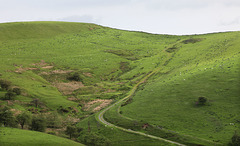
Back Sponds
| |
|
|
This small valley in Lyme Handley between Pott Shrigley and Kettleshulme formed part of the Lyme Estate owned by the Legh family of Lyme Hall. The thin coal seams found under here were worked in the second half of the nineteenth century by William Hewitt a local man. There is evidence of both shafts and adits in this view and in the 1870s there was a small brickworks just below the centre. After the death of William in 1890 his son struggled to capitalise the business and the mine was closed by 1896. That was not the end of coal working in the valley and in 1950 William Hewitt's great-grandson opened an adit close to the tight bend where the road crosses and which operated for a few years.

Feedstuff
| |
|
|
Adjacent to the Parkhouse brickworks is the feedstuffs mill of ForFarmers UK. The business offers organic feedstuffs to the livestock farming industry. It is a subsidiary of ForFarmers N.V., a leading player in Europe with sales of approximately 10 million tonnes of animal feed.

Irlam autumn
| |
|
|
|
The leaves are turning gold as a Trans Pennine Express service to Liverpool arrives at Irlam Station. As well as an excellent cafe the site has a fine local railway museum.
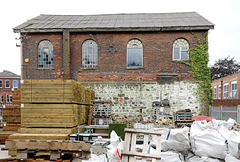
Sheepbridge No.1 Colliery
| |
|
|
The colliery was sunk in 1857-58 in the works yard of the Sheepbridge Iron and Coal Company (established 1862 and incorporated in 1864) to the Deep Hard seam. The Sitwell Coal was reached at 54 feet and the Deep Hard at 218 feet. This is the pumping enginehouse which appears to have contained a horizontal pumping engine working a shaft in the area just to the right of the building. The 1914 OS map shows the main colliery buildings demolished but the pumping engine house and boiler house remained and may ahve continued in use for a while after winding coal ended. The building is now used for storing builders' materials.

Crushing
| |
|
|
A happy afternoon some years ago exploring an old abandoned stone quarry which yielded lots of old machinery quietly rusting and rotting away. Here two crushers sit side-by-side, both made by Robert Broadbent & Son Ltd., Phoenix Ironworks, Stalybridge. On the left is a jaw crusher of the Blake's patent type for primary crushing of larger pieces of rock. To the right is a roll crusher designed to break smaller pieces of rock down to cubes for roads and paths etc. I think that the remains below the crushers might have included some form of rotary screen but the decay of the various parts made it difficult to be sure.
