

Eugène Lorrain's autograph at the back
Eugène Lorrain by Carjat
Elisa Volpini's autograph at the back
Elisa Volpini by Cezar Massat
Regina Pacini by Atelier Fillon (Bobone)
Adelina Patti and Giovanni Mario by Caldesi
Enrico Tamberlick by Negretti & Zambra
Enrico Tamberlick by Nadar
Céline Anna van Ghell; dedication and signed Anna
Céline Anna van Ghell by Mayer & Pierson
Zoé Bélia by Numa Blanc
Marie van Zandt by Benque (4)
Rosine Bloch by Petit (2)
Victor Maurel by Nadar
Augusto Brogi by Bini
Mira Heller's autograph at the back (1)
Mira Heller by Antonopoulo (1)
Mira Heller's autograph at the back (2)
Mira Heller by Antonopoulo (2)
Jules-Célestien Devoyod by Unknown with autograph
Alma Fohström von Rode by Trunov with autograph
Ortensia Synnerberg's dedication to Auguso Brogi a…
Ortensia Synnerberg by Fedecki with autograph
Therese Tietjens by Mayall with autograph
Célestine Galli-Marié by Carjat (2)
Letter by Célestine Galli-Marié to Mr. Briet
Célestine Galli-Marié by Bingham
Célestine Galli-Marié by Lumière
Célestine Galli-Marié by Nadar (2)
Blanche Cole by Elliott & Fry
Angelina Luger by Leopold Bude
Angelina Luger's autograph at the back
Caroline Girard by Franck
Achille-Felix Montaubry by Carjat
Gabrielle Krauss by Petit
Jean-Baptiste Faure by Reutlinger (4) with autogra…
Jean-Baptiste Faure by Disdéri (5)
Italo Gardoni by Chancellor
Marie-Julie Baretti by Bureau
Edmond Duvernoy by Ken
Mathieu-Émile Balanqué by Constantin
Christine Nilsson by Reutlinger (7) with autograph
Adele Isaac by Reutlinger
Adele Isaac's autograph at the back
Armand Castelmary by Niclas
See also...
Authorizations, license
-
Visible by: Everyone -
All rights reserved
-
374 visits
Antoine Renard by Victoire with autograph
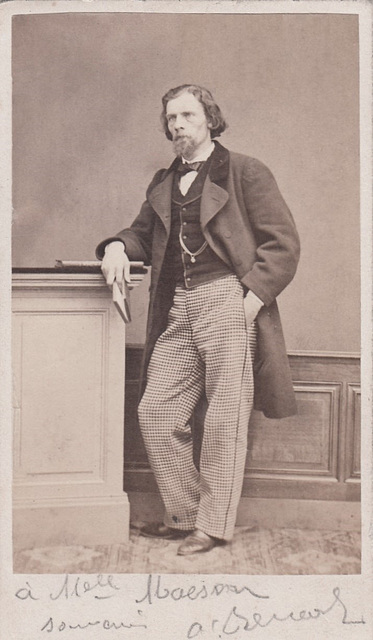

Antoine Aimé Renard (1825-1872); French tenor and composer.
He is best remembered for composing the melody for the famous "Le Temps des cerises", now a milestone of the French repertoire. Born in a working class family, as a teen he joined his father in a print shop and afterwards he was a foundry worker. In the evenings he sang in vaudeville productions at local inns or in the streets. He slowly established himself by joining the regional choirs and the choir of the Grand Opéra Paris. Then he obtained a commitment as a tenor at the theatre of Nîmes in 1852 followed by Le Havre, Strasbourg, Bordeaux, Lyon in 1855 and finally the Grand Opéra Paris in 1856. The following year he had his breakthrough in Rossini’s "Guillaume Tell". As a true bohemian, he was a popular figure in the French capital, what was illustrated by the caricatures made of him by Etienne Carjat and others, several of which are preserved at the French National Library. Hector Berlioz, who directed Renard at a concert in Baden in 1861 wrote that the tenor had "a very full and sonorous voice", an extended range and a very clear enunciation. In 1867, Renard met the impoverished songwriter Jean-Baptiste Clément in Brussels, and, according to lore, offered him his coat. In return, Clément offered Renard one of his songs, Le Temps des Cerises. Renard put music to it and introduced the song to the public in 1868, at the Paris Eldorado Theatre. It quickly became popular and has been recorded by a great number of artists since then. Renard then became gravely ill (a victim of laryngeal cancer, according to some sources) and his career rapidly declined. The artist died three years later, without reaping the rewards of his enduring creation.
He is best remembered for composing the melody for the famous "Le Temps des cerises", now a milestone of the French repertoire. Born in a working class family, as a teen he joined his father in a print shop and afterwards he was a foundry worker. In the evenings he sang in vaudeville productions at local inns or in the streets. He slowly established himself by joining the regional choirs and the choir of the Grand Opéra Paris. Then he obtained a commitment as a tenor at the theatre of Nîmes in 1852 followed by Le Havre, Strasbourg, Bordeaux, Lyon in 1855 and finally the Grand Opéra Paris in 1856. The following year he had his breakthrough in Rossini’s "Guillaume Tell". As a true bohemian, he was a popular figure in the French capital, what was illustrated by the caricatures made of him by Etienne Carjat and others, several of which are preserved at the French National Library. Hector Berlioz, who directed Renard at a concert in Baden in 1861 wrote that the tenor had "a very full and sonorous voice", an extended range and a very clear enunciation. In 1867, Renard met the impoverished songwriter Jean-Baptiste Clément in Brussels, and, according to lore, offered him his coat. In return, Clément offered Renard one of his songs, Le Temps des Cerises. Renard put music to it and introduced the song to the public in 1868, at the Paris Eldorado Theatre. It quickly became popular and has been recorded by a great number of artists since then. Renard then became gravely ill (a victim of laryngeal cancer, according to some sources) and his career rapidly declined. The artist died three years later, without reaping the rewards of his enduring creation.
- Keyboard shortcuts:
Jump to top
RSS feed- Latest comments - Subscribe to the comment feeds of this photo
- ipernity © 2007-2026
- Help & Contact
|
Club news
|
About ipernity
|
History |
ipernity Club & Prices |
Guide of good conduct
Donate | Group guidelines | Privacy policy | Terms of use | Statutes | In memoria -
Facebook
X

Sign-in to write a comment.