

Xata's photos
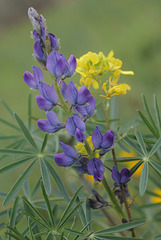
Lupinus angustifolius, Fabaceae, Ammaia, Marvão
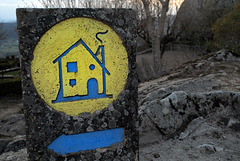
Blue and Yellow for TSC530
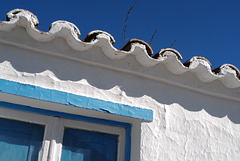
Penedos, I am not drunk ...yet !
| |
|
|
|
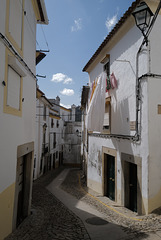
Castelo de Vide, Judiaria
| |
|
O castelo rodeado pelo casario branco destaca-se na paisagem e é sem dúvida a primeira surpresa para o visitante. Do alto, a paisagem alentejana adquire todo o seu esplendor. Pequenas aldeias no meio dos campos perdem-se de vista. Ali bem perto, a cerca de 20 km, espreita Marvão e um pouco mais além avistam-se terras de Espanha.
Na encosta Norte, entre o Castelo e a Fonte da Vila, uma série de ruas mais estreitas delimitam o núcleo histórico da Judiaria. A Judiaria de Castelo de Vide é um dos exemplos mais importantes da presença dos judeus no nosso país, remontando ao século XIII, tempo de D. Dinis. Aí podemos encontrar uma das melhor preservadas judiarias de Portugal, já há alguns anos incluída num programa de recuperação de edifícios e de revitalização, onde se preserva um dos maiores espólios de arquitetura civil do período gótico.
Passeie-se então, ao acaso por essas ruas íngremes e estreitas e deixe-se encantar pelo charme da sua memória medieval.
Mas Castelo de Vide tem outros monumentos que valem a pena visitar. Falamos por exemplo da Capela do Salvador do Mundo, a mais antiga (finais do séc. XIII) cujo interior está coberto de painéis de azulejos azuis e brancos, ou da Capela de São Roque construída no séc. XV e reconstruída no séc. XVIII. Mas estas são apenas duas das 24 igrejas existentes.
Se ainda tiver tempo e vontade, pode subir ao monte fronteiro a Castelo de Vide, onde fica a Capela de Nossa Senhora da Penha e de onde tem uma outra perspetiva da vila.
Castelo de Vide sempre foi conhecida pelas suas riquezas naturais nomeadamente pelas termas, cuja água tem propriedades terapêuticas. Pode encontrar várias fontes sendo a Fonte da Vila e a Fonte da Mealhada as mais conhecidas. No entanto aqui fica um alerta. Fique sabendo que, a acreditar nos ditos populares, quem bebe da água da Fonte da Mealhada há de voltar a Castelo de Vide para casar.
+++++
The castle surrounded by white houses stands out in the landscape and is undoubtedly the first surprise for the visitor. From the top, the Alentejo landscape acquires all its splendour. Small villages in the middle of the fields are lost to view. Nearby, about 20 km away, you can see Marvão and a little further on you can see Spain.
On the northern slope, between the castle and Fonte da Vila, a series of narrow streets mark the boundaries of the historic nucleus of the Judiaria. The Jewish quarter of Castelo de Vide is one of the most important examples of Jewish presence in Portugal, dating back to the 13th century, the time of King Dinis. It is one of the best preserved Jewish quarters in Portugal. For some years it has been included in a programme of building restoration and revitalisation, where one of the largest collections of civil architecture from the Gothic period is preserved.
So, stroll at random through these steep and narrow streets and let yourself be enchanted by the charm of its medieval memory.
But Castelo de Vide has other monuments which are worth visiting. We speak for example of the Capela do Salvador do Mundo, the oldest (late 13th century) whose interior is covered with blue and white tiled panels, or the Capela de São Roque built in the 15th century and rebuilt in the 18th century. But these are only two of the 24 existing churches.
If you still have the time and desire, you can climb the hill in front of Castelo de Vide, where the Chapel of Nossa Senhora da Penha is located and from where you have another perspective of the town.
Castelo de Vide has always been known for its natural riches, namely its thermal springs, whose water has therapeutic properties. You can find several fountains, the Fonte da Vila and Fonte da Mealhada being the best known. However, here is a warning. Believe the popular sayings, whoever drinks from the water of the Mealhada Fountain will have to return to Castelo de Vide to get married.
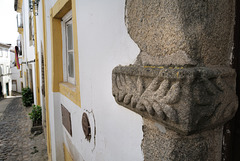
Castelo de Vide, Judiaria
| |
|
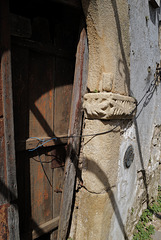
Castelo de Vide, Judiaria
| |
|
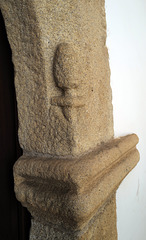
Castelo de Vide, Judiaria
| |
|
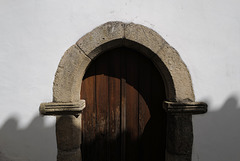
Castelo de Vide, Judiaria
| |
|
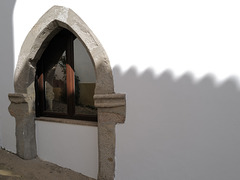
Castelo de Vide, Judiaria
| |
|
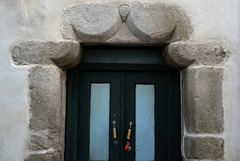
Castelo de Vide, Judiaria
| |
|
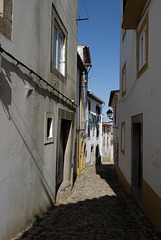
Castelo de Vide, Judiaria
| |
|
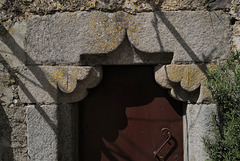
Castelo de Vide, Intramuros
| |
|
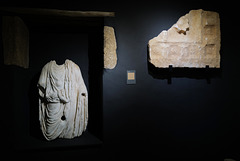
Ammaia, Marvão
| |
|
The Roman town of Ammaia was founded in the 1st century, likely under the reign of Claudius. Archaeological research from the early 21st century suggest that the town was already intensively settled around the reign of Augustus (end of the 1st century BC-beginning of the 1st century AD). The flourishing Roman town, lying in the Roman province of Lusitania, acquired its civitas statute in 44–45 AD, although there is some debate on whether it received its municipal status (municipium) during the reign of Nero, Lucius Verus or Vespasian. Many of its urban structures developed through the exploitation of the area's natural resources, and access to several roads connecting it to the provincial capital of Emerita Augusta (Mérida).
During the 4th century there was a systematic reconstruction and restoration of the spaces of Ammaia. Yet, between the 5th and 9th centuries, Ammaia fell in decline and depopulated. When this part of the Iberian peninsula was already under Arab rule, the city seems to have been completely abandoned in favor of the nearby fortified settlement of Marvão. Ibn Maruán, an influential and powerful muladi began using the self-styled title of master of Ammaia and its ruins in the 9th century.
In 1398, there is a reference to a mill along the Ribeira de Sever, owned by Diogo Gonçalves, a resident of Marvão.
Around the beginning of the 16th century, there are references to the use of materials from the ruins in Ammaia to construct religious projects in Portalegre and neighbouring communities. By 1619, Diogo Pereira de Sotto Maior indicated that the bridge of Portagem was still visible during a hike, noting: "...where there still appears a base that the river could not undue. It was torn down and destroyed by greed, to say, that it stole the rights of the goods passing to the kingdom of Castile. In its place, was constructed another far below the same river (Sever), which is a tower that is below the city (of Ammaia), which was called Portagem. There used to reside the guards of the kingdom, who executed the rights of the King."
In 1710, one of the gateways from the site were extracted for the Castle of Vide, and later destroyed.
Spanish investigator D. José de Viu (in 1852) cited the sale of 20 statutes from Ammaia to England.
The archaeological and historical identification of the site as the Roman town of Ammaia dates from the mid-thirties (1935). It was Leite de Vasconcelos who first proved that the Roman site was the city of Ammaia, and not Medóbriga, as was pre-supposed by André de Resende. It was first referred to as Medóbriga by Pliny, by Arab authors such as ʿĪsā al-Rāzī and by various writers and historians during the 16th century, including André de Resende, Father Amador Arrais, Diogo Pereira de Sotto Maior and Duarte Nunes de Leão.
On 26 April 1982, the old bridge of Ammaia finally collapsed. Part of the Roman road, and referred to as the Ponte Velha (old bridge), it was situated at quite a distance from the main ruins (four kilometres). It was a unique arch, constructed of masonry and Roman stonework.
The beginning of archaeological investigations of the Roman ruins began in 1994, and was followed by similar projects in 1995 and 1996 under the Fundação Cidade de Ammaia; there was a topographic survey and excavations were done in four locations, which also involved cleaning, studying and conservation: the Porta do Arco, Forum and Temple, Quinta do Deão building and the Forum baths. Since 2007, supervision of scientific research was handled by the University of Évora. The site of Ammaia has been chosen as "open-lab" of the European funded project Radio-Past, and it is now used as test-site for the integration and innovation in non-destructive approaches to complex archaeological sites (surface artifacts collections, geophysical and geo-archaeological survey, remote-sensing and aerial photography).
en.wikipedia.org/wiki/Roman_villa_of_Ammaia
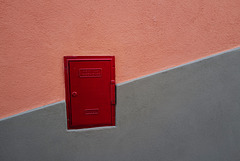
Mértola, Lines, HWW
| |
|
|
|
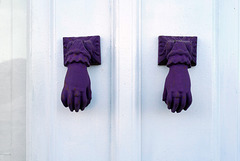
Mértola, Just knock once!
| |
|
|
|
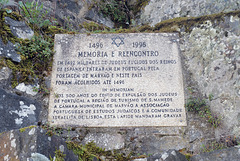
Portagem
| |
|
Memory and reunion
In the year 1492 thousands of jews escaped from the kingdom of spain and entered Portugal through Marvão toll and were received in this country until 1496.
In memoriam
On the 500th anniversary of the Edict of Expulsion of the Jews from Portugal...
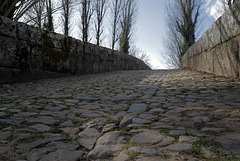
Ponte Romana da Portagem
| |
|
|
|
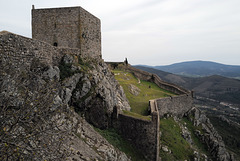
Marvão, Castle
| |
|
|
The Castle of Marvão is constituted by an imposing wall, where the typical and monumental picturesque village is enclosed, with a very old hull, and the castle itself, situated at the highest point of the rocky spur, in permanent vigilance over a bordering territory.
D. Afonso Henriques is said to have taken the fortress from the Moors in 1166.
Its excellent strategic position on the border defence line has earned it the attention of numerous monarchs, who have carried out major remodelling works, some of which can still be seen today.
D. Sancho II granted it a charter in 1226 in order to keep this outpost populated and thus protected from the numerous attacks from Spain.
But it was King Dinis who undertook the first major expansion and remodelling works. At that time - 1300 - the keep was built.
Years later, during the War of Restoration, the castle was rebuilt in an architectural language which seems to have been not only of a military nature but also, we might say, aesthetic, evident in the volumetry developed at the time.
Adjoining the Keep, a high interior wall still survives today, which surrounds the terreiro. This structure is still surrounded by a second line of walls, reinforced with turrets and battlements.
The barbican is the beginning of an extensive defensive line that crowns the hill and surrounds and protects the town.
