

Zahn um Zahn (2xPiP)
Im Verborgenen blühen ...
Handwerkskunst !
Michel Legrand - La valse des lilas (1976)
Verführerisch, aber sehr giftig - Seductive, but v…
Ein Zaun ||| ||| |||
CHIUSO
Schwanowski - ähh ... Swarowski
Einen der größten Laufkäfer Mitteleuropas ... One…
Passez un bon we mes ami(e)s ❤️ Bon dimanche
Roses pour tous*****************
Coucher de soleil vu de ma fenêtre ❤️
Einsame Tulpe
Fressen und gefressen werden - Eating and being ea…
Pompon***************
Pansy Party
Rosen mit Bubble Bokeh
Reifezeit
Wenn die Sonne das Meer berührt
620A0479
Mitica Ducati
Bon WE mes ami'e)s !
IMG 911600
verschlossen
Drei Farben
| o V o | - in blue
Sundown am Chiemsee
Rose Edith Piaf
Fine estate a Méjanes - HFF !!!
Let the sunshine in ...
memories
Seglertraum
Biene oder Wespe? Bee or wasp?
Sunset On Glass Door.
Passez un bon we mes ami(e)s !❤️
Paarungsbereit - Ready to mate
Une rose rouge pour nos coeurs*************
Echinacea - Sonnenhut
Pour vous mes ami(e)s ! belle journée ❤️
Summer in the mountain
Cosmea
Innenleben einer Amaryllis
Alle Antennen ausgefahren
Sooo lange Fühler - So long antennae
Kaisermantels Abstieg

See also...
Keywords
Authorizations, license
-
Visible by: Everyone -
All rights reserved
-
703 visits
Der zweitkleinste Bläuling Mitteleuropas - The second smallest blue in Central Europe
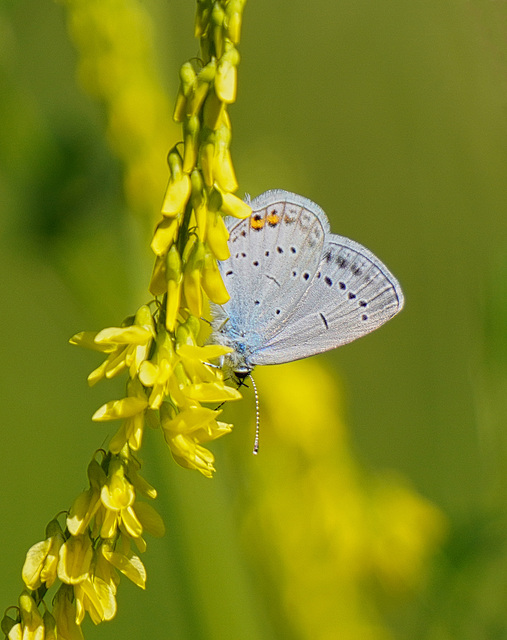

Mit einer Flügelspannweite von 25-35 mm ist der Kurzschwänzige Bläuling (Cupido argiades) der zweitkleinste Bläuling in Mitteleuropa. Ein Erkennungsmerkmal ist das winzige "Schwänzchen" am Hinterflügel (siehe Notiz).
Diese sehr unauffällige Art galt noch vor Jahren in vielen Gebieten Deutschlands als ausgestorben, zum Glück tauchen aber immer mehr Falter auf, so dass diese Bläulingsart mittlerweile als nicht mehr bedroht angesehen wird. Allerdings habe ich den Kurzschwänzigen Bläuling hier bei uns in der Würzburger Gegend noch nie gesehen. Deshalb war ich mehr als überrascht, dass bei der Auswertung der Fotos nach einer Wanderung diese bei uns seltene Art bestimmt werden konnte.
Da ich nur wenige Sekunden Zeit zum Fotografieren hatte, ist die Bildqualität etwas eingeschränkt.
de.wikipedia.org/wiki/Kurzschw%C3%A4nziger_Bl%C3%A4uling
With a wingspan of 25-35 mm, the Short-tailed Blue (Cupido argiades) is the second smallest blue in Central Europe. A distinguishing feature is the tiny "tail" on the hindwing (see note).
Years ago, the very inconspicuous species was considered extinct in many areas of Germany, but fortunately more and more butterflies are appearing, so that this species of blue butterfly is now no longer considered threatened. However, I have never seen the Short-tailed Blue here in the Würzburg area. I was therefore more than surprised that when I analysed the photos after a hike, I was able to identify this species, which really is rare in our region.
As I only had a few seconds to take the photos, the picture quality is somewhat limited.
Translate into English
Diese sehr unauffällige Art galt noch vor Jahren in vielen Gebieten Deutschlands als ausgestorben, zum Glück tauchen aber immer mehr Falter auf, so dass diese Bläulingsart mittlerweile als nicht mehr bedroht angesehen wird. Allerdings habe ich den Kurzschwänzigen Bläuling hier bei uns in der Würzburger Gegend noch nie gesehen. Deshalb war ich mehr als überrascht, dass bei der Auswertung der Fotos nach einer Wanderung diese bei uns seltene Art bestimmt werden konnte.
Da ich nur wenige Sekunden Zeit zum Fotografieren hatte, ist die Bildqualität etwas eingeschränkt.
de.wikipedia.org/wiki/Kurzschw%C3%A4nziger_Bl%C3%A4uling
With a wingspan of 25-35 mm, the Short-tailed Blue (Cupido argiades) is the second smallest blue in Central Europe. A distinguishing feature is the tiny "tail" on the hindwing (see note).
Years ago, the very inconspicuous species was considered extinct in many areas of Germany, but fortunately more and more butterflies are appearing, so that this species of blue butterfly is now no longer considered threatened. However, I have never seen the Short-tailed Blue here in the Würzburg area. I was therefore more than surprised that when I analysed the photos after a hike, I was able to identify this species, which really is rare in our region.
As I only had a few seconds to take the photos, the picture quality is somewhat limited.
Erhard Bernstein, bonsai59, Rafael, Berny and 37 other people have particularly liked this photo
- Keyboard shortcuts:
Jump to top
RSS feed- Latest comments - Subscribe to the comment feeds of this photo
- ipernity © 2007-2026
- Help & Contact
|
Club news
|
About ipernity
|
History |
ipernity Club & Prices |
Guide of good conduct
Donate | Group guidelines | Privacy policy | Terms of use | Statutes | In memoria -
Facebook
X

Wünsche noch einen schönen Tagesausklang,ganz liebe Grüße Güni :))
Superb detailed picture of the delicate butterfly!!!
Best Wishes, a nice week, and stay cool!!
Peter
Sign-in to write a comment.