

Andrew Trundlewagon's photos
BEECH BLISTER FUNGUS-1000029917
| |
|
|
|
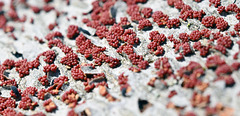
Possibly of limited interest but here it is anyway. These are the sporing bodies (or perithecia) of the beech blister fungus. The fungus infects beech trees through wounds caused by a tiny insect, the beech scale insect (Cryptococcus fagisuga). The fungus causes blisters to form in the bark. I have read estimates that between 50 and 85% of the trees will die from the disease. The insect is an invasive species that probably arrived in Canada through Nova Scotia in the early 20th century. (If you look closely, there are some small black animals crawling among the fungus. These are some kind of springtail).
Nuthatch IMG 20250407 080110
Spring snow IMG 20250326 001253

Lunar eclipse_DSC 1607
| |
|
|
|
Last Friday morning we had a full lunar eclipse. I had to get up early (3.00 a.m) to catch it, but the moon turned completely dark red for a while, so it was quite impressive. My camera lenses are not ideal for photographing the moon, but I gave it a go anyway.
psycho-pomme-IMG 0002
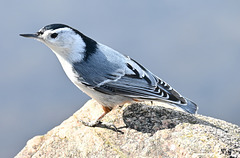
Nut hatch IMG 20250315 150734
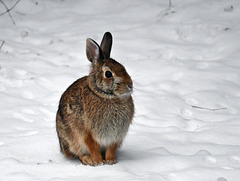
ice rabbit IMG 20250307 174533
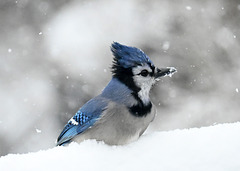
blue jay snow day-DSC 1129v
Quantum coffee press IMG 0005x
hexagon IMG 0012
Stethoscope in winter IMG 20250219 123728
| |
|
|
|
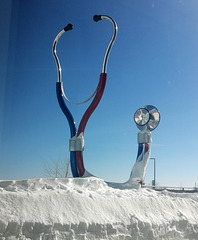
A very large stethoscope resting in the snow; on the grounds of the McGill University Health Centre (hospital in other words).
Christmas cactus IMG 20250218 220222
| |
|
|
|
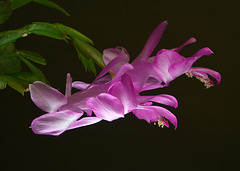
Flowers from our Christmas cactus, which, true to form, skipped Christmas and decided to flower in mid-February instead. For most of the year it is a very unimpressive looking plant, but it produces these lunatic flowers. It blooms in response to shorter days and longer nights so growing indoors under house lights probably confuses its flowering cycle.
The parent of the Christmas Cactus, (or Schlumbergera), is from Brazil:-
Copied from Wikipedia "Schlumbergera truncata occurs only in a small area of the coastal mountains of south-east Brazil, in the state of Rio de Janeiro, located in the southernmost part of the tropics. Sites where it has been found include the Organ Mountains (Serra dos Órgãos) in the Parque Nacional da Serra dos Órgãos and in the Serra do Mar near to the city of Rio de Janeiro. Plants grow at altitudes of 700–1,000 metres (2,300–3,300 ft). Because of their altitude and proximity to the Atlantic Ocean, the coastal mountains have high humidity – warm moist air is forced upwards into higher, colder locations where it condenses. S. truncata usually grows on trees (epiphytic),[3] or on rocks (epilythic)."
en.wikipedia.org/wiki/Schlumbergera_truncata
The aftermath. Bike after snow IMG 20250218 174821

Unicycle in the woods IMG 20250208 185927
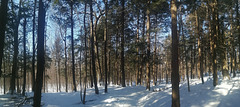
Snow and trees St B IMG 20250208 113246
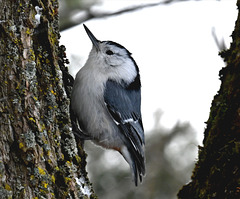
White breasted nuthatch_IMG 20250202 223219

Moon and Venus MG 20250201 174530
| |
|
|
|
The New Moon and Venus for the first days of the Lunar (Chinese) New Year of the Serpent. May it bring health and happiness.
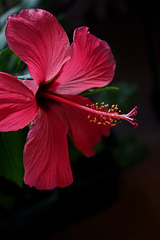
Hibiscus IMG 20250126 200409
| |
|
|
|
Every autumn the hibiscus comes indoors to get out of the cold. It blooms intermittently through the winter, which is a welcome, though transient, splash of colour in the seasonal greyness.
