

Andrew Trundlewagon's photos
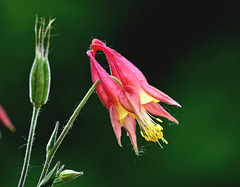
Aquilegia_Columbine_DSC 3052
| |
|
|
|
By now, most of the aquilegia (or columbine) has lost its flowers and set seed. This is reminder from earlier in the year.
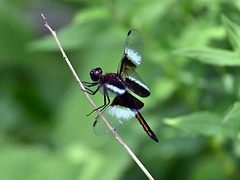
DSC 3547
| |
|
|
|
A Widow Skimmer ( Libellula luctuosa ) resting. These are one of the most common dragonflies around here.

redblobDSC 3436
| |
|
|
|
Big Red Blob: Probably the fruiting bodies (spore producing structures) of the Red Raspberry Slime Mold, Tubifera ferruginosa . Growing on a very rotten fallen log, in the woods, St Bruno, Quebec. Neither animal, plant nor fungus, according to Wikipedia it is widely distributed in forests of North America and Europe (it has also been seen in China and Japan)
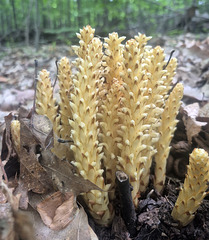
Conopholis Cancer-root or Bear corn_20250607 11142…
| |
|
|
|
Not a great beauty, and one of nature’s renegades, this is the American cancer-root or bear corn (Conopholis americana). It grows on the forest floor among the leaf litter and is a parasitic plant that survives solely by feeding on the roots of oak trees and sometimes beeches. These are the flowering stalks, which emerge in late Spring. For the rest of the year the body of the plant is hidden below ground. It cannot photosynthesize as it lacks chlorophyll, which explains its off-white colour. Cancer-root is a member of the broomrape family (Orobanchaceae). It is widespread in Eastern North America, but not very common, indeed in Quebec it is listed as vulnerable. I have been following this patch for about three years, and it has spread quite appreciably in that time, from just a few clumps until now it extends over many yards. The host trees seem to tolerate its presence. It has a life cycle of around ten years, which is not long placed against the life of an oak tree. It has no connection with cancer, despite the name, which instead probably refers to its underground growths on the roots of its host.

Sunset and pylons 20250630 210123

A sense of direction.
| |
|
|
|
This way or that way, the question. The Lee's, Folkestone Kent, UK. And no alcohol, no legal highs (so I guess illegal highs are good to go), no begging or sleeping, whichever way you decide to go. And mind the dog.
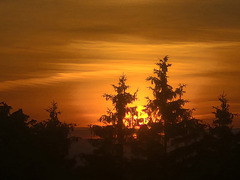
Sunset trees 20250615 205109

Head ROM DSC 1963 (3)
| |
|
|
|
The sharp teeth and skull of Deinonychus antirrhopus , a cast, Royal Ontario Museum, Toronto. The original is from Montana and is about 112 million years old. It is a member of the dromaeosaurs, possibly warmed blooded and with a shared ancestor with birds.
Boat by lake DSC 2944

20250617 142013(1)(1)

Smooth carrionflower Smilax herbacea DSC 2853(1)(1…
| |
|
|
|
The smooth carrionflower (Smilax herbacea), a climbing wildflower. As the name suggests it smells of rotting meat. In the interests of research I can confirm that it has a rather unfortunate aroma.

Poppy DSC 2888

Water avens G 20250608 205647
| |
|
|
|
Water avens (Geum Rivales), a small wildflower growing beside a small lake, St. Bruno, Quebec.

DSC 2701

20250530 141821

In memoriam: H.T. C 1926-2025
| |
|
|
|
In a park in North York, a suburb of Toronto, there is a slope where, in winter, the children gather to sled down. And in summer people gather to watch the sunset.

Last tulips_2025_05

Virginia bluebells 1000031310
| |
|
|
|
A closer look at the Virginia bluebell (Mertensia virginica). These grow in wooded hillsides and bloom early in Spring, forming dense mats of blue flowers (Upper Don trail, Toronto).
