Andrew Trundlewagon's photos
Orange roadworks_DSC 5229(1)
| |
|
|
|
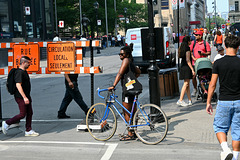
Perhaps Montreal's most characteristic sight, orange road closure street signs warning of roadwork that either never ends or never begins. Everywhere. Making driving a minor horror. At the end of my street there is an orange "detour" sign. It's been there for weeks, but nothing to say what the detour is meant to avoid, or where the detour actually goes. A purely random orange street sign serving no purpose that will stay there until someone steals it.
Saint Suplice Seminary Old Montreal DSC 5220(1)
| |
|
|
|
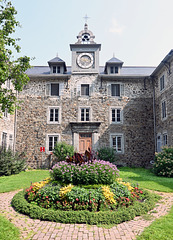
Montreal: The Saint-Sulpice Seminary, dating from 1687; the clock was installed in 1701.
Montréal : Le Séminaire Saint-Sulpice, datant de 1687; l'horloge fut installée en 1701.
en.wikipedia.org/wiki/Saint-Sulpice_Seminary_(Montreal)
Orange_street_DSC 5213(1)(1)
| |
|
|
|
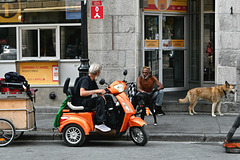
Old friends in Old Montreal.
On Orange Street. www.youtube.com/watch?v=ha8pHA7hXFw
white-2-DSC 4954 1(1)
DSC 5147
| |
|
|
|
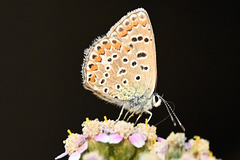
A common blue butterfly feeding on yarrow flowers. This is an invader, it comes from Europe but has been rapidly colonizing the regions around Montreal.
Saint Annes lace DSC 5040
20250731 122900(1)(1)
Super symmetry-0250727 095648(1)
pinesapDSC 3275 cropped
| |
|
|
|
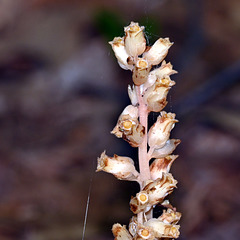
The parasitic plant Pinesap (Monotropha hypopitys) lacks chlorophyll and cannot photosynthesize but gathers all the metabolic carbon it needs from soil fungus. Trees photosynthesize and make sugars; they share some of this with their fungal partners and the fungus reciprocates by providing minerals to the trees. The pinesap steals these nutrients from the fungus. It is all rather devious.
Despite the name pinesaps are found near many trees. Where the photo was taken, there was a lot of birch, some beeches and maples but no pines. The stem here is very light pink, but sometimes it can be bright red (I haven’t seen that in life, only in photos). It occurs throughout the temperate Northern hemisphere and is part of the heath and heather family, Ericaceae which also includes blueberries, and cranberries as well as azaleas and rhododendrons.
Aquilegia_Columbine_DSC 3052
| |
|
|
|
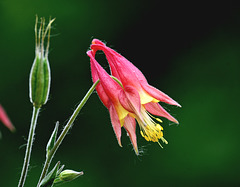
By now, most of the aquilegia (or columbine) has lost its flowers and set seed. This is reminder from earlier in the year.
DSC 3547
| |
|
|
|
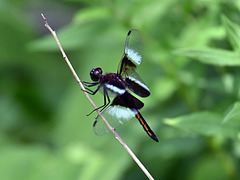
A Widow Skimmer ( Libellula luctuosa ) resting. These are one of the most common dragonflies around here.

redblobDSC 3436
| |
|
|
|
Big Red Blob: Probably the fruiting bodies (spore producing structures) of the Red Raspberry Slime Mold, Tubifera ferruginosa . Growing on a very rotten fallen log, in the woods, St Bruno, Quebec. Neither animal, plant nor fungus, according to Wikipedia it is widely distributed in forests of North America and Europe (it has also been seen in China and Japan)
Conopholis Cancer-root or Bear corn_20250607 11142…
| |
|
|
|
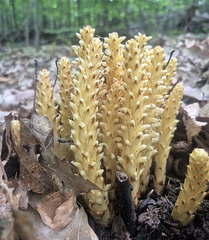
Not a great beauty, and one of nature’s renegades, this is the American cancer-root or bear corn (Conopholis americana). It grows on the forest floor among the leaf litter and is a parasitic plant that survives solely by feeding on the roots of oak trees and sometimes beeches. These are the flowering stalks, which emerge in late Spring. For the rest of the year the body of the plant is hidden below ground. It cannot photosynthesize as it lacks chlorophyll, which explains its off-white colour. Cancer-root is a member of the broomrape family (Orobanchaceae). It is widespread in Eastern North America, but not very common, indeed in Quebec it is listed as vulnerable. I have been following this patch for about three years, and it has spread quite appreciably in that time, from just a few clumps until now it extends over many yards. The host trees seem to tolerate its presence. It has a life cycle of around ten years, which is not long placed against the life of an oak tree. It has no connection with cancer, despite the name, which instead probably refers to its underground growths on the roots of its host.
Sunset and pylons 20250630 210123
A sense of direction.
| |
|
|
|
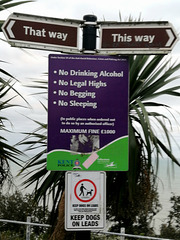
This way or that way, the question. The Lee's, Folkestone Kent, UK. And no alcohol, no legal highs (so I guess illegal highs are good to go), no begging or sleeping, whichever way you decide to go. And mind the dog.
Sunset trees 20250615 205109

Head ROM DSC 1963 (3)
| |
|
|
|
The sharp teeth and skull of Deinonychus antirrhopus , a cast, Royal Ontario Museum, Toronto. The original is from Montana and is about 112 million years old. It is a member of the dromaeosaurs, possibly warmed blooded and with a shared ancestor with birds.