

Golden Gate
Wild Geese
DON'T SWEAT THE SMALL STUFF
His cats
Coir / rope
Buy earth-friendly bag
Cultural Outfit
Days of Forest fire
Caramels
Fats Asia Bistro, Roseville
By the entrance
Chop Sticks!
....Just finished...!
Aisle
Lettuce Wrap
Lettuce Wrap
Michael Wood and a Purohit (Priest)
Teaching the 'mantras' to the next generation
The Fight Between Carnival and Lent
Morning colours
Fall morning
Mantis
Figure 3
The Rape of Europa (Artist : Titian)
Plate 10. Ad Reinhardt, “How to Look at Modern Ar…
A bird
Fig.51
Fig. 50
Figure 42
Plate 12
Welcome shoppers
Plate 9
Hanuman Temple
Fig. 16
Napoleon on Northumberland
A London Slum, from Gustave Dore & William Blanch…
Johann Heinrich Wilhelm Tischbein Goethe
A Young Girl Reading. 1776
Wanderer Above the Sea of Fog. 1818
Location
Lat, Lng:
You can copy the above to your favourite mapping app.
Address: unknown
You can copy the above to your favourite mapping app.
Address: unknown
See also...
Keywords
Authorizations, license
-
Visible by: Everyone -
All rights reserved
-
95 visits
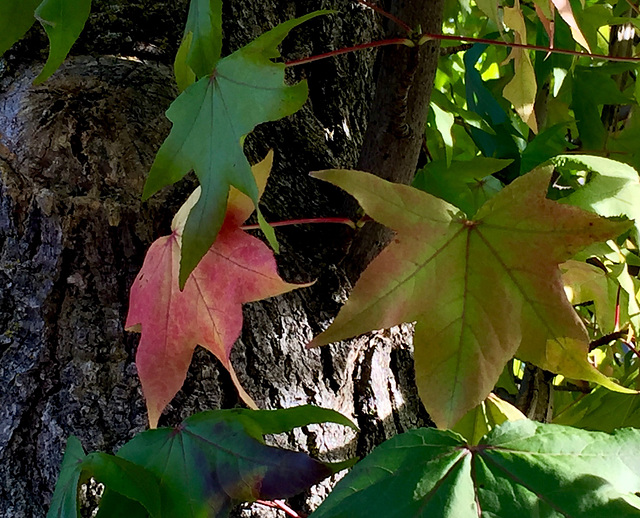
Changing colours

www.rutgers.edu/news/why-do-leaves-change-color
Leaves change color when chlorophyll – a substance plants use to turn light into sugar that makes a leaf look green – is breaking down and the plant is not rebuilding replacement molecules as the days get shorter. Other pigments, a class called the carotenoids, show as yellow and contribute to the appearance of orange and brown. Carotenoids are always on some level in the leaf, but instead of being overwhelmed by the green as they are in the summer, they appear as the chlorophyll, and thus the green, fades away. The reds are from a more “expensive to make” pigment, anthocyanin, and they develop in fall. The reds and yellow together give us the orange fall colors in some tree species.
Leaves change color when chlorophyll – a substance plants use to turn light into sugar that makes a leaf look green – is breaking down and the plant is not rebuilding replacement molecules as the days get shorter. Other pigments, a class called the carotenoids, show as yellow and contribute to the appearance of orange and brown. Carotenoids are always on some level in the leaf, but instead of being overwhelmed by the green as they are in the summer, they appear as the chlorophyll, and thus the green, fades away. The reds are from a more “expensive to make” pigment, anthocyanin, and they develop in fall. The reds and yellow together give us the orange fall colors in some tree species.
Roger Bennion, Marije Aguillo have particularly liked this photo
- Keyboard shortcuts:
Jump to top
RSS feed- Latest comments - Subscribe to the comment feeds of this photo
- ipernity © 2007-2026
- Help & Contact
|
Club news
|
About ipernity
|
History |
ipernity Club & Prices |
Guide of good conduct
Donate | Group guidelines | Privacy policy | Terms of use | Statutes | In memoria -
Facebook
X

HFF Dinesh and have a very good Sunday.
Sign-in to write a comment.