tarboat's photos
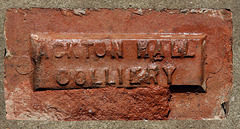
Ackton Hall Colliery
| |
|
A pre-1947 example from this Featherstone colliery. According to the 1946 Colliery Year Book the Ackton Hall Colliery Co., Ltd. worked the Warren House, Haigh Moor and Silkstone seams along with clay for brickworks. Ackton Hall colliery closed in 1984.
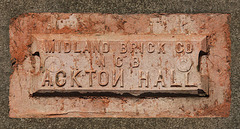
Midland Brick Co, NCB Ackton Hall
| |
|
Post 1947 National Coal Board brick from the works at the Ackton Hall Colliery in Featherstone. The Midland Brick Co Ltd (with several works in Nottinghamshire, Leicestershire and Staffordshire) was absorbed by Butterley Building Materials Ltd in 1973. Ackton Hall colliery closed in 1984.
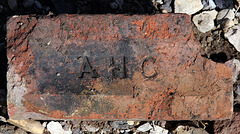
AHC (Ackton Hall Colliery)
| |
|
The economy Ackton Hall Colliery lettering. This brick was manufactured at this colliery and brickworks in Featherstone. Ackton Hall colliery closed in 1984.
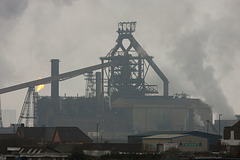
Coming soon
| |
|
Sadly, what was coming soon was closure of the Redcar Blast Furnace in February 2010. This view from the railway bridge at Coatham.
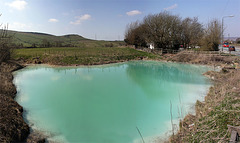
Bibbington's blue pool
| |
|
Samuel Bibbington operated quarries and limekilns around Dove Holes. His Victory Quarry was connected by a tramroad, running under the (now) A6 road, to a limeworks with a long bank of kilns alongside the railway just south of Dove Holes station. The quarry has been closed for many years and the limeworks site has been landscaped and planted with trees. This has not stopped the runoff of lime rich water from the waste tips and this now collects in this pool adjacent to the A6.
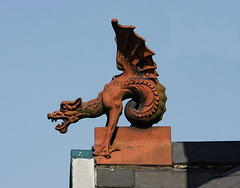
Another wyvern
| |
|
|
Whilst in Buxton I was tipped off about another terracotta beast in the town. This one is in much better condition than the previous example but looks almost identical in design. The house on which it sits is dated 1901.
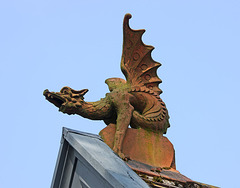
Not a dragon after all
| |
|
|
I returned to Buxton on a sunny day to have another go at photographing this wonderful piece of terracotta ornamentation. Having looked again at the creature depicted I can see that it only has two legs and must therefore be a wyvern rather than a dragon.

Eggborough
| |
|
British Energy's only coal fired power station is the 1960 megawatt plant at Eggborough. Generation is with four 500 megawatt units, the first of which started working in 1967.
Daw Mill
| |
|
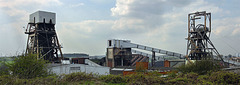
Downcast shaft at Daw Mill colliery in Warwickshire. This is the largest colliery in the UK, mining a five-metre thick section of the Warwickshire Thick seam some 750 metres below the ground. The shafts here are 558 metres and 556 metres deep. In 1982, a drift was completed and all coal is now brought out this way.

W Hammond Ltd, Shrigley, Macclesfield
| |
|
In response to the request from Capitol 203, here is an example of the firebricks produced by William Hammond Ltd at their brickworks at Bakestonedale, Pott Shrigley. This is an extra large example as shown by comparison with the Tarboat size 11 boot. It is in the boilerhouse of a textile mill.

Sandon limekiln
| |
|
The Sandon limekiln stands just below the Trent and Mersey Canal at Sandon and is owned by the Harrowby Estate. It was erected c1793 and may have also been used for calcining flints that were subsequently ground up in the adjacent watermill. It is thought to have been abandoned between 1850 and 1860.
This kiln has been subject to excavation and partial restoration by members of the Staffordshire Industrial Archaeology Society. Their website contains images and details of the project.

Westbound towards Lindong
| |
|
Another one from my last trip to the Jitong railway in 2005. Although the sun was scarce at times there was still some fine steam action. Here a pair of QJs blast up the bank just to the east of Lindong.

Skelton Park
| |
|
Abandoned in 1938, the buildings of the Skelton Park ironstone mine are slowly decaying. In this view the tall walls of the 384ft deep upcast shaft are seen through the window frames of the boiler pump house.
Lambert, Pott Shrigley
| |
|
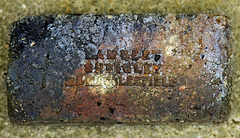
A very interesting brick from the collection of my friend Si.
In c1820 George Lambert and Abraham Bury started a small brickworks near Brink Farm with one kiln to fire the bricks. When they needed to expand they moved to the site in Bakestonedale.By 1848 George Lambert was operating a coal and fireclay mine with associated Pott Brickworks on the south side of the road at Bakestonedale, Pott Shrigley. Lambert was still working the Pott Shrigley coal mine in 1884 but had relinquished the firebrick works to James Hall before 1878. By 1896 all had been absorbed into the business of William Hammond on the north side of the road. This firebrick must therefore date from between 1848 and 1878.
A dying breed
| |
|
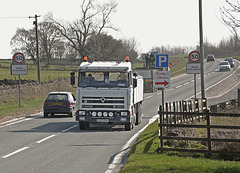
The constant stream of stone lorries on the A6 through Dove Holes still contains a good number of Foden built wagons. The numbers are dwindling though and I thought I would grab a shot of one passing by. Of course then all I saw were Scania and Volvo and after giving up this one appeared just as I was putting the camera away. In the ensuing fluster I managed to knock the switch to manual and horribly overexpose the shot. I have pulled a bit back in PS and that will have to do for today.
Upper Benllech
| |
|
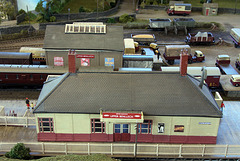
Another fine bit of modelling from the recent Macclesfield Model Railway Exhibition. This one is based on the premise that the old Anglesey Central Railway had extended beyond Red Wharf Bay to reach Benllech. Sunday services actually ran on this line, unlike the original, ! :-)
Penned in
| |
|
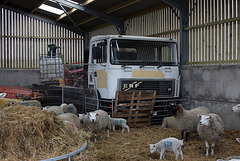
This one is for SemmyTrailer who knows everything about British lorries. As I know little about the subject I shall leave it to him to add the details. I can say that I spotted it hiding in a Derbyshire barn whilst out and about looking at disused railways.