

tarboat's photos
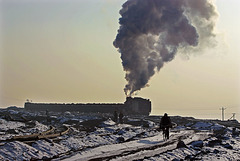
End of the day
| |
|
Yet another spoil train heads up the tip lines at Xibolizhan on the Sandaoling Coal Railway, whilst workers head for home by bike.
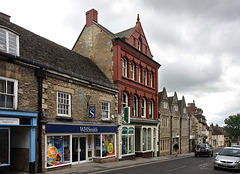
The Old Library
| |
|
Malmesbury is situated on the edge of the Cotswolds and is almost entirely built of local stone. This makes the Old Library on High St stand out as something completely incongruous. The brick facade with terracotta decoration is dated 1901. It seems very strange to introduce such alien materials on the High Street of such a picturesque town. I do,however, much prefer it to the corporate awfulness of the W H Smith frontage.

An unexpected find
| |
|
Malmesbury is situated on the edge of the Cotswolds and is almost entirely built of local stone. This makes the Old Library, 44 High St, stand out as something completely incongruous. The brick frontage with terracotta decoration is dated 1901. It seems very strange to introduce such alien materials on the High Street of such a picturesque town.
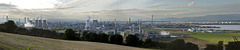
Grangemouth refinery panorama
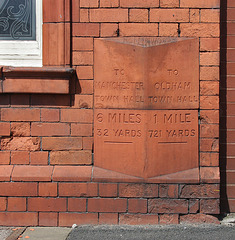
Hollinwood
| |
|
I had never seen a terracotta milestone before I spotted this one in the wall of the Smut Inn, Oldham. It may say Hollinwood on the top, but this is quite a bit north of that place. It must date from the rebuilding of the pub in 1884.
Sandaoling spoil
| |
|
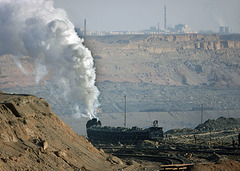
The climb is steep as a JS pushes spoil from the pit at the Sandaoling opencast coal mine. On the horizon is Sandaoling town and the local power plant. The semaphore signals on the roof of the cabin on the leading wagon show a clear road ahead.
Lafarge Hope
| |
|
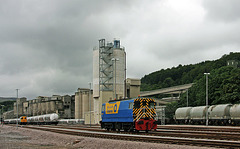
Blue John and a class 20 stand on the expanded sidings in the Lafarge cement works at Hope, Derbyshire.
Taking the coal to Liushuguan
| |
|
|
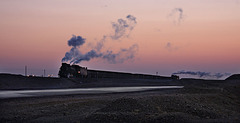
This morning we were out and ready for the morning empties coming back uphill to Sandaoling from the exchange sidings at Liushuguan. As it happened the loaded train was running later than usual and this shot against the sunrise shows the train topped and tailed by a pair of JS class 2-8-2s running backwards. They returned some 40 minutes later with a long train, but the sky was rather brighter by then.
Heads up
| |
|
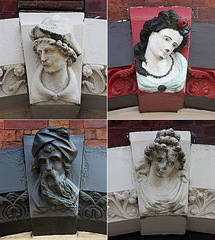
There is a terrace of four houses, numbers 228-234 Greenacres Road, Oldham, that was built in the early 1870s as Cambrian Terrace. Over the door of each house is a stone head and associated decorative work which is really attractive and eyecatching. I wonder why this was not done more often, and whether they were meant to be specific characters?
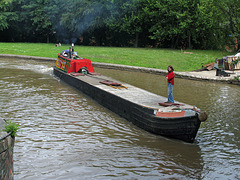
Powering around the turn
| |
|
It was Middlewich Boat & Folk weekend and there was lots happening around the canal. Here the tanker narrowboat is powered around the tight turn between the second and top locks on the Middlewich flight. The drydock is just off to the right on the outside of the bend.
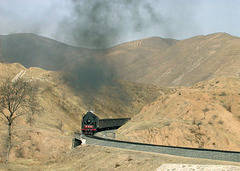
Amongst the bare hills
| |
|
Late April in the Da Hinggan mountains and there are still remnants of winter ice on the rivers. QJ 6763 is heading empty coal wagons westwards on the Jinpeng section of the Jitong Railway just after passing the small town of Reshui.

Arcelor Mittal Ghent
| |
|
The Ghent steelworks produces c5 million tonnes of flat steel steel a year. Much of the production goes to motor manufacturers. The two blast furnaces were completed in 1967 and 1968 whilst the works was being constructed for then owners Sidmar.
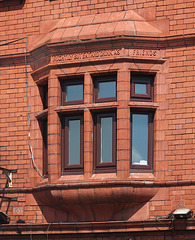
Strive Mightily But Eat And Drink As Friends
| |
|
Admirable thought above an upstairs window of the Smut Inn, Manchester Road, Oldham. Rebuilt in 1884 in a glorious high quality red brick and terracotta, the pub has fallen on hard times and is unlikely to re-open. The supplier of the terracotta is unknown, but is likely to have been one of the Rochdale area makers.
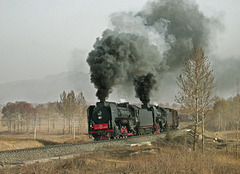
On the 'S' curves
| |
|
Climbing, climbing, climbing; that was the line westwards from Daban. This was the first train that I photographed on the Jinpeng section of the Jitong Railway. A pair of QJs is hard at work with a heavy freight train on the curves west of the little town of Linxi.
Kakanj Cement
| |
|
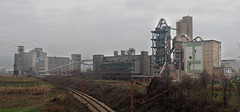
Based in Kakanj is Tvornica Cementa Kakanj (TCK), founded in 1978. In 2000 Heidelberg Cement bought 51% of TCK and this has since risen to a stake of 91.15%.

Level 2
| |
|
On the Jinpeng section of the Jitong Railway the climb for westbound trains after passing Reshui comprised a series of big curves looping the line back and forward as it gained height. This train has already passed along the tracks in the background and will soon pass through a curving tunnel and reappear behind me going in the opposite direction on level 3. I have recently read that rail traffic is so great that there are plans to replace this entire section with a deviation incorporating much tunnelling.
Dump truck and tarmac plant

D Co
| |
|
Dalmellington Iron Co.
The original Dunaskin brickworks was situated in Dunaskin Glen at Waterside, Ayrshire. The brickworks was built in the 1850's by the Dalmellington Iron Company to serve the ironworks at Waterside. The Dalmellington Iron Company was founded in 1848 by Henry Houldsworth, a Glasgow cotton mill owner. The company owned the ironworks at Waterside and operated a number of mines in the surrounding area. The brickworks manufactured firebricks for lining the furnace and for building the ancillary buildings, such as the workshop range, needed to service the ironworks. The brickworks in Dunaskin Glen closed in 1928 and was resited on the ground where the furnaces used to stand. The bricks were stamped DICO, or more rarely D Co, standing for Dalmellington Iron Company. The ironworks closed in 1921 but the company continued to operate their mines until 1930 when bankruptcy caused the company to fold. In 1931 the brickworks was taken over by William Baird and a new company formed, Baird and Dalmellington Ltd. The Brickworks featured a Staffordshire transverse arch kiln that had 14 connected chambers which were heated to 1,100-1,200°C by an under-floor heating system. The draught from the chimney drew heat through each chamber and up to 16,000 bricks were fired for two weeks in each chamber. In 1947 the brickworks came under the ownership of the Scottish Brick Company after nationalisation of the industry. The brickworks closed in 1976.
