

tarboat's photos
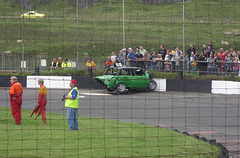
All wheels off the ground
| |
|
This was once a Volvo. The banger racing at Buxton raceway today resulted in this one being shunted into the barrier at speed. It stayed there for some time suspended above the track until the race finished. The driver (in the red overalls in the crowd) came away with a small cut on his leg whilst it took a big lorry with a Hiab to lift the car off the barrier.
Photo courtesy of Miss Tarboat.
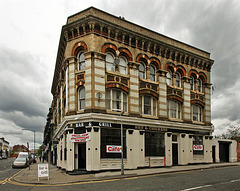
Hen and Chickens
| |
|
|
The Hen and Chickens on Constitution Hill, Birmingham, dates from c1880. The stone sills, cornice, and polychromatic brickwork with terracotta panels above the first floor windows makes for a very pleasing effect. Listed Grade II.
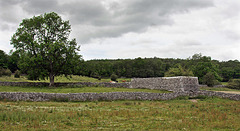
Dawson Fold limekiln
| |
|
There are several limekilns around Crosthwaite on the west side of the Lyth valley. This one is in good condition and can just be seen from the road near Dawson Fold.
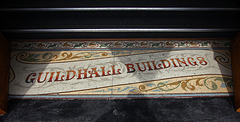
Guildhall Buildings
| |
|
The entrance to Guildhall Buildings, Navigation St, Birmingham has this tiled mosaic. The building dates from 1899.
Crossing the sands
| |
|
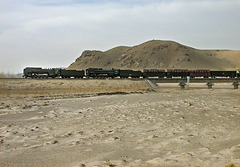
A westbound freight heads downhill for Gulumanhan after crossing the summit after Chaganhada on the Jitong Railway.
Griffin
| |
|
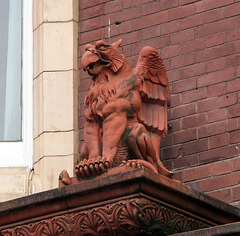
This Griffin is one of two atop the columns flanking the central section of, Ruskin Buildings, Corporation St Birmingham. The fine beast is part of the restoration works undertaken in 2000 and was, I believe, manufactured by Ibstock Hathernware.
Sea Lock
| |
|
|
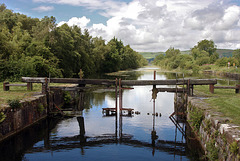
The Ulverston Canal was completed in 1796, in order to provide the town of Ulverston with a port. At 15 feet (4.6m) deep and 66 feet (20m) wide, it was intended to accommodate large ships. Railway competition led to a decline through the second half of the 19th century. Commercial traffic ended c1914 and it was abandoned in 1945. These are the top gates of the sea lock with the 1 mile dead straight canal heading off towards the terminal basin.
Langdale
| |
|
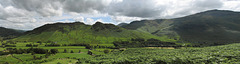
Towards the top end of Langdale on a day when the weatherman said heavy rain! The nearer hill is Side Pike and to the right the land rises to Kettle Crag and Wrynose Fell. Best viewed large .

Cacak
| |
|
1922 built 0-6-0T, 61-023 sits derelict outside the Cacak paper factory where it worked until c1999. The factory didn't look much less derelict than the locomotive but was, apparently, still working.
Kostolac
| |
|
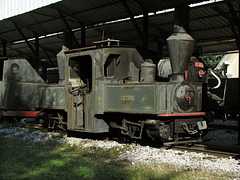
Built for the Kostolac coal mine railway system, this is one of only two surviving examples of the Péchot-Bourdon version of the Double-Fairlie type locomotive. Developed by Captain Péchot of the French artillery this type differs mainly from the original Fairlie type by having only one steam dome. The builder is believed to be Baldwin in 1916. It is now preserved at the Pozega railway museum in Serbia
Saddlestone mill
| |
|
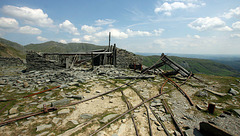
Mandalls Slate Co Ltd worked a number of quarries on the slopes of Coniston Old Man. The main processing area was the mill at Saddlestone to where the slate 'clogs' were brought down by an aerial ropeway and sawn in the shed seen here. There were also a number of riving or dressing sheds on this level. The worked stone could then be sent further down the ropeway towards the Coppermines Valley for outward transport by road.
Remains of the ropeway are still evident right up the hill with both fixed and moving ropes lying on the ground. The collapsed wooden framework was the start of the next flight of the ropeway.
A grand day out
| |
|
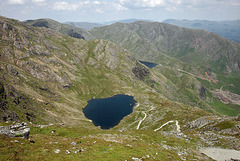
A perfect summer's day for a walk up a mountain. Today's walk took in slate quarries above Coniston and then on up to the summit of the Old Man of Coniston. Looking back down from close to the summit, the nearer lake is Low Water and in the distance is Levers Water. The latter was created as a reservoir for the copper mines just visible at the right margin of the view.
Wesley Hall
| |
|
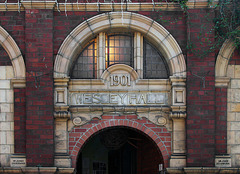
Very much of its time is the Wesley Hall in Whitby. Plenty of terracotta trim with 1901 date and named over the door.
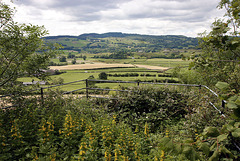
On top of the kiln
| |
|
Where the byway known as Whitbarrow Road drops down into the Winster Valley and meets the surfaced road stands a limekiln. The pot appears to have been filled in, but there is a fine view from the top over the valley to Bowland Bridge.

Levens limekiln
| |
|
The limestone areas of the southern Lake District were extensively exploited for limeburning, although the majority of the use was local. This little kiln stands by the bypass, just outside the village of Levens.
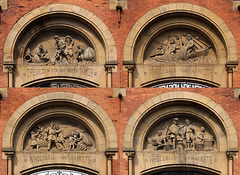
Netted
| |
|
The old Manchester Fish Market dates from 1873 and has now been developed internally for modern apartments. The external walls survive and gables on High St have four tympana in which are scenes in stone of fishing activities by sculptor Henry Bonehill. The architects were Speakman, Son and Hickson.
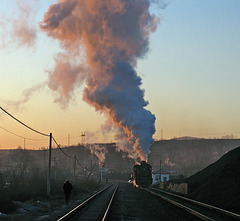
Walking home
| |
|
There is often a well beaten path at the side of industrial railways in China. After all, it is often the shortest route home for a tired workforce. As the sun sets in icy Jixi a lone figure trudges homeward, hands in pockets, as SY 1058 heads up bank from Nanchang with a train of spoil tippers.
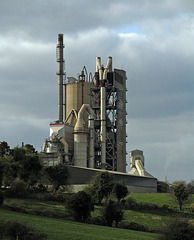
Quinn Cement, Derrylin
| |
|
Quinn Cement operates two plants one on each side of the border between Northern Ireland and the Irish Republic. This is Derrylin works in County Fermanagh which was opened in 1989. The single rotary kiln has a capacity to produce 1400 tonnes of cement clinker daily.
