

tarboat's photos

173 Stamford Street Central
| |
|
Woolworths logo in mosaic at the entrance to their former shop in Stamford Street Central, Ashton-under-Lyne. The premises now house the charity shop of the Wooden Canal Boat Society.

Ochre tanks
| |
|
The Goldsitch Moss coalfield in Quarnford is drained by a sough which empties into a small stream that runs into the Flash Brook above Manor Farm. Even today the waters are coloured bright orange by the ochre contained in the outflow. At one time the ochre was seen as a source of profit and was colllected in this series of settling tanks alongside the Flash Brook. The dried material would be sold for use in paints, dyeing etc.
Gradbach limekiln
| |
|
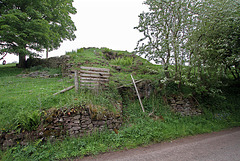
I have driven past this spot many times and never noticed this old limekiln at Gradbach. Having seen it on an old map it didn't take long to spot it in the ground. It was old in 1875 and may date from the eighteenth century.

On the ledge
| |
|
Kerr Stuart 13 is well above Tiger Camp heading in the direction of Bawdwin on the Burma Mines Railway.
Torchbearer and her dog
| |
|
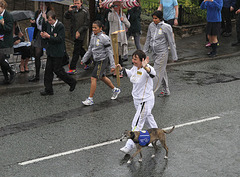
The Olympic torch made its soggy way through Macclesfield but the rain didn't stop crowds from turning out. Passing Tarboat Towers is torchbearer Lynn Ratcliffe, who has epilepsy, and was accompanied by Dougal, who knows what to do when she has a seizure. The grey clad people behind are the torch police!
Miner's contract, Nelson Pit, Poynton 1855
| |
|
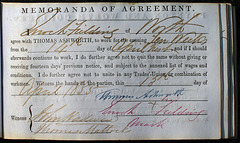
Miner's contract to work for ten weeks at the Nelson Pit, Poynton, dated April 13th 1855. It is signed by the colliery agent, Thomas Ashworth, John Hadwen the colliery manager, and Thomas Mattocks the undermanager. Enoch Fielding of Worth was unable to write his own name and consequently made his mark which was, by the look of the handwriting, then noted in red by Thomas Mattocks. The rest of the document appears to have been completed by Hadwen.
Ashworth stood firm against a number of strikes during his stewardship from 1834 to 1857 and was strongly against trade unionism. In 1857 he stated his position in his final annual colliery report to Lord Vernon:
'The Pitmen are engaged under written contract, for various periods of 6 months and upwards at uniform prices & at various dates, so that it would be impossible for them to strike or turn out without rendring themselves liable to imprisonment for breach of contract - they are consequently quiet and much more easily controlled.'
Document courtesy of David Arnold.

Xifeng afternoon
| |
|
Late afternoon at Xifeng on the Lishu system at Jixi as SY 0951 is prepared for its next duty. The wooden hoppers on the left were shortly to be taken up to Qikeng Colliery for loading.
Adlington Colliery
| |
|
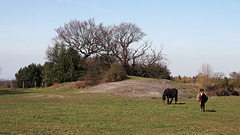
Coal mining in Adlington was on a smaller scale than Poynton due to there being fewer seams available. The industry flourished during the nineteenth century and in the 1830s after the opening of the Macclesfield canal there was a surge in development of workings to the east of the present marina. This shaft may be that of the Pilot Pit which in 1838 was worked with a 5hp steam engine in a wooden engine house. There was also a horse gin on site.

Draw holes

Via Gellia limekilns
| |
|
A pair of draw kilns are hidden away behind this stone wall alongside the main road just above the Via Gellia mills.

Draw holes

Wyverns
| |
|
|
Burmantofts terracotta including a pair of Wyverns on the side of an access stair at the Midland Hotel, Manchester. The Wyvern was the emblem of the Midland Railway Company, original owner of the hotel which opened in 1903.

Hairy Dragonfly (Brachytron pratense)
| |
|
The visit to the marlpits at Churton saw lots of dragonfly action. Patience was rewarded when this male Hairy Dragonfly landed right in front of me and stayed around long enough for a few portraits.

Four-spotted Chaser (Libellula quadrimaculata)
| |
|
With the weather finally warm and sunny I headed for the west of Cheshire in search of Odonata and had a great day on the Dee and nearby marlpits. This male Four-spot was busy working his territory on a pond at Churton.

First Aid Room
| |
|
New Ingleton Colliery was sunk by the New Ingleton Collieries Ltd in 1912-13 with the first coal wound in September 1914. By 1919 the output from the Six Foot seam was about 2,200 tons a week, whilst from 1921 working was concentrated in the deeper Four Foot seam and later the Yard Seam. Production ceased in February 1936 due to geological and economic problems and salvage continued until 1940. A few buildings survive around the former pithead including the first aid room where the red cross on the door is still evident over 70 years on.

Key in mouth
| |
|
This sculpture watches over the door into the Natwest Bank on Warrington St, Ashton-under-Lyne. I am not sure what it is supposed to be. It looks a bit like a lion and at first I wondered if it was an otter!

Wilton chemical landscape

