

tarboat's photos

B1 at Crownthorpe
| |
|
Thompson B1, 61306 Mayflower, passing Crownthorpe towards Dereham on the first day of the Mid Norfolk Railway gala.

Container cranes

Waiting

Rattlesden Airfield
| |
|
Control Tower at Rattlesden Airfield, Suffolk with T2 hangar in background. This airfield opened in 1942 and from 1943 to 1945 was home to the B-17 Flying Fortresses of the US 708th, 709th, 710th and 711th Bombardment Squadrons of the 447th Bomb Group (Heavy). It was a Bloodhound Missile station for the RAF in the 1960s. Today the tower forms the clubhouse for the local gliding club.

Flask crossing
| |
|
Nuclear flask at Knodishall Crossing east of Saxmundham en route from Sizewell to Windscale.

Reade Brickworks, Aldeburgh
| |
|
The Aldeburgh brickworks had produced quality hand made bricks from 1648 until 2011 when it had become uneconomic and was closed. The site is now being redeveloped and a visit was made just before the kilns were to be demolished. There is a bank of four open-topped oil fired kilns that held between 40 and 45 thousand bricks each. Also on site is an older coal fired kiln that has been derelict for many years.

Fuel rods amongst the oilseed
| |
|
DRS 37610 and 20309 westbound at Knodishall Crossing east of Saxmundham with a couple of nuclear flasks from Sizewell power station.

Greater Anglia
| |
|
A grab shot whilst walking in Suffolk. 90008 heads a Greater Anglia service towards Ipswich is seeen passing Munton's Cedars Maltings outside Stowmarket. The livery of these trains is awful - dull and dismal, hardly better than all-over rail blue!

Dulux
| |
|
Storage tanks at the AkzoNobel (Dulux) paint plant at Stowmarket. I really do hope that the colours inside match those outside.
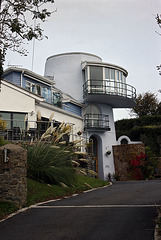
Red Wharf Bay limekiln
| |
|
|
At first glance this house may appear to have incorporated a windmill, but in fact this was a circular tower limekiln. The internal form at the bottom is an inverted cone with very thick walls. The adjacent quarry is shown with a rectangular limekiln on the 1889 OS map and this is marked as 'old' by 1900. This kiln first appears on the 1920 map, so probably dates from soon after 1900. The RCAHMW website states that an early twentieth century photograph shows a group of labourers in front of the kiln, which was banded with iron straps and had a tall chimney above.

Station
| |
|
A rare survival in eastern region blue, spotted whilst mooching the streets of Stowmarket.

Wyrley branch canal
| |
|
|
The Wyrley Branch canal was originally northern end of the main line of the Wyrley and Essington Canal when it opened in 1795 to a wharf close to Cannock Lodge Colliery. It became a branch shortly after when the extension from Sneyd to Huddlesford on the Coventry Canal was completed in 1797. Several further branches were constructed off this line, but all had fallen derelict by 1954 when this section was abandoned. This view was taken at a time when extensive opencast coal mining was affecting the old canal and several sections including this piece heading northwards towards the former Broadlane Bridge at Bloxwich. Today at this spot it is filled-in and converted to a footpath.

Berw Colliery
| |
|
The Anglesey coalfield is little known, but there are a number of interesting remains to be found. Coal has been worked on the island since at least the 15th century but the most extensive development appears to have been in the mid 19th century. In 1839 a shaft was sunk at Berw and a steam engine installed to drain the workings. Four seams were worked; the 3ft, the 4ft, the 6ft and the three quarter yard. Production levels were not high with only 2,500 tons of coal being raised here in 1849-50, indeed in 1857 the whole coalfield only yielded 4,500 tons. There appears to have been little coal worked after 1868 and the buildings at Berw were converted to agricultural purposes. The remains today include this chimney, derelict cottages, and a number of shaft mounds. The site became a scheduled ancient monument in 2005.

Inside the kiln
| |
|
Refractory firebrick works, kiln interior. The business was killed off by competition from China.

Steel melting house - Messrs Samuel Osborn & Co, S…
| |
|
Samuel Osborn established a business as a file manufacturer in Broad Lane , Sheffield, in 1851. In 1867 he went into partnership withhis brother-in-law William Fawcett and moved to the Clyde Iron & Steel Works. In spite of financial difficulties in the 1870s the firm developed into a major force in steelmaking. It was only in the 1960s that the firm was merged with Hadfields to form Osborn Hadfields Steel Founders. In this view from the early 1900s is notable for the large number of crucibles on the shelves and the tidiness of the floor.
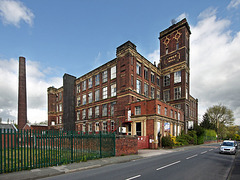
Tower Mill
| |
|
Completed in 1886 for Christian Koch, the Tower Mill in Dukinfield was designed by Potts, Pickup & Dixon. It had a capacity of 44,000 mule spindles and 5,000 twiner spindles. On Koch's death in 1895 the mill passed to The River & Tower Mills Co (Ltd in c1912). Ring spinning was introduced from 1930 and the mill ended cotton spinning in 1955 by when it contained 13,000 mule spindles and 24,000 ring spindles. It has had a range of uses since then and is currently empty and for sale.

A selection of services

Nant Gadwen incline
| |
|
|
Winding drum remains at the topof the Nant Gadwen Incline which carried ore from the various Rhiw Manganese Mines down to a pier at Porth Ysgo. The pier was completed in 1902-3 and the incline operated until the closure of the mines in 1925, although a certain amount was shipped from the tips for a few years afterwards
