

tarboat's photos
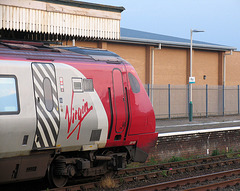
Rhyl Voyager

Glazed
| |
|
|
|
An unusual combination of coloured bricks over shops on Market Jew Street, Penzance. The combination of cream brick with brown and green glazed detailing around the windows is certainly eyecatching.
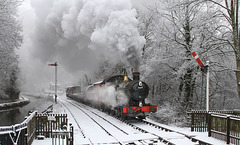
Consall Arrival
| |
|
|
|
Short freight arriving at Consall Station during a 30742 Charters event. Beautiful snowy conditions made for a chilly wintry scene.
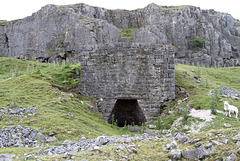
Limekiln and sheep
| |
|
|
|
This 19th century draw kiln at Carnau Gwynion is high up in the Brecon Beacons National Park in an area that saw extensive limeburning before the enclosure of 1819.
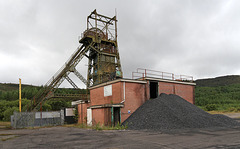
Tower
| |
|
|
British Coal closed Tower Colliery on 22 April 1994 but the workforce refused to give up and after pledging £8,000 each from their redundancy money bought the pit On 3 January 1995 the Colliery re-opened under the ownership of the workforce buy out company Goitre Tower Anthracite. Having extracted the economically attainable reserves the colliery was last worked on 18 January 2008 and the official closure occurred on 25 January. The company is currently involved in a joint venture with Hargreaves to extract a further 6 million tons of anthracite from an opencast operation.
Switchgear
| |
|
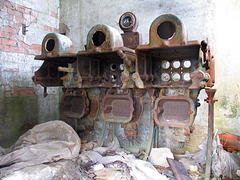
Remains of British Thompson Houston electrical switchgear in the substation for the WWII mineral mill at Harboro Rocks near Brassington.
Salvation Army
Gifford
| |
|
|
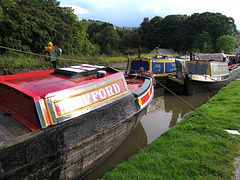
Wooden narrowboats at the Bollington Boat and Folk Festival. The two to the right are former maintenance boats used on the Ashton, Peak Forest and Macclesfield Canals by the London & North Eastern Railway and its predecessors.
Oven top risers
| |
|
|
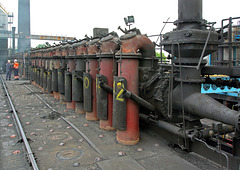
Gas risers on top of the coke ovens at the Monckton coke works not long before closure.
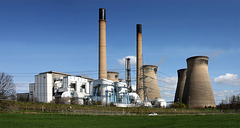
Ferrybridge 'C'
| |
|
|
Ferrybridge 'C' power station was closed in 2016. Operated by Scottish and Southern Energy plc this 2000 megawatt power station first generated electricity in 1966.
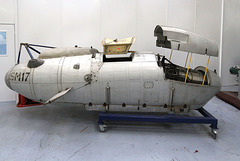
De Havilland Spectre 4 Assistant Take-Off (ATO) Un…
| |
|
|
Note: some panels of the ATO are raised to show the internal arrangement.
As in the case of the earlier de Havilland Super Sprite ATO Units for the Vickers Valiant bomber, the Spectres for the Handley Page Victor and the Avro Vulcan were carried in two jettisonable and recoverable nacelles (pods) under the aircraft s wings between its jet engines. The Spectre and the nacelle were designed to withstand very high 'g' loads and rough handling. Each nacelle houses a Spectre complete with tanks for oxidant and fuel. The nacelle structure is of riveted light-alloy construction There is a basic floor above which are mounted the tanks, engine and recovery parachute while below is contained the air-bag used for cushioning impact with the ground after jettisoning.
Immediately behind the spun nose -cap of the nacelle is the large oxidant tank compartment. The bay has an inner metal skin to provide smooth boundaries for the polythene bag-tank containing the HTP (hydrogen peroxide) oxidant This tank is filled via the removable nose-cap, and a polythene supply pipe passes through the bulkhead at the rear to feed the engine. Aft of this bay is strapped the small kerosene tank (the ratio of HTP to kerosene used is about 9:1) and four nitrogen bottles which pressurise both kerosene and HTP tanks, thus supplying inlet pressure to the propellant pumps.
Above the kerosene tank is the parachute compartment which houses a glass-fibre pack containing a 36ft diameter parachute (designed to give a rate of descent of 25ft per sec), a 4 ft diameter pilot canopy and an extractor gun. The Spectre is canted down at an angle and exhausts through an orifice in the rear of the nacelle. Below the floor in a central compartment is the air-bag which is enclosed by plywood doors coated with Nutracote, a finish compatible with HTP. As the nacelle is nose -light when the propellants are exhausted, stub wings are fitted on each side of the nose so that the nacelle is pushed down on jettisoning.
Nacelle Dimensions: Length 162in: Width 65m: Height 49m
The nacelle could be released from as low as 1,000ft and at speeds up to 290mph.
Spectre 4 Engine
The main cylindrical structure contains the turbine for driving the propellant pumps, the catalyst pack and the combustion chamber. Ahead of this integral assembly is the gearbox, on which are mounted the centrifugal-type propellant pumps and under the gearbox is the oil sump. On the engine's sides are various control valves and associated linkage systems, the starter unit and fuel-cooled oil cooler. A small high-speed turbine energised by a separate supply of HTP is employed for driving the pumps and the associated decomposition products from this unit are subsequently directed through the combustion chamber. The high flow of HTP is able to cool the nozzle before it is injected into the engine (known as regenerative cooling)
Dimensions: Length 59in; Width 37in; Height 38in
Applications
One reason for using extra power at take-off was that either more fuel or a heavier weapon could be carried. Alternatively, the extra power could be used to permit operation from high-level airfields in high ambient temperatures, or taking-off within the standard Bomber Command runway length when carrying the stand-off bomb. (Blue Steel)
Historical Note
Although the nacelle and engine went into limited production, circumstances changed with requirements for V-bomber operation limited to UK bases and only one single trial take-off was undertaken with a Victor.
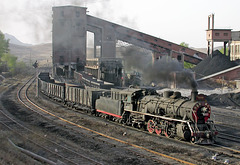
No.5 Mine
| |
|
|
SY 1092 shunts the sidings at the No.5 Mine, Sanjiazi, on the Nanpiao coal railway.
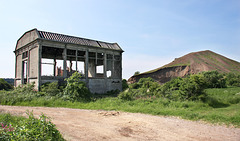
Kilton Ironstone Mine
| |
|
The Kilton ironstone mine installed an electric winding engine c1918 to replace a beam type steam winder with overhead drum. This enginehouse was erected immediately behind the steam winder which was to the right in this shot. In order to ensure continuity of production the winding ropes were transferred over a weekend and initially had to run through the upper part of the older building. The shaft was 720ft deep and single deck cages holding two tubs were wound in 45 seconds. The mine closed in 1963.
There aren't many ironstone mining spoil heaps left in Cleveland and the best remaining is probably that at Kilton.
Wreckage
| |
|
|
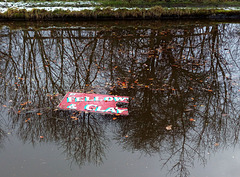
After the storm, the wreckage on the Macclesfield Canal. I did wonder whether to call the lifeboat.
Railway Institute
| |
|
|
|
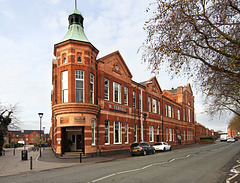
The Midland Railway Institute on Railway Terrace, Derby, was opened in February 1894 as a cultural and educational centre for railway workers. At one time it contained a library of some 18,000 books, a concert hall with a stage and sitting for 500 people. In addition there were several other rooms set on one side for dining, meetings and games. In 1980 the Railway Institute had been leased off to the Post Office Social Club but that closed in 1994. Following the failure of plans to convert it to an arts centre, it was opened as a pub and party venue in 1996.
Compressors
| |
|
|
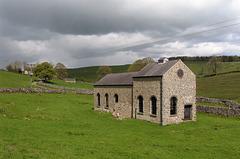
The Roystone Grange limestone quarry was developed around the time of the First World War and by 1920 was using compressed air drills to assist in extracting the stone. This compressor house to supply the air was erected some distance away where there was a spring that supplied water to cool the oil engines and compressors. The structure has been secured and the roof is sound but it stands empty and unused.
Flue Gas Desulphurisation
| |
|
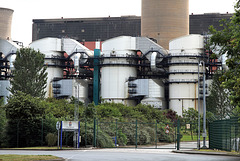
EDF Energy opened the flue gas desulphurisation plant at its Cottam power station in 2007. The project, which commenced in 2002, cost £108 million.
The FGD plants operate without flue gas reheat, which allowed the FGD units to be placed closely around the chimney, with a relatively simple ductwork design. This required significant alterations to the chimney flues to minimise any risk of droplet carryover resulting from operation with water saturated flue gas.
Rolls-Royce Marine Spey SM1C Power Module
| |
|
|
|
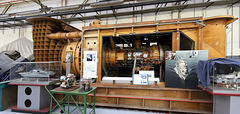
This large wooden structure is a full scale "mock-up" of the Marine Spey SMIC propulsion unit, used at Rolls-Royce, Ansty, to finalise pipe runs, wiring schemes, component siting, etc., prior to production. An exhibit in its own right as an example of patternmaking, it is a dimensional replica of what would be the starboard unit in the two-Spey engine room of, for example, a Type 22 frigate of the Royal Navy and gives an accurate representation of its layout. Its final use at Ansty, however was to facilitate its projected installation in a large hydrofoil ferry for Sweden.
The SM range originated in a M.O.D.-funded design study in 1972 for an engine of a size between the Olympus TM and the Tyne RM, although at that time no application existed. Development started in 1977 and the engine selected was the Allison TF4IA licence-built Rolls Royce Spey as being the latest uprated Spey available, used in the Vought A7E Corsair strike aircraft of the United States Navy. In addi¬tion to being marinised the main modification was the cropping of the fan section of the LP compressor and redesign of the casing. An en¬tirely new control system was also developed by Lucas. Depending on the application, power ranges from 14,750 BHP (11 Mw) of the SM1A to 20,800 BHP (15.5 Mw) of the SMIC and could be further uprated. Its specific fuel consumption is almost half that of its predecessors. The first two SMIA production units, built and tested at Ansty, were installed in HMS Brave "type 22 frigate in 1983 in place of the originally specified Olympus TM3B. The Marine Spey was installed in 21 frigates of the Royal Navy combining with Tyne RM3C (Type 22) or diesel electric (Type 23). It was also be used in 8 frigates of the Royal Netherlands Navy and in 12 destroyers end 6 frigates of the Maritime Self-Defence Force of Japan. In the Asagiri class of destroyer, the Japanese reverted to the original concept of the Spey providing all the propulsion power, in this case 4xSMIA. However, in common with most of its overseas defence procurement, Japan manufactured under licence the Spey SM series and other Rolls-Royce machinery.
