

tarboat's photos
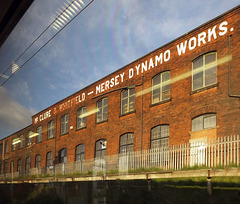
Mersey Dynamo Works
| |
|
|
|
A snap from a passing train.
The Mersey Dynamo works of McClure & Whitfield appears to have originated in a foundry business called Cameron Pearson which was merged into McClure & Whitfield in 1892 and became one of the first electrical engineering companies in the world, manufacturing dynamos. McClure & Whitfield installed the first electrical lighting powered by one of their dynamos on the Embankment in 1897, it also supplied the navy through 2 world wars with steering and drive motors for submarines, surface ships and indeed for mulberry harbour. In 1946 the business partnership existing between David McClure and Robert Brotherton Whitfield dissolved but the business continued. The company still exists and is still a private company owned by the family trading as Piggott and Whitfield Ltd, based in the North-West and in the City of London, installing mechanical, electrical, control and data systems into commercial and industrial properties all over the UK and beyond.

Brymbo
| |
|
Derelict cupolas at the foundry section of the Brymbo steelworks which finally closed in 1990. The collapsed roof has now been removed.
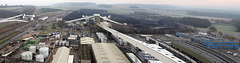
Ratcliffe panorama
| |
|
|
The view from the top of the boiler building at Ratcliffe on Soar power station. A four image stitch in Photoshop.
Adit

Silos
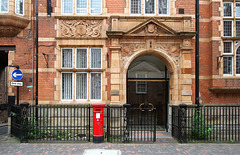
Pacific Exchange
| |
|
By the end of the 19th Century Hull had become the largest seed crushing area in the country. The business was undertaken by brokers travelling about office to office that was inefficient and time consuming. It was decided that an exchange was needed for the improvement of business. A commission was given to B.S. Jacobs of Bowl Alley Lane, Hull. The building was Renaissance Revival style with Tudor style mullioned windows and a mahogany paneled entrance hall and trading floor. At the gable top is the Hull City emblem of three crowns and above the lower left window is a date of 1899. However the building was not open for trading until 1901. The 1899 could well be from when the Pacific Club was formed. I think the traders had to belong the club to make use of the trading floor.
The front section and entrance hall were completed first and it wasn't until 1909 that the building was extended through to the River Hull at the back. In the end the building contained trading hall, corn trade riverside board room, four floors of kitchens, offices, toilets and stores.
The Exchange was called the Pacific it seems purely because London had the Baltic and Liverpool had the Atlantic Exchanges! Millers, seed crushers, merchants and brokers packed the trading floor, up to a hundred at a time. Traders on the floor wore their hats and none traders had to remove them. When telephones were introduced offers would come from London to 15 trunk phone boxes on one wall along with two others for local calls.
The building is now divided into offices including those of the City of Culture and the Humberside Police Authority.
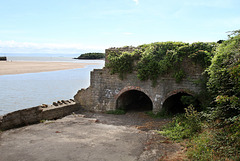
Storehouse Point limekiln
| |
|
|
A two draw tunnel kiln on the shore of Barry Harbour. The top has been grassed over as part of a small park.
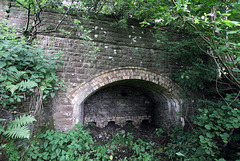
Wat Riggs limekiln
| |
|
A typical single oval pot Cumbrian type kiln. It is somewhat overgrown but in good condition.
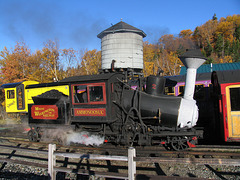
Ammonoosuc
| |
|
|
|
Locomotive No.2 'Ammonoosuc' at the base station of the Mount Washington Cog Railway. This is currently the oldest locomotive operating on this line, having been built in 1875 at the Manchester Locomotive Works and subsequently rebuilt after the major fire of 1895.
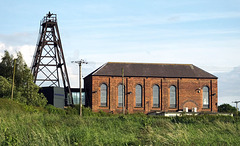
Calcutta Pit
| |
|
|
|
The Calcutta Pit was one of 5 collieries (pits) in Swannington. These gradually stopped being mined in the late 19th century. However, when pumping stopped in these pits, the water began to seep down into mines in the newly developing town of Coalville. In order to solve this problem, it was necessary to set up a Joint Pumping Company, at the former Calcutta mine to drain the whole new coalfield. The Calcutta pumping engine was made by Robert Stephenson and Co. It was capable of removing 54,000 gallons of water an hour. It was installed in 1877 at a cost of £13,000 and worked until 1947 when it was replaced with electric pumps. The building is listed Grade II and is now used as offices.
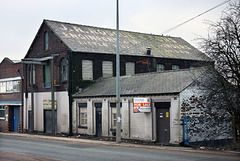
J.R. Roscoe & Sons
| |
|
|
J.R. Roscoe & Sons, Engineers & Iron Founders, Little Hulton, Walkden. This business was established by James Roscoe – inventor of the Roscoe Lubricator and proprietor of James Roscoe & Sons of Peel Hall Colliery and New Lester Colliery, Tyldesley. I have been unable to discover exactly when Roscoe's closed.

Ratcliffe at work
Door opening
Port Augusta power stations
| |
|
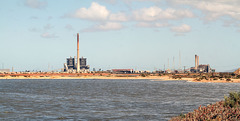
On the right is the Playford B Power Station which was located at Port Paterson in the Australian state of South Australia about 5.5 kilometres (3.4 mi) south of the city centre of Port Augusta. It was coal powered with four 60 MW steam turbines that generate a total of 240 MW of electricity. Commissioned in 1963, it was co-located with the larger, newer Northern Power Station. Playford B was mothballed in 2012 and its permanent closure was announced by operator Alinta Energy in October 2015. Prior to being mothballed it primarily operated in the summer, when electricity demand peaks.
Northern Power Station was located in the locality of Port Paterson in the Australian state of South Australia about 6 kilometres (3.7 mi) south of the city centre of Port Augusta. It was coal powered with two 260 MW steam turbines that generated a total of 520 MW of electricity. It was operated and maintained by Alinta Energy and was commissioned in 1985. The plant ceased electricity production in May 2016 and has subsequently been demolished.
Both power stations received coal by rail from the Leigh Creek Coal Mine, 280 km to the north and drew cooling water from Spencer Gulf, returning it to the sea at an elevated temperature
Chatterley ironworks, Harecastle
| |
|
|
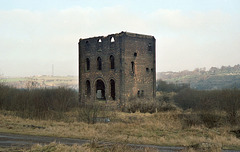
The Chatterley Iron Company was established in 1865 and soon developed three blast furnaces opposite the Ravensdale Forge near Harecastle on the Trent and Mersey Canal in North Staffordshire. A vertical blowing engine by Adamson of Manchester was erected in 1868 in this building. The venture was not very successful and went into voluntary liquidation in 1879. The company continued to trade under supervision for a few years before final winding up in 1889. Subsequently in the ownership of Chatterley Whitfield Collieries Ltd the last furnace was blown out in 1900.
The empty blowing engine house stood derelict until the 1980's when it was demolished during the construction of a new road. Another fascinating relic lost to progress.
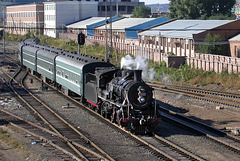
Diaobingshan
| |
|
|
Something a bit less spectacular from China. The Tiefa coal railway did run an intensive passenger service between Diaobingshan and the numerous branches to the outlying mines although this has been now been drastically cut. Back in 2004 this is an arrival from the Sanjiazi direction at the large station at Diaobingshan. Although there are three platform faces passenger services sometimes started from outside of these entailing passengers having to cross the tracks. Not a problem it would appear.
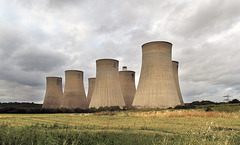
Ratcliffe-on-Soar Power Station

Dumpling
| |
|
|
|
This is the base of one of the two early gasholders at Carrickfergus gasworks. The brick lined tank only needs water around the sides of the metal holder and therefore some of the space inside is filled with a brick cone often referred to as a dumpling.
