

tarboat's photos

Branch local

Right away

Seraing Centrale
| |
|
This combined cycle gas power station was commissioned in 1994 and has a generating capacity of 485MW. Since 2014 the Seraing plant has been part of Belgium's strategic power reserve and is called on to generate electricity only at times of shortage. The station is currently managed by EDF Luminus but at the time I took the photo it was under the Belgian company SPE.

Dillingen
| |
|
|
|
Blast furnaces at Dillingen steelworks. Dillinger Hütte GTS specialises in the production of heavy plate. The company was founded in Founded in 1685 and is Germany's oldest joint stock corporation.

Recording the infrastructure train
| |
|
|
DRS 66 427 leads an infrastructure train north through Tamworth High Level. The enthusiast on the platform speaks the details into his tiny recorder. No more pencils and paper here.

Slag tipping
| |
|
|
Hot work on the slag tipping area at the ArcelorMittal integrated steelworks at Dunkerque. The plant produces more than 6 million tonnes of steel per year.

Grube Velsen, Gustav II shaft
| |
|
|
The Velsen coal mine was sunk in 1899 and the Gustav II shaft was developed between 1913 and 1917. In 1965 the mine was amalgamated into the Warndt complex which finally closed in 2005 with this shaft then being partially filled. The surviving surface buildings and headgear of the Gustav II shaft are considered a "top-class ensemble" of the Saarland mining industry and are listed structures. Inside the winding house is preserved the original steam winding engine made at the Dingler works.

Big prairie passing
| |
|
|
|
Big prairie tank 4144 at the crossing at Little Rock on the Severn Valley Railway.

Clamp kiln
| |
|
|
In addition to the 'Pye' kilns around Litton there is this well preserved circular clamp limekiln.

Bell-Edison Telephone Building
| |
|
|
The Bell-Edison Telephone Building at 17-19 Newhall St, Birmingham was completed in 1896 to the design of architect Frederick Martin of the firm Martin & Chamberlain. Whilst fairly plain at ground level, the upper storeys feature a rich variety of terracotta ornamentation.

Lady Victoria Colliery
| |
|
|
Lady Victoria Colliery at Newtongrange is now the Scottish National Mining Museum. The colliery was sunk by the Lothian Coal Company in 1890 and came into production in 1894. It was closed in 1981.

On the straight
| |
|
|
|
Large Prairie 4144 heads onto the waterworks straight shortly before Hampton Loade on the Severn Valley Railway.

Panned Prairie
| |
|
|
|
An excellent charter with 4144 on the Severn Valley Railway. Before the sun made an appearance it was a case of looking for opportunities towards the tunnel.

Not a way to treat a chimney
| |
|
|
|
The summit of Kit Hill is topped with the stack of South Kit Hill Mine. The mine was worked from 1856 to 1884 mining deposits of tin, copper, arsenic and wolfram. The addition of the communications dishes etc. is unforgiveable.
Springwater Mill
| |
|
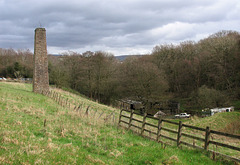
This chimney is the most substantial of the remains of this interesting industrial location.
The mill had several uses throughout its life, but it appears to have originated as a bone and madder grinding mill, probably being closely linked with Strines Print Works as a supplier of red-madder dye. This substance was extracted from the roots of the madder plant, and the preliminary process would be the grinding of these roots to a powder. Strines Print Works was established about 1790, and the bone and madder grinding mill might be similarly dated. Cotton spinning also took place in this area about that time, as Pigot's Directory, 1824-25 lists a firm called Mosley and Howard as cotton spinners at Strines Hall. The mill building was offered for lett ing in an advertisement of 12 July 1833 in the Stockport Advertiser which reads, 'All that erection or building at Turf Lee lately occupied as a bone and madder mill with steam engine, boiler, shafting, reservoir and a spring of water, and one or two cottages adjoining thereto. The building is 2 storeys high, 14 yards long x 12 yards wide, and the engine is 10 hp. Water from a rock spring, perfectly clean, at 40 gallons per minute. The property is near good roads and within a short distance from the Peak Forest Canal. The premises are well adapted for printing silks or bleaching purposes'.
It seems that the building was taken by a Mr Thomas Bruce Jnr, of Marple, and converted into a calico print works, but the business was short lived and must not have prospered, as a sale notice of 15 April 1836 in the Stockport Advertiser reads:
'To be sold by auction at the print works of Mr Thomas Bruce, Jnr of Marple, known as the Springwater Print Works, all stock in trade, machinery, utensils and materials for the printing of calicos consisting of In Machine Room - a number of copper rollers with the newest patterns, one two-colour machine frame for same. In Boiler House and Stove Room - drying rails and perforated cylinder for steaming pieces. In Dye House - a Fly Dung Vessel with rollers complete, and two dye cisterns, etc. In Wash House - dash wheel, a square wood cistern and winch, a pair of squeezers, fly winch and cistern. In Print Shop - 10 tables with frames, tier and tubs complete, 2 tables and frames not set up.
In Edging Room - rails and pieces for hanging pieces on. In Drug Room - a quantity of drugs of various kinds. In Colour Shop - a large copper pan for decocting, colour pots and mugs copper pan and bath for making colours, one square copper pan and two other copper pans.
The above works are well worthy of the attention of persons engaged in the trade, or desirous of embarking thereon. The works have lately been completed at considerable expense, and are in the best possible repair and working condition.
There is an excellent and unfailing spring of water, and a steam engine of 8 hp'.
Another firm appears to have taken the premises for printing, but their occupation seems to have been brief in the extreme, for an advertisement of 10 September 1836 also in the Stockport Advertiser states, 'Sale by auction of Turf Lee Mill. The mill, buildings, reservoir and water privileges there situated, used as a print works and in the occupation of Messrs Briar and Dutton, together with the steam engine apparatus and a variety of printing utensils now on the premises, in use and in excellent condition. The spring produces 100 gallons of water per minute, and never fails in drought seasons.
It is the purest and best adapted for printing in the district. The premises have been long established'.
Another change of use took place either at this time or later to bleaching, and a further sale notice in the Advertiser dated 26 October 1849 offers, 'Springwater Mill at Turf Lee, now used as a bleach works, fitted with engine, boiler, etc, and now in the occupation of Mr James Cooper as tenant'. Throughout its life the mill has been referred to locally as the 'Bone Mill1, in the 1851 Census records for Marple there are cottages listed under the heading of 'Bone Mill' which must have been situated adjoining the mill. James Cooper, described as a Master Bleacher, and his wife occupied one of them, and two men living in the other two are described as bleachers. There is a further mention of 'The Springwater Bleach Works of Mr Cooper' in an account of a walk round the Marple Boundary in 1855. Finally, an advertisement in the Stockport Advertiser dated 30 September 1904 offered for sale 'The plot of land partly covered with water and used as a reservoir at Turf Lee in Marple,and also all the buildings formerly used as a bleach works and known by the name of Springwater Mill, now in a ruinous condition’.
All that remains apart from the chimney oare the mill dam, with a swampy area which was the mill pond, and various ruined buildings and walls.

Halifax Flour Society Limited, 1879
| |
|
|
The Halifax Flour Society was formed on 1st May 1847 to provide a co-operative corn mill following discontent against the Corn Laws, corn dealers' prices, and because much flour was adulterated. The Society sold to the public through agents. Initially 2,800 people bought £1 shares, and the Society bought a mill at Bailey Hall from where the first batch of cheap flour was sold in 1848. When the Bailey Hall mill became too small, a new 6-storey Bailey Hall was built in 1862. This was one of the most modern grain mills at the time and was opened with a party for 1,400 people on April 7, 1863. Later the Society bought more land at Bailey Hall and a new mill was opened in 1880. This is the building seen here. The Society was sold to the Co-operative Wholesale Society in 1915 and the Bailey Hall mill was sold to Paton & Baldwin. This mill eventually closed for flour production in the 1930s. It is now occupied by Nestlé.
Gailey
| |
|
|
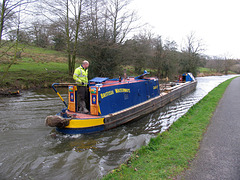
Gailey was originally built as a butty boat by Fellows Morton and Clayton at their Saltley Dock in 1899.It was converted to a motor boat at Yarwoods in Northwich in 1937. The boat continues in service as part of the Canal & River Trust maintenance fleet. It is seen here between Disley and Marple on the Peak Forest Canal.

Another pye
| |
|
The Litton area has several of the rectangular 'Pye' type intermittent clamp limekilns. This is another fine example of the genre at the top of Cressbrook Dale.
