

tarboat's photos

Empties before sunrise
| |
|
|
|
JS 8366 and 8358 thrashing uphill on the Sandaoling coal railway with empties from Liushuguan. All China is on Beijing time and this remote desert area is so far to the west that even at 9.15am the sun had yet to rise on this cold January morning.

The watcher
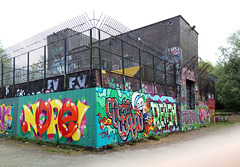
Pumping station
| |
|
|
Chorlton Ees Nature Reserve is situated partly upon the former site of the Withington sewage works, built in the 1880s an finally closed in 1972. This was replaced by this pumping station which raise the sewage so that it can then flow to the works at Stretford. The locals seem to have decided that the building needs a constantly changing set of decorative paintings.

Farm bothy
| |
|
|
|
This little bothy type building caught my eye as I was walking in Lyme Handley this afternoon. To the right (out of frame) is a small field barn at the edge of the walled yard. The bothy roof is formed of lovely gritstone flags and the ridge pieces are all hand shaped from gritstone. The dressed quoins are a nice touch too.

Threlkeld action
| |
|
|
|
BRONLLWYD sets off from the siding at Threlkeld Quarry whilst resident locomotive SIRTOM waits outside the shed.

In the outback
| |
|
|
19D 3322 north of Het Kruis on the Klawer branch of South African Railways in the Western Cape.

Cavendish Mill
| |
|
|
Hopper for raw materials arriving at Cavendish Mill. Stoney Middleton.
British Fluorspar Limited is based at Cavendish Mill, Stoney Middleton, Derbyshire where are situated mineral processing facilities, drying plant, mine office and associated facilities. Two quarries are operated at Longstone Edge and Tearsall. The Milldam Underground Mine extends along the vein system under Great Hucklow and Eyam. The mill produces fluorspar, barytes, lead and aggregates.
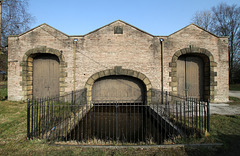
Transshipment
| |
|
|
Southern end of the transshipment warehouse at the terminus of the Peak Forest Canal in Whaley Bridge. It is listed Grade II*.
The first warehouse at the head of the Whaley Bridge Branch of the Upper Peak Forest Canal was built in 1801 and it is attributed to Thomas Brown who was the Resident Engineer for the construction of the canal. This was a three-storey building of gritstone construction positioned at 90 degrees to the canal. It was five bays wide with the central bay straddling the canal. There was an arched shipping hole in the central bay that permitted two boats to enter, side-by-side, so that they could be loaded and unloaded undercover.
The potential of the Peak Forest Canal was considerably enhanced when it became the northern terminus of the Cromford and High Peak Railway in 1831, offering a route for Midlands carriers from the Cromford Canal to reach Manchester and the North West via the Peak Forest Canal. The capacity of the 1801 warehouse was adequate for effective day-to-day operation until the railway brought about a considerable increase in traffic for the Peak Forest Canal at Whaley Bridge and it was deemed that the existing storage facilities were no longer adequate and neither was there a connection with the railway. Consequently, it was decided to increase the storage capacity and make a railway connection by adding an extension of gritstone constructionto the original building.
The extension was built in 1832 and a stone tablet over the central bay of the south elevation, is inscribed with the date, '1832'. It was built by Manchester contractor David Bellhouse Junior.
The Ordnance Survey map of 1875 shows the railway approaching the north and south elevations of the warehouse on the east side. However, this was later changed to a single-track line entering the western bay of the extension through a doorway in the south elevation. This line had a curious arrangement in that it did not provide direct access from the main railway line. Rather, it curved in from the siding of the Bingswood Print Works and an amount of shunting by horses would have been required before waggons from the main line could enter the warehouse. A possible explanation for this arrangement is the possibility that a considerable amount of goods associated with the print works were carried on this line.
The original 1801 warehouse and the 1832 extension remained intact until 1915 when, for reasons now lost, the top floor of the warehouse was removed. The remaining north, east and west elevations of the original building were then re-modelled and re-roofed to match the 1832 extension.
The water feed from the Toddbrook and Combs Reservoirs reaches the canal through the warehouse, emerging from a culvert behind the metal fence.
Thanks to Peter Whitehead for the information.

Drift mine
| |
|
|
A small coal mine at Qikeng a few kilometres outside Jixi. The two concrete arches mark the drift entrances with one haulage enginehouse seen through the yellow gantry crane. There is also another electric hauler for tubs lower right of frame. This mine was closed in early 2008 but was still in full production when I visited.

Brick tower

A rock of frogs
| |
|
|
The rock in our little garden pond was filled with frogs this morning. None were practising social distancing apart from the one hiding on the right.

On the crossing
| |
|
|
SY 0141 shuffles across one of the internal level crossings within the Baotou steelworks complex.

Pacific Exchange
| |
|
Terracotta panel on the Pacific Exchange building in Hull. The building accommodated brokers trading in oil seed because by the end of the 19th Century Hull had become the largest seed crushing area in the country. The architect for the building was B.S. Jacobs of Bowl Alley Lane, Hull. Above the lower left window is this shield with a date of 1899. However, the building was not open for trading until 1901. The 1899 could well be from when the Pacific Club was formed. I think the traders had to belong the club to make use of the trading floor.
The Exchange was called the Pacific it seems purely because London had the Baltic and Liverpool had the Atlantic Exchanges! Millers, seed crushers, merchants and brokers packed the trading floor, up to a hundred at a time. Traders on the floor wore their hats and none traders had to remove them. When telephones were introduced offers would come from London to 15 trunk phone boxes on one wall along with two others for local calls.

Agarshill Fell
| |
|
This limekiln has a single oval pot with two draw tunnels. The location is way out on the moors.

Fighting the wind and gravity
| |
|
|
On the Jixi Coal Railway each morning a train of empty coal wagons was brought up to Xinghua Mine from the washery with a reversal at Zhengyang. There was a steep climb from Zhengyang and the train did not always make the summit first time. On this occasion a strong side wind was not helping and I seem to remember that this was the second attempt which was ultimately successful with SY 1369 making a lot of noise as it came into view.

Turning triangle
| |
|
The Cromford and High Peak Railway which wound its way through this area via sharp curves and the use of a number of inclines up which the wagons were hauled by stationary steam engines. On the opening of the Buxton to Ashbourne railway some sections were incorporated in the new line whilst others were abandoned. Here at Hindlow the new line passes through a tunnel and the old alignment is left at a higher level. On this section are the remains of a triangular section of the original railway which was used to turn wagons so that their end door was facing uphill when being run on the inclines.

No.2 Mill
| |
|
|
Owned by the Bee Hive Spinning Co Ltd of Great Lever, Bolton, the No.2 Mill was built as an expansion of the business in 1902. The mills closed for cotton spinning in 1967 and subsequently became used for mail order warehousing and distribution. The adjacent No.1 mill was burned down in an arson atack in August 2019 and although both mills were listed Grade II they were rapidly demolished to make way for a housing development.

Caziba stop
| |
|
|
Lots of custom about to board the train to Bagou as it makes a stop at Caziba on the Shibanxi Coal Railway.
